
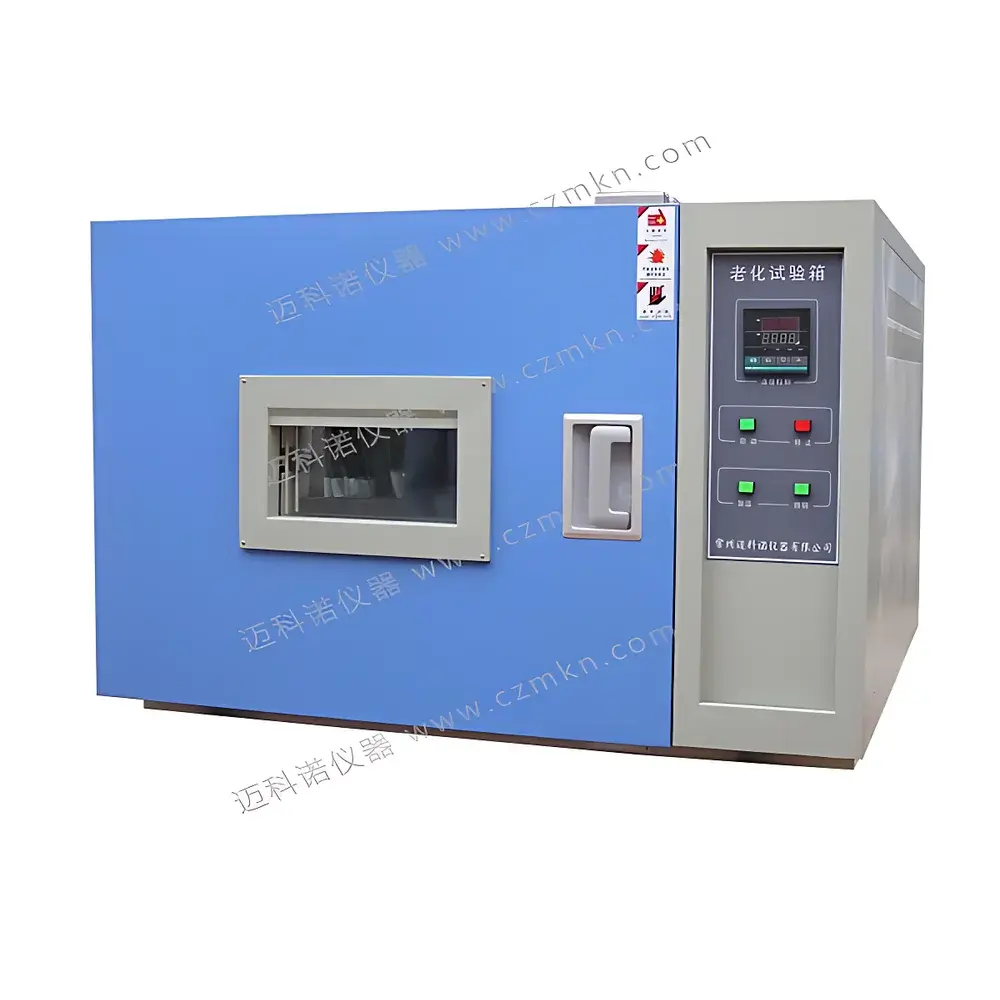
RLH-010 Thermal Aging Test Chamber
| Origin | Zhejiang, China |
|---|---|
| Manufacturer Type | Authorized Distributor |
| Origin Category | Domestic (China) |
| Model | RLH-010 |
| Pricing | Upon Request |
| Temperature Range | RT+10°C to 300°C |
| Temperature Uniformity | ≤ ±1.5°C |
| Temperature Fluctuation | ≤ ±0.5°C |
| Internal Chamber Dimensions (W×D×H) | 400 × 500 × 500 mm |
| Heating Rate | 20°C to 300°C in ≤70 min |
| Air Exchange Rate | Adjustable up to 300 cycles/hour |
| Construction | Interior – AISI 304 stainless steel |
| Insulation | Dual-layer — high-density mineral wool + rigid polyurethane foam |
| Controller | Programmable microprocessor-based temperature controller with timer and over-temperature protection |
| Sensor | PT100 platinum resistance thermometer |
| Power Supply | 220 V AC, 50 Hz (single-phase) or 380 V AC, 50 Hz (three-phase, four-wire) |
| Optional Accessory | Rotating sample turntable (10–12 rpm) |
Overview
The RLH-010 Thermal Aging Test Chamber is an engineered environmental simulation system designed for accelerated thermal aging evaluation of polymeric materials, insulating compounds, elastomers, and cable sheathing under controlled, reproducible high-temperature conditions. It operates on the principle of forced convection heating—utilizing a robust axial fan and optimized airflow ducting to ensure uniform thermal distribution across the test volume. The chamber complies with key industry standards including JB/T 7444–1994 (Chinese National Military Standard for High-Temperature and Aging Chambers) and IEC 60540 (formerly IEC 540), which specify test methodologies for evaluating thermal endurance of electrical insulation materials. Its design prioritizes long-term operational stability, thermal repeatability, and compliance-readiness for quality assurance laboratories operating under GLP or ISO/IEC 17025 frameworks.
Key Features
- Double-wall construction with interior chamber fabricated from AISI 304 stainless steel for corrosion resistance and cleanability; exterior available in either brushed SUS304 stainless steel or epoxy-coated A3 carbon steel.
- Dual-layer thermal insulation comprising high-efficiency mineral wool and rigid polyurethane foam, minimizing heat loss and enabling rapid, energy-efficient heating cycles.
- Intelligent programmable controller with PID algorithm, real-time digital display, adjustable ramp-soak profiles, and built-in timer function for unattended operation.
- Over-temperature cut-off protection circuit independent of the main controller, ensuring fail-safe operation during extended thermal stress tests.
- High-capacity centrifugal blower rated for continuous operation at 300°C, coupled with a symmetric air duct layout to maintain temperature uniformity within ±1.5°C across the working volume.
- Adjustable air exchange system calibrated to deliver up to 300 air changes per hour—critical for simulating oxidative degradation mechanisms in thermoplastics and elastomers.
Sample Compatibility & Compliance
The RLH-010 accommodates standardized test specimens per ASTM D3045 (Standard Practice for Heat Aging of Plastics), IEC 60811-401 (Electric Cables – Tests on Polymeric Insulations and Sheaths), and GB/T 2951.12 (Chinese national standard equivalent to IEC 60811-1-2). Its 400 × 500 × 500 mm working chamber supports multiple specimen racks, wire spools, or molded plaques. Optional rotating turntable (10–12 rpm) ensures uniform exposure for asymmetrical or vertically oriented samples. All thermal performance data—including uniformity, fluctuation, and heating rate—are traceable to NIST-traceable reference sensors and documented per ISO/IEC 17025 calibration protocols. The unit’s electrical architecture conforms to IEC 61000-6-3 (EMC emissions) and IEC 61000-6-2 (immunity), supporting integration into regulated manufacturing environments.
Software & Data Management
While the base RLH-010 operates via standalone microcontroller interface, optional RS485/Modbus RTU communication enables connection to centralized laboratory data acquisition systems (e.g., LabVIEW, DeltaV, or custom SCADA platforms). Temperature logging intervals are configurable (1 s to 60 min), with time-stamped CSV export capability. Audit trail functionality—including user login, parameter modification history, and alarm event logs—is available through compatible supervisory software packages compliant with FDA 21 CFR Part 11 requirements when deployed with electronic signature modules and role-based access control.
Applications
- Accelerated life testing of PVC, PE, XLPE, EPDM, and silicone rubber insulation in wire & cable manufacturing.
- Thermal index determination (UL 746B) for polymer formulations used in automotive harnesses and aerospace components.
- Validation of shelf-life predictions for medical device packaging materials exposed to elevated storage temperatures.
- Quality control screening of adhesives, sealants, and encapsulants prior to high-reliability electronics assembly.
- Supporting R&D activities in polymer science labs assessing oxidative induction time (OIT), crosslink density evolution, and embrittlement thresholds.
FAQ
What standards does the RLH-010 explicitly support?
It meets JB/T 7444–1994 (China military specification), IEC 60540 (cable insulation aging), and is operationally aligned with ASTM D3045, IEC 60811-401, and GB/T 2951.12.
Is the temperature uniformity validated across the full working volume?
Yes—uniformity is measured at nine designated points per IEC 60068-3-5 using calibrated PT100 probes and verified to ≤ ±1.5°C at setpoint.
Can the chamber be integrated into a LIMS or MES environment?
With optional Modbus RTU interface and compatible gateway firmware, it supports bidirectional data exchange for automated test record generation and electronic batch records.
Does the unit include calibration documentation?
Factory calibration certificates (as-found/as-left) are provided with each shipment, referencing ISO/IEC 17025-accredited external calibration services for sensor verification.
What maintenance intervals are recommended for sustained accuracy?
Annual verification of controller PID parameters, fan motor bearing inspection, and insulation integrity check are advised per manufacturer’s technical bulletin TB-RLH-010-Rev.3.



