
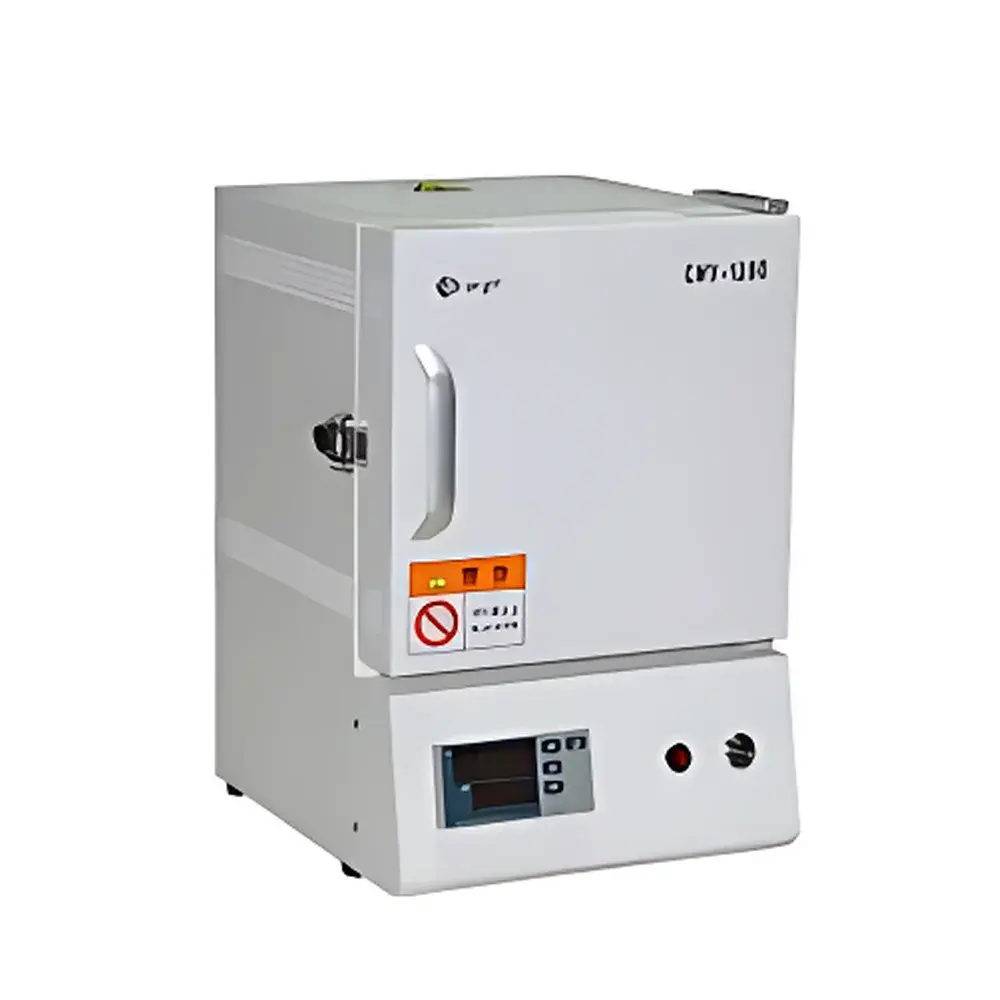
Mini Box Furnace M1210 – 1200°C Laboratory Benchtop Muffle Furnace
| Origin | Henan, China |
|---|---|
| Manufacturer Type | Authorized Distributor |
| Origin Category | Domestic (PRC) |
| Model | M1210 |
| Instrument Type | Box-Type Muffle Furnace |
| Max Operating Temperature | 1200°C |
| Control Accuracy | ±1°C |
| Rated Power | 1 kW (Typical Operating Power ≤ 800 W) |
| Heating Rate (to Max Temp) | 10°C/min (Standard), up to 30°C/min (Max) |
| Heating Zone | Single-Zone |
| Internal Chamber Dimensions | 100 mm × 100 mm × 100 mm |
| Chamber Volume | 1 L |
| Heating Element | Mo-doped Fe-Cr-Al Alloy (OCr27Al7Mo2), Triple-Sided Integrated Casting |
| Insulation Material | High-Purity Alumina Fiber |
| Thermocouple Type | K-Type |
| Control System | Intelligent PID with 30-Step Programmable Ramp-Soak Profile |
| Display | High-Brightness LED Digital Interface |
| Door Configuration | Side-Opening |
| Surface Temperature (at 1200°C) | <50°C |
| External Dimensions | 250 mm × 280 mm × 380 mm |
| Input Voltage/Frequency | 220 V AC, 50 Hz |
| Safety Features | Over-Temperature Alarm, Current Overload Protection, Thermocouple Break Detection |
| Warranty | 12-Month Limited Warranty, Lifetime Technical Support |
Overview
The Mini Box Furnace M1210 is a compact, high-performance benchtop muffle furnace engineered for precision thermal processing in research laboratories, quality control environments, and small-scale materials development workflows. Designed around a single-zone resistive heating architecture, it employs a triple-sided integrated Mo-doped Fe-Cr-Al (OCr27Al7Mo2) heating element embedded directly into the high-purity alumina fiber insulation matrix—enabling rapid thermal response, exceptional temperature uniformity, and extended service life under repeated thermal cycling. With a maximum rated temperature of 1200°C and stable operation up to 1150°C, the M1210 delivers consistent thermal profiles across its 1 L internal chamber (100 × 100 × 100 mm), while maintaining external surface temperatures below 50°C during full-load operation—a critical safety and ergonomic advantage in densely configured lab spaces. Its side-opening door design minimizes heat loss during sample loading and ensures compatibility with standard ceramic crucibles and quartz boats.
Key Features
- Compact footprint (250 × 280 × 380 mm) optimized for benchtop integration without sacrificing thermal performance
- Triple-sided Mo-doped Fe-Cr-Al heating elements cast integrally into the insulation structure for enhanced thermal efficiency and oxidation resistance up to 1400°C surface temperature on the element itself
- Intelligent PID temperature controller supporting up to 30 programmable ramp-soak segments, enabling precise thermal protocol execution for sintering, ashing, annealing, and calcination
- High-stability K-type thermocouple with real-time feedback loop, achieving ±1°C control accuracy across the full operating range
- Robust safety architecture including over-temperature cut-off, current overload protection, and thermocouple break detection with audible/visual alert
- LED digital display with intuitive interface for immediate parameter verification and operational status monitoring
Sample Compatibility & Compliance
The M1210 accommodates standard laboratory sample containers—including alumina, quartz, and silicon carbide crucibles—within its 100 mm cubic chamber. Its inert muffle configuration isolates samples from combustion by-products, making it suitable for ASTM E167, ISO 562, and USP <281> compliant ash content determination, as well as pre-treatment steps in ICP-OES and XRF sample preparation workflows. While not certified for GMP or GLP environments out-of-the-box, its programmable temperature logging capability (via optional RS485/Modbus interface) supports audit-ready data capture when integrated into validated systems adhering to FDA 21 CFR Part 11 requirements. The furnace meets CE marking essential safety requirements (EN 61000-6-3, EN 61000-6-4) and complies with IEC 61000-4 electromagnetic immunity standards.
Software & Data Management
The M1210 operates via standalone hardware-based PID control with no embedded software stack. However, its RS485 communication port (optional accessory) enables integration with third-party SCADA platforms or custom LabVIEW/Python-based acquisition systems using Modbus RTU protocol. This allows for remote setpoint adjustment, real-time temperature streaming, and time-stamped profile logging—facilitating traceability in regulated environments. When paired with compliant data acquisition software, the system supports electronic signature, audit trail, and user access control features required for GLP-compliant thermal validation studies.
Applications
- Thermal gravimetric analysis (TGA) sample pre-conditioning and residue quantification
- Low-mass ceramic and metal oxide sintering trials in materials science labs
- Ash content testing per AOAC 942.05 and EPA Method 200.2
- Heat treatment of thin-film substrates and MEMS components
- Calibration reference source for secondary temperature sensors in metrology labs
- Controlled oxidation studies of nanomaterials and catalyst precursors
FAQ
What is the recommended maximum continuous operating temperature?
The furnace is rated for continuous operation up to 1150°C; prolonged use at 1200°C is permissible but reduces long-term heating element lifespan.
Can the M1210 be used under inert or reducing atmospheres?
No—it is designed strictly for air atmosphere operation. For controlled-atmosphere applications, a tube furnace with gas inlet/outlet ports is recommended.
Is the temperature uniformity specified across the chamber volume?
Yes—under steady-state conditions at 1000°C, radial and axial uniformity is typically ±3°C within the central 60 mm cube; uniformity degrades near chamber walls and corners due to geometric constraints.
Does the unit include data logging capability by default?
No—internal data storage is not implemented. Temperature history must be captured externally via the optional RS485 interface and compatible host software.
What maintenance is required to ensure long-term calibration stability?
Annual verification of thermocouple output against a NIST-traceable reference source is advised; visual inspection of heating element integrity and insulation compression should occur every 500 operating hours.



