
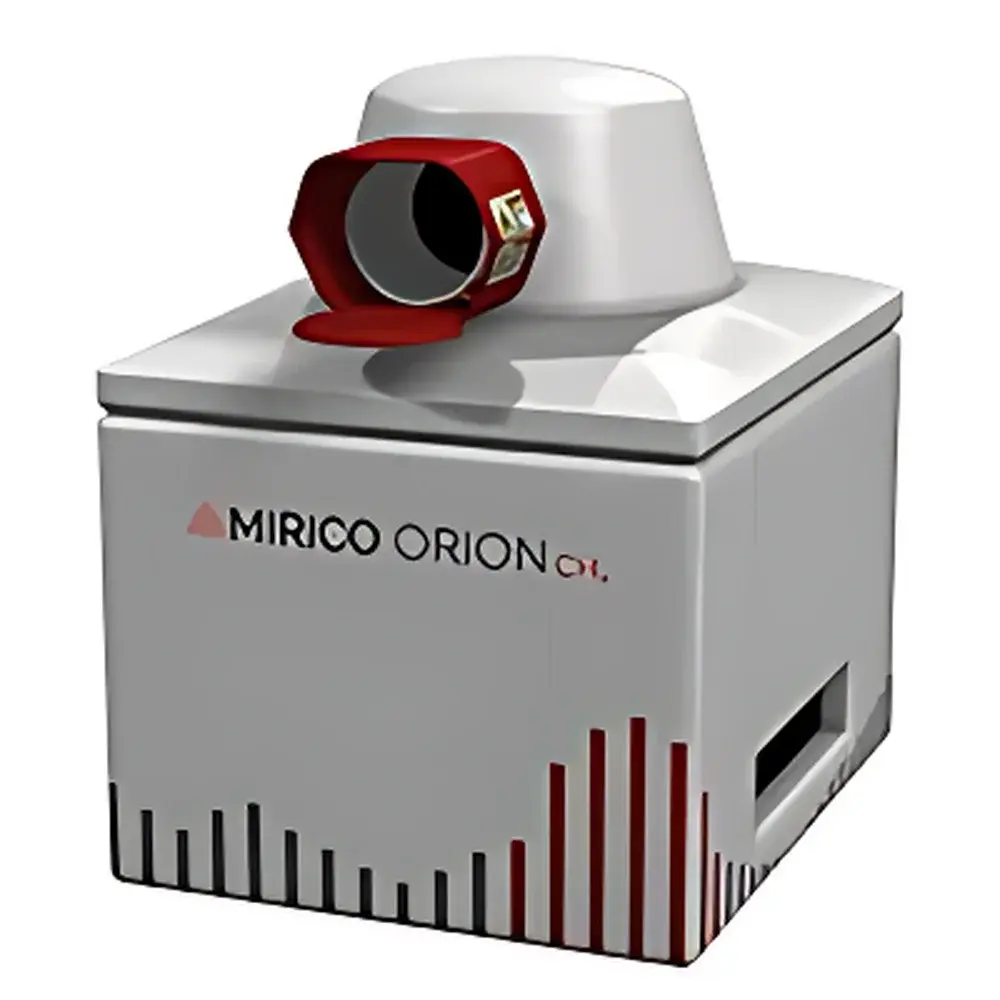
MIRICO ORION CH4 Open-Path Methane Analyzer
| Origin | UK |
|---|---|
| Manufacturer Type | Authorized Distributor |
| Origin Category | Imported |
| Model | ORION CH4 |
| Pricing | Available Upon Request |
Overview
The MIRICO ORION CH4 Open-Path Methane Analyzer is an engineered solution for high-sensitivity, real-time atmospheric methane (CH₄) monitoring across heterogeneous landscapes. It operates on the principle of mid-infrared (MIR) laser dispersion spectroscopy — a technique that leverages tunable quantum cascade lasers (QCLs) to probe fundamental vibrational-rotational absorption lines of CH₄ near 7.7 µm. Unlike extractive or point-sensor systems, the ORION employs true open-path geometry: the laser beam propagates unimpeded through ambient air over distances ranging from 50 to 400 meters, enabling path-integrated concentration measurements (in ppm·m units) with inherent spatial representativeness. This architecture eliminates sampling artifacts, inlet delays, and calibration drift associated with closed-cell analyzers — critical advantages when quantifying fugitive emissions from oil & gas infrastructure, landfills, rice paddies, or natural wetlands. Its immunity to precipitation-induced signal attenuation and robust performance under wind, fog, or temperature gradients make it suitable for long-term unattended deployment in field conditions where conventional NDIR or CRDS-based systems exhibit degraded stability.
Key Features
- True open-path configuration with dual-gas referencing capability — simultaneously measures CH₄ and a co-propagating reference gas (e.g., CO₂ or H₂O) to correct for atmospheric turbulence and optical path fluctuations
- Mid-infrared quantum cascade laser source operating at 1300 cm⁻¹ (7.7 µm), targeting the strongest fundamental absorption band of CH₄ for optimal sensitivity and selectivity
- Full 360° horizontal scanning and −10° to +10° vertical articulation, enabling dynamic plume mapping and sector-based flux estimation
- Integrated self-diagnostic routines including laser wavelength verification, detector responsivity tracking, and optical alignment monitoring — reducing scheduled maintenance intervals
- Automatic co-location calibration using integrated reference cells and ambient background normalization, minimizing reliance on external gas standards
- Web-native user interface accessible via Wi-Fi or Ethernet, supporting remote configuration, real-time spectral visualization, and firmware updates without local software installation
Sample Compatibility & Compliance
The ORION CH4 analyzer requires no sample extraction, conditioning, or pre-concentration — it directly interrogates ambient air along the optical path. As such, it is compatible with all naturally occurring atmospheric matrices, including humid, dusty, or aerosol-laden environments typical of agricultural, landfill, or upstream energy sites. The system complies with ISO 14064-3 guidance for greenhouse gas emission quantification and supports methodologies aligned with EPA Method 21 (fugitive emissions screening) and IPCC Tier 3 inventory reporting frameworks. Data integrity features include timestamped spectral logs, checksum-verified raw interferograms, and audit-trail-enabled configuration changes — facilitating GLP-aligned data governance and regulatory submissions.
Software & Data Management
The embedded web interface delivers full instrument control, spectral acquisition, and real-time concentration calculation. Raw spectra are stored in HDF5 format with metadata compliant with CF-1.8 conventions. Export options include CSV (time-series path-averaged CH₄), NetCDF (for GIS integration), and JSON (for API-driven ingestion into cloud platforms). Optional software modules support eddy covariance flux computation when synchronized with 3D ultrasonic anemometers (e.g., Gill WindMaster Pro or Metek uSonic-3 Class A), applying standard corrections for coordinate rotation, sonic temperature, and density fluctuations per Aubinet et al. (2012). All data streams support TLS 1.2 encryption and role-based access control, meeting baseline requirements for FDA 21 CFR Part 11–compliant environments where electronic records are subject to audit.
Applications
- Quantification of area-source CH₄ emissions from oil & gas production facilities, compressor stations, and pipeline corridors using mobile or fixed scanning configurations
- Long-term ecosystem-scale monitoring of CH₄ exchange in peatlands, freshwater lakes, and flooded rice agriculture under varying hydrological regimes
- Validation of satellite-based CH₄ retrievals (e.g., TROPOMI, GHGSat) through ground-truth path-integrated column measurements
- Source attribution studies combining ORION angular scans with backward Lagrangian stochastic (bLST) dispersion modeling
- Regulatory compliance reporting for operators subject to EU MRV, US EPA OOOOa, or Canada’s GHG Reporting Program
FAQ
What is the detection limit under field conditions?
The instrument achieves an effective noise-equivalent concentration of 50 ppb (1σ, 1-second integration) over path lengths exceeding 100 m, corresponding to a normalized sensitivity of 5 ppm·m/Hz.
Does the system require periodic calibration with certified gas standards?
No external calibration gases are required during routine operation; the dual-gas referencing and internal reference cell enable continuous self-validation. Traceable calibration is recommended annually for metrological traceability.
Can the ORION be deployed in extreme climates?
Yes — the optical head is rated IP66 and operates continuously between −30 °C and +50 °C; active thermal management prevents condensation on optics in high-humidity environments.
Is synchronization with meteorological sensors supported?
Yes — dedicated TTL and RS-485 interfaces enable hardware-level synchronization with 3D ultrasonic anemometers and environmental stations for eddy covariance or inverse modeling workflows.
How is data security managed for remote deployments?
All communications use HTTPS with client-certificate authentication; locally stored spectral data is encrypted at rest using AES-256, and firmware updates require signed digital signatures.




