
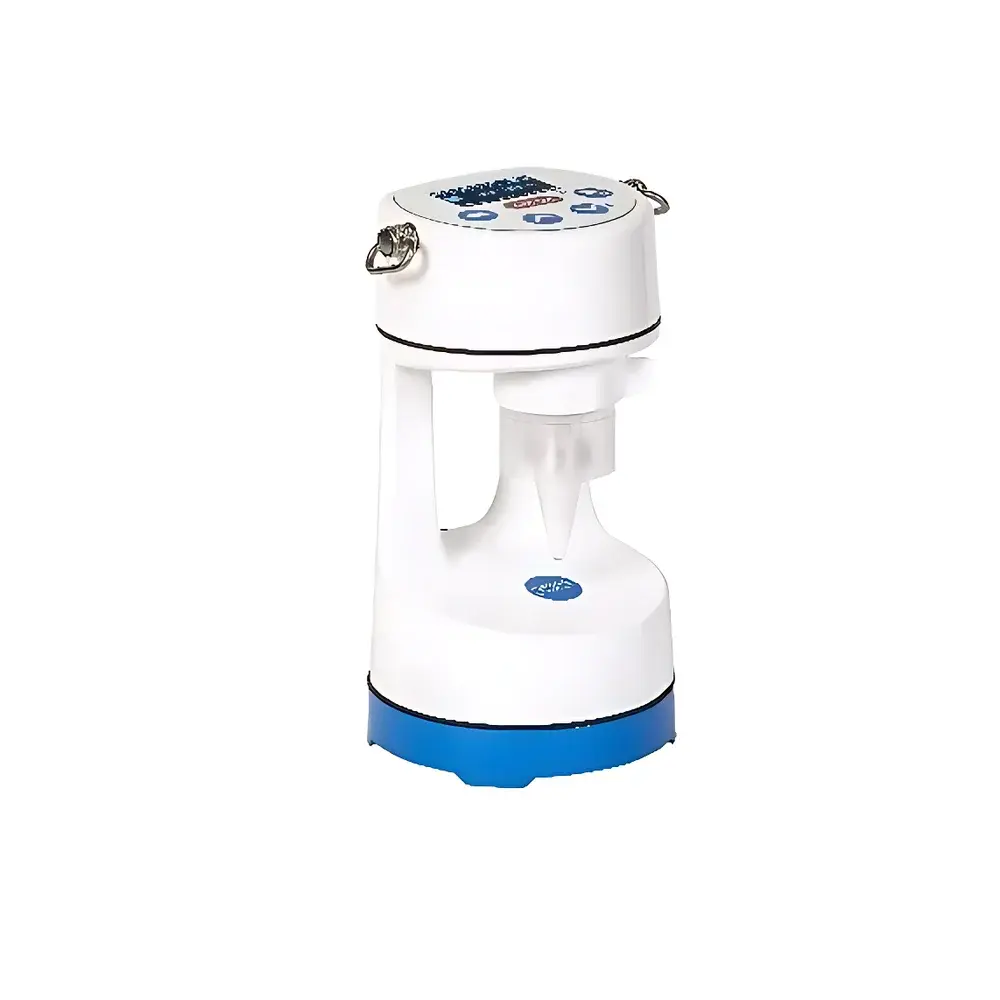
Bertin Coriolis C Dry Cyclonic Air Microbial Sampler
| Brand | Bertin |
|---|---|
| Origin | France |
| Model | Coriolis C |
| Sampling Principle | Dynamic Cyclonic Separation |
| Flow Rate | 50 LPM |
| Flow Accuracy | ±2% |
| Maximum Sampling Duration | 8 h |
| Operating Temperature | 5–45 °C |
| Operating Relative Humidity | 10–90% RH |
| Collection Size Range | 0.5–10 µm |
| Dimensions | 255 × 135 × 130 mm |
| Weight | 1.4 kg |
| Sample Output Format | Dry Concentrate in Collection Liquid (e.g., PBS, TE Buffer) |
Overview
The Bertin Coriolis C is a compact, dry-cyclonic air microbial sampler engineered for high-efficiency bioaerosol collection in field-deployable and mission-critical environmental monitoring applications. It operates on the principle of dynamic cyclonic separation—using controlled rotational airflow to inertially separate airborne particles from the carrier gas stream without filter media or liquid impingement. This physics-based approach ensures minimal particle damage, preserves biological integrity (including fragile viruses and spores), and delivers concentrated, resuspendable samples directly into small volumes (typically 5–20 mL) of compatible elution buffers. Unlike membrane filtration or gelatin filter systems, the Coriolis C achieves near-quantitative collection efficiency across a broad aerodynamic diameter range (0.5–10 µm), with independent validation confirming ≥100% efficiency at 1 µm and up to 130% at 5 µm—attributable to enhanced particle trajectory control and reduced wall loss in the cyclone chamber. Its design supports continuous unattended operation for up to 8 hours, making it suitable for both short-duration tactical sampling and extended surveillance campaigns.
Key Features
- Dry cyclonic sampling technology—no consumable filters, no liquid pumps, no risk of buffer evaporation or cross-contamination between runs
- Ultra-portable form factor (255 × 135 × 130 mm; 1.4 kg) with integrated rechargeable battery enabling vehicle-, drone-, tripod-, or handheld deployment
- Robust operational envelope: validated performance across 5–45 °C ambient temperature and 10–90% RH—suitable for indoor facilities, agricultural barns, pharmaceutical cleanrooms, and outdoor desert or coastal environments
- Precision mass flow control with ±2% accuracy over full 50 LPM range, digitally compensated for temperature and pressure variations
- Low-noise operation (<55 dB(A)) ensuring minimal disturbance during covert or occupational monitoring
- Modular sample collection module compatible with standard 15 mL or 50 mL conical tubes—enabling direct integration with downstream molecular, culture-based, or immunoassay workflows
Sample Compatibility & Compliance
The Coriolis C produces dry-concentrated bioaerosol deposits that are readily resuspended in biocompatible solutions such as phosphate-buffered saline (PBS), Tris-EDTA (TE), or viral transport media—preserving nucleic acid integrity for qPCR, digital PCR, and next-generation sequencing (NGS). It is routinely used in laboratories adhering to ISO 14698-1 (Biocontamination control), ISO/IEC 17025 (Testing laboratory competence), and USP (Microbiological control of nonsterile products). While the instrument itself does not require FDA 21 CFR Part 11 compliance (as it generates raw physical samples rather than electronic records), its output is fully compatible with GLP/GMP-compliant analytical pipelines when paired with validated sample handling SOPs and chain-of-custody documentation.
Software & Data Management
The Coriolis C operates via an embedded microcontroller with real-time logging of flow rate, elapsed time, temperature, and relative humidity. All operational parameters are stored internally with timestamped metadata and exportable via USB-C interface in CSV format. No proprietary software is required for basic operation; however, Bertin provides optional configuration utilities for batch programming of multi-stage sampling protocols (e.g., timed start/stop, flow ramping) and firmware updates. Data files are structured for seamless import into LIMS platforms and comply with FAIR principles (Findable, Accessible, Interoperable, Reusable) when archived with appropriate contextual metadata (e.g., location GPS coordinates, operator ID, environmental conditions).
Applications
- Public health surveillance: early detection of airborne pathogens (e.g., influenza A, SARS-CoV-2, Mycobacterium tuberculosis) in hospitals, schools, and transportation hubs
- Occupational hygiene: exposure assessment in pharmaceutical manufacturing, composting facilities, and livestock operations
- Biosecurity and defense: field validation of biological agent dispersion models, as demonstrated in the U.S. Army’s S/K Challenge (Dugway Proving Ground, 2018), where Coriolis C achieved 100% detection sensitivity for Bacillus globigii under dust, smoke, and high-humidity interference
- Food and cosmetic production: routine environmental monitoring of cleanrooms and processing lines per ISO 14644 and EU GMP Annex 1 requirements
- Ecosystem and agricultural research: characterization of fungal spore dynamics, pollen dispersal, and zoonotic virus circulation in natural and peri-urban settings
FAQ
What types of microorganisms can the Coriolis C effectively collect?
It captures viable and non-viable bacteria, bacterial spores, fungi, fungal spores, viruses, and respirable particulate matter (0.5–10 µm aerodynamic diameter) with high recovery rates—validated using Bacillus subtilis, Aspergillus niger, MS2 bacteriophage, and PM2.5 test aerosols.
Is the Coriolis C compatible with automated downstream analysis platforms?
Yes—its liquid-eluted samples integrate directly with robotic nucleic acid extraction systems (e.g., QIAGEN QIAcube, Thermo KingFisher), qPCR thermocyclers, and NGS library prep workflows without intermediate concentration steps.
Can it be powered externally during long-term deployments?
Yes—supports 12 V DC input via automotive cigarette lighter adapter or external power bank, enabling indefinite operation beyond the 8-hour internal battery limit.
Does the device require calibration before each use?
No—factory-calibrated mass flow sensor maintains traceable accuracy (±2%) across its operating range; annual recalibration by an ISO/IEC 17025-accredited lab is recommended for regulatory audit readiness.
How does it compare to impactor-based samplers in terms of viability preservation?
Cyclonic separation subjects collected microbes to significantly lower shear stress than jet impaction, resulting in higher culturability retention—particularly critical for fastidious organisms and enveloped viruses.







