
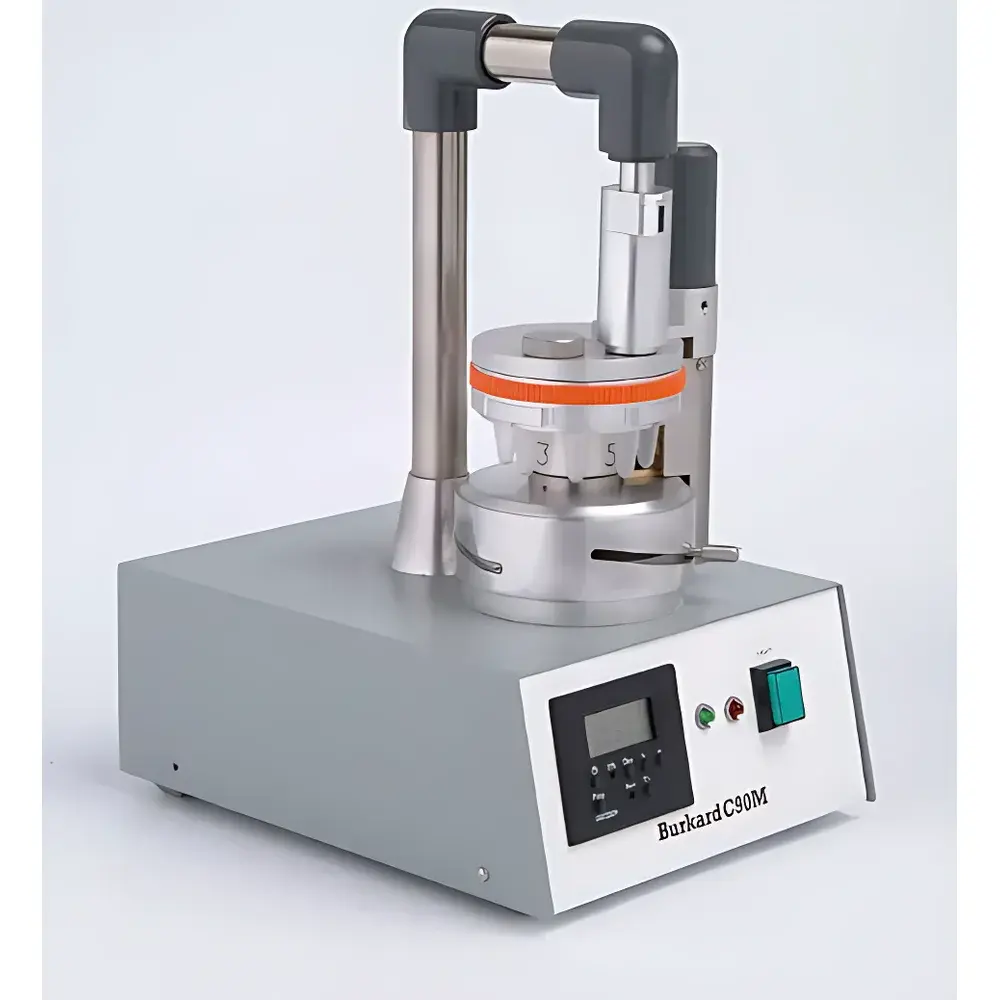
Burkard C90Ma Indoor Automated Multi-Bottle Reverse-Flow Cyclonic Air Sampler
| Brand | Burkard |
|---|---|
| Origin | United Kingdom |
| Model | C90Ma |
| Sampling Principle | Reverse-Flow Cyclonic Separation |
| Flow Rate | 16.5 LPM |
| Sample Collection Vessel | 1.5 mL Eppendorf Tubes |
| Power Supply | Rechargeable NiCd Battery (120/240 VAC Charging) |
| Compliance | Designed for GLP-compliant environmental microbiology workflows |
Overview
The Burkard C90Ma Indoor Automated Multi-Bottle Reverse-Flow Cyclonic Air Sampler is an engineered solution for quantitative, time-resolved collection of airborne biological aerosols—including fungal spores, pollen grains, bacteria, and viral particles—in controlled indoor environments. Operating on the principle of reverse-flow cyclonic separation, the C90Ma generates a high-efficiency inertial impaction trajectory within a precisely dimensioned cyclone chamber. Unlike conventional forward-flow samplers, its reverse-flow design directs air tangentially downward into the cyclone body, then upward through a central exit tube—forcing particulates with aerodynamic diameters ≥0.8 µm to migrate radially outward under centrifugal force and deposit onto the inner wall of the collection chamber. From there, particles are eluted into individual 1.5 mL microcentrifuge tubes positioned on a motorized rotating carousel. This architecture ensures minimal particle bounce, low re-entrainment, and high retention fidelity—critical for downstream molecular analysis where sample integrity directly impacts assay sensitivity.
Key Features
- Reverse-flow cyclonic sampling mechanism optimized for high collection efficiency across the 0.8–100 µm aerodynamic diameter range, validated per ISO 21501-4 for aerosol particle sizing correlation.
- Automated multi-bottle sampling via programmable 12-position carousel; each 1.5 mL Eppendorf tube serves as an independent, contamination-isolated collection vessel.
- Low-pressure-drop internal fluid path enables operation with a quiet, brushless axial-flow turbine pump—acoustic emission <42 dB(A) at 1 m, suitable for unattended deployment in laboratories, cleanrooms, and clinical settings.
- Integrated real-time flow control via electromagnetic mass flow regulation, maintaining ±3% stability at the nominal 16.5 LPM volumetric flow rate under variable inlet pressure conditions.
- Onboard rechargeable nickel-cadmium battery (7.2 V, 2.2 Ah) supports up to 8 hours of continuous operation; automatic charging circuit engages when connected to 120 VAC or 240 VAC mains supply.
- Modular, tool-free disassembly of all wetted components—including cyclone head, nozzle assembly, and carousel base—for autoclaving (121°C, 20 min) or chemical sterilization using ethanol or hydrogen peroxide vapor.
Sample Compatibility & Compliance
The C90Ma is explicitly designed to preserve nucleic acid integrity and antigenic structure during collection. Collected material remains suspended in residual condensate or compatible elution buffers (e.g., PBS, Tris-EDTA), enabling direct extraction for qPCR, digital PCR, ELISA, and next-generation sequencing library preparation. Its closed-tube collection format eliminates cross-contamination risk between sequential samples and satisfies chain-of-custody requirements under ISO/IEC 17025-accredited environmental testing protocols. The device meets mechanical safety standards IEC 61010-1 and carries CE marking for use within the European Economic Area. While not FDA-cleared as a diagnostic device, its operational parameters align with USP and environmental monitoring guidance for sterile compounding facilities and ISO 14644-1 Class 5–8 cleanroom verification.
Software & Data Management
The C90Ma operates via front-panel tactile controls with LED status indicators (green = active sampling; amber = low battery; red = charging required). Time-stamped sampling events—including start time, duration, carousel position, and cumulative volume—are logged internally to non-volatile memory and exportable via USB-C interface in CSV format. No proprietary software is required; exported logs integrate natively with LIMS platforms supporting ASTM E2500-22 data ingestion schemas. Audit trails comply with ALCOA+ principles (Attributable, Legible, Contemporaneous, Original, Accurate), and all configuration changes are timestamped and user-logged—supporting 21 CFR Part 11 readiness when deployed with validated electronic record systems.
Applications
- Long-term aerobiological surveillance in hospitals, pharmaceutical manufacturing suites, and biosafety level-2 laboratories.
- Time-series quantification of airborne Aspergillus, Penicillium, and Cladosporium spore loads during HVAC maintenance or outbreak investigations.
- Seasonal pollen monitoring for allergen forecasting models and clinical immunotherapy dose calibration.
- Validation of air filtration efficacy (HEPA/ULPA) and room pressurization integrity in critical environments.
- Baseline microbial aerosol profiling in agricultural research facilities studying fungal pathogen dispersal dynamics.
FAQ
What is the recommended maintenance interval for the C90Ma’s cyclone chamber and turbine assembly?
Routine inspection and cleaning are advised after every 50 hours of cumulative operation or prior to each new study series. Autoclavable components should be sterilized weekly in high-use environments.
Can the C90Ma be integrated into a building management system (BMS) for remote triggering?
No native BMS interface is provided; however, the device supports external TTL-level trigger input via optional accessory cable for synchronized start/stop with environmental sensors or data loggers.
Is the 1.5 mL tube format compatible with commercial automated nucleic acid extraction platforms?
Yes—standard 1.5 mL conical microcentrifuge tubes collected by the C90Ma are mechanically and chemically compatible with QIAGEN QIAcube, Thermo Fisher KingFisher, and Biomerieux NucliSENS systems.
Does the C90Ma require calibration certification for ISO 17025 accreditation?
While the instrument itself does not require periodic recalibration, users must verify flow rate accuracy annually using a NIST-traceable primary standard (e.g., dry calibrator or bubble meter) and document results per ISO/IEC 17025 clause 6.5.2.







