
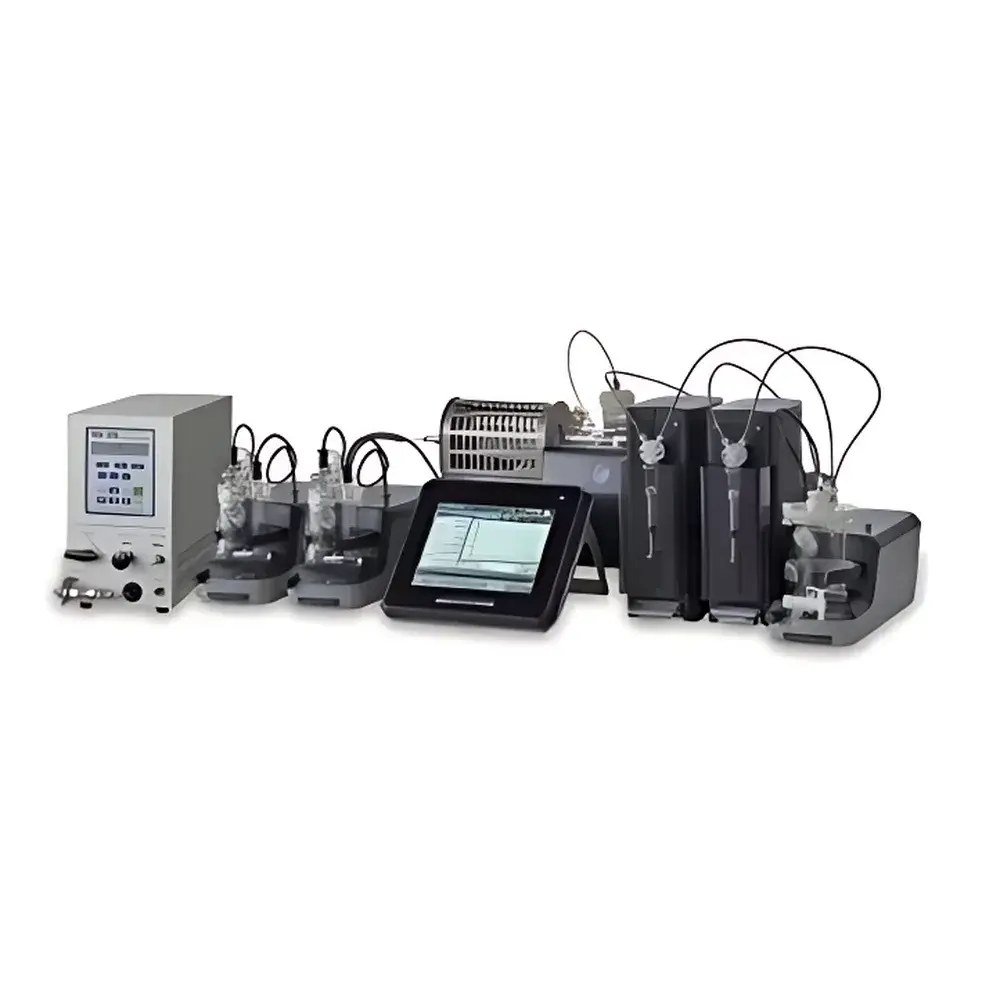
Mitsubishi Chemical CVS-300 Universal Trace Moisture Detection System
| Brand | Mitsubishi Chemical |
|---|---|
| Origin | Japan |
| Manufacturer Type | Authorized Distributor |
| Product Origin | Imported |
| Model | CVS-300 |
| Titration Method | Fully Automated Coulometric Karl Fischer Titration |
| Instrument Type | Coulometric Karl Fischer Moisture Analyzer |
| Current Resolution | ±0.1 µA |
| Water Content Range | 5 µg to 999.9999 mg |
| Measurement Accuracy | <0.3% RSD |
| Minimum Dispense Volume | 0 µL |
| Titration Control Precision | N/A |
Overview
The Mitsubishi Chemical CVS-300 Universal Trace Moisture Detection System is a high-precision, fully automated coulometric Karl Fischer (KF) analyzer engineered for quantitative determination of trace water content across solid, liquid, and gaseous samples. Unlike conventional volumetric KF systems, the CVS-300 employs coulometric titration—generating iodine electrochemically at the anode in real time—enabling sub-microgram-level detection (down to 5 µg H₂O) with exceptional reproducibility and minimal reagent consumption. Its modular architecture integrates four functionally independent measurement channels: one universal main unit, plus dedicated sample introduction modules for solids, liquids, and gases. This design eliminates cross-contamination risks and allows concurrent analysis of heterogeneous sample types under identical environmental and calibration conditions—critical for QC laboratories managing diverse raw materials, pharmaceutical intermediates, battery electrolytes, or semiconductor process gases.
Key Features
- Four physically isolated, application-specific sample introduction channels: solid (heated oven with programmable temperature ramping up to 250 °C), liquid (syringe-based direct injection with inert gas purge), gas (mass-flow-controlled sampling via heated transfer lines), and universal interface for custom adapters.
- 8.4-inch high-resolution color touchscreen HMI enabling simultaneous real-time monitoring and control of all four channels—including live current response curves, titration progress bars, endpoint stabilization indicators, and dynamic moisture accumulation graphs.
- Embedded data management system supporting up to 9,999 test records with timestamp, operator ID, method name, sample ID, environmental parameters (ambient T/RH), and full electrochemical trace logs (current vs. time).
- Multi-tier user access control with role-based permissions (e.g., analyst, supervisor, administrator) compliant with ALCOA+ principles; audit trail functionality logs all method modifications, data exports, and user logins.
- Coulometric cell optimized for low background current (<1 µA), fast endpoint detection (6 months under standard usage).
Sample Compatibility & Compliance
The CVS-300 accommodates a broad spectrum of sample matrices without derivatization or pre-treatment: hygroscopic powders (e.g., LiCoO₂ cathode materials), viscous polymers (e.g., polyimide precursors), volatile solvents (e.g., acetonitrile, THF), and reactive gases (e.g., SF₆, NH₃, HCl). Each channel conforms to ISO 8533:2017 (Karl Fischer titration—general requirements), ASTM E203–22 (standard test method for water using KF titration), and USP (Water Determination). The system supports 21 CFR Part 11-compliant electronic signatures when paired with validated LIMS integration, and its data integrity framework aligns with ICH GCP and EU Annex 11 expectations for regulated environments.
Software & Data Management
The embedded firmware includes method templates for common applications (e.g., “Pharmaceutical Solid Dosage,” “Lithium Battery Electrolyte,” “Industrial Gas Purity”), each configurable for electrode conditioning cycles, drift correction intervals, endpoint sensitivity thresholds, and automatic blank subtraction. Raw current-time datasets are exportable in CSV and XML formats with embedded metadata. Optional PC software (CVS-Link Suite) enables advanced statistical analysis (Shewhart X-bar/R charts, trend analysis over time), automated report generation per GLP/GMP templates, and secure cloud backup with encrypted AES-256 transmission. All data changes are immutably logged with hash-verified timestamps.
Applications
- Pharmaceutical manufacturing: residual moisture in lyophilized APIs, excipients, and sterile packaging headspace validation.
- Electrochemical energy: water quantification in lithium-ion battery electrolytes (<10 ppm specification), separator films, and cathode/anode slurries.
- Electronics: moisture in fluorinated cooling fluids, etchant gases, and encapsulation resins where hydrolysis induces device failure.
- Polymer & coatings industry: real-time monitoring of moisture in polyurethane prepolymers, silicone elastomers, and epoxy curing agents.
- Research laboratories: kinetic studies of hydration/dehydration reactions using temperature-programmed solid-channel analysis.
FAQ
Is the CVS-300 compliant with 21 CFR Part 11 for electronic records and signatures?
Yes—the system supports configurable audit trails, electronic signatures, and role-based access controls when deployed with validated network configurations and approved third-party authentication services.
Can the solid and gas channels operate simultaneously with the liquid channel?
Yes—each channel operates independently with dedicated power supplies, current sensors, and electrode cells; no shared fluidic or electrical pathways exist between modules.
What maintenance is required for long-term coulometric stability?
Routine maintenance includes monthly cell rinsing with dry methanol, quarterly replacement of cathode/anode membranes, and annual calibration verification using certified water standards (e.g., Hydranal® 1.00 mg/mL).
Does the system support external automation integration (e.g., robotic samplers)?
Yes—RS-232, USB Device, and Ethernet (TCP/IP) interfaces enable bidirectional communication with PLCs, SCADA systems, and laboratory automation platforms via Modbus RTU or custom ASCII protocols.
How is moisture quantified in gaseous samples without condensation errors?
Gas samples are introduced via thermostatically controlled stainless-steel lines (maintained >5 °C above dew point) into a heated reaction chamber; water is quantitatively stripped and titrated in real time using dynamic flow compensation algorithms.






