
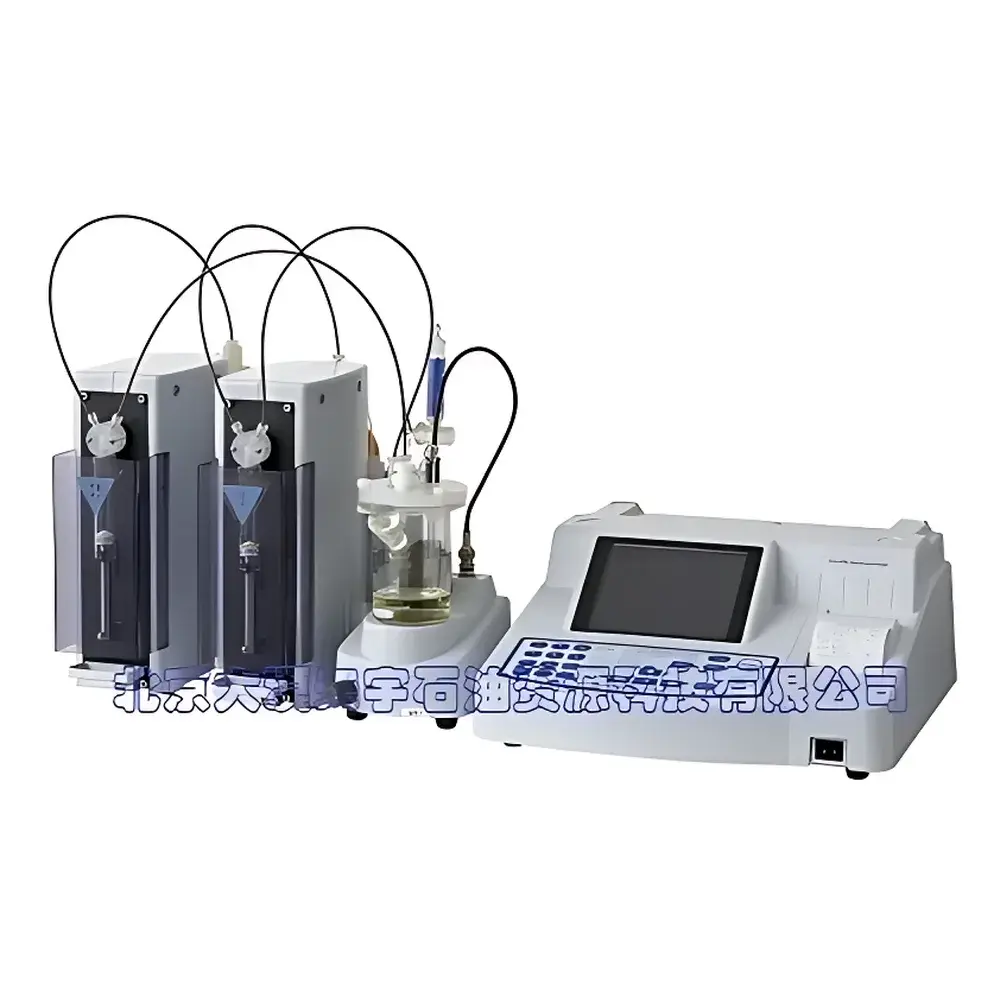
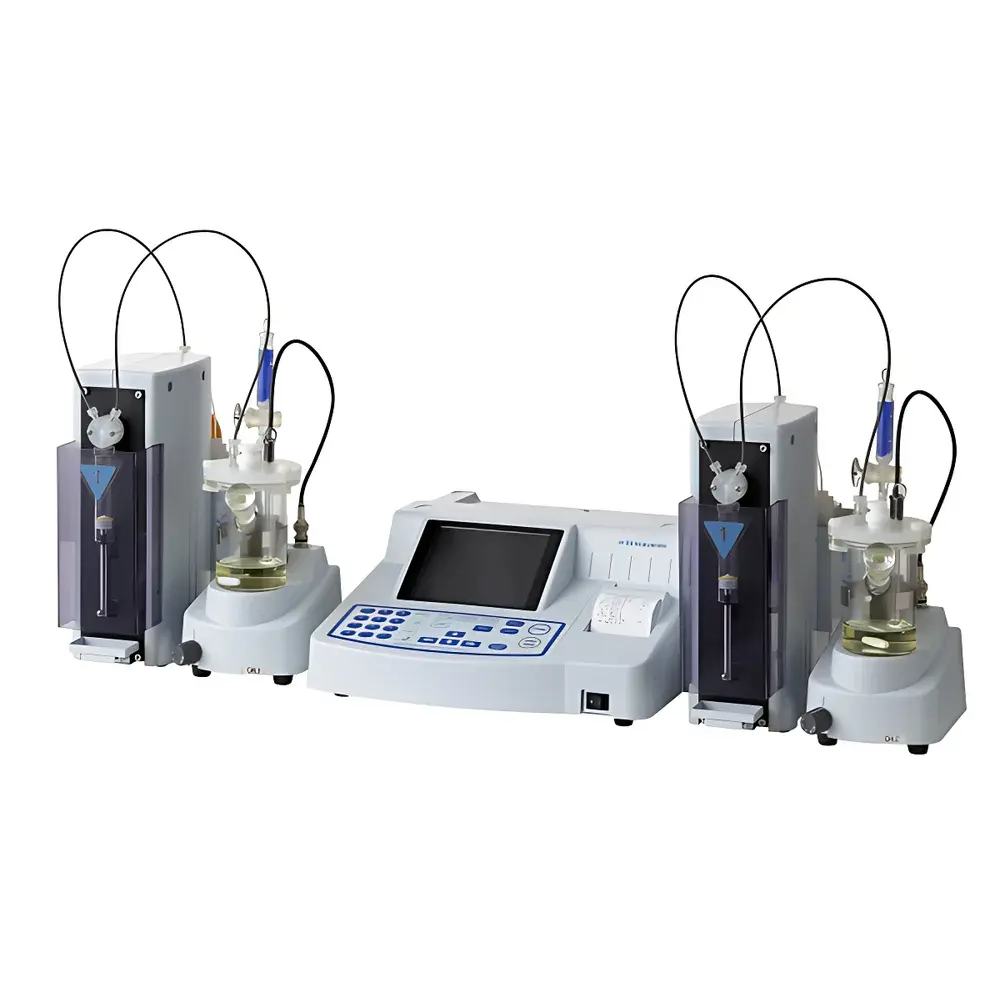
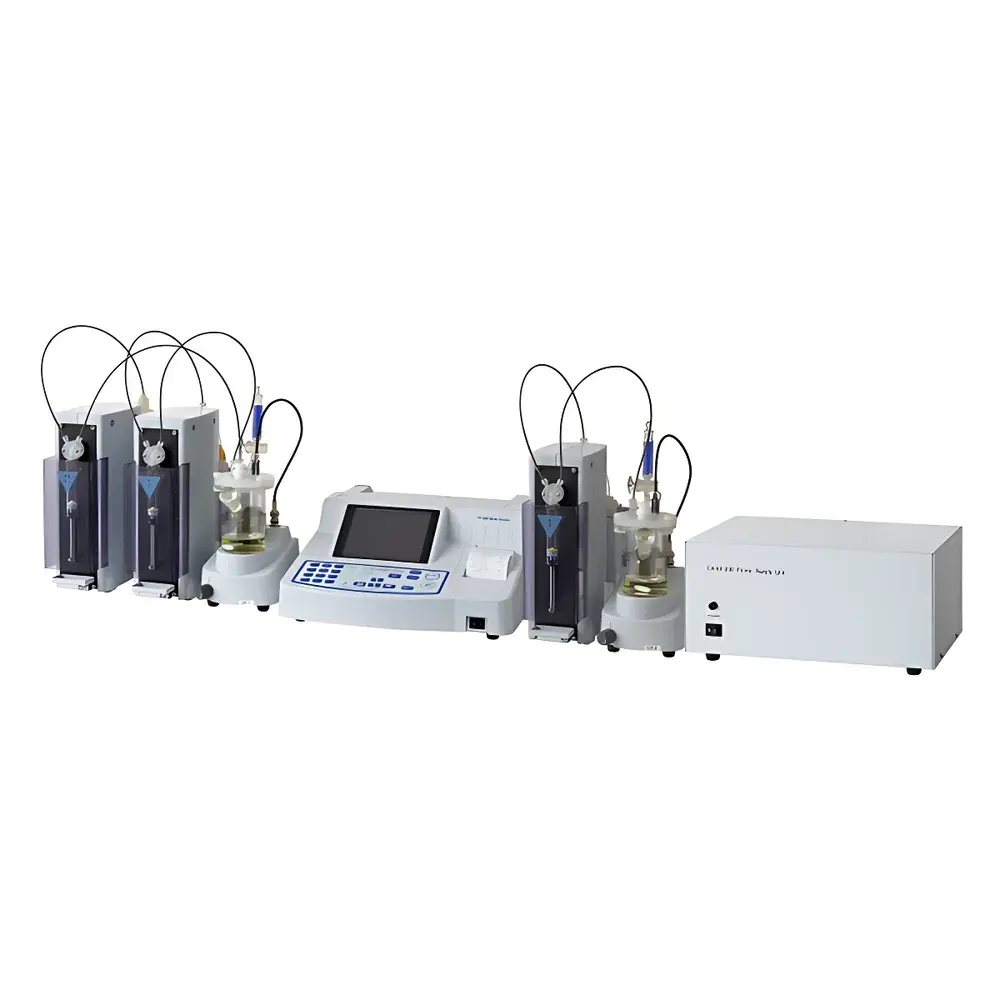
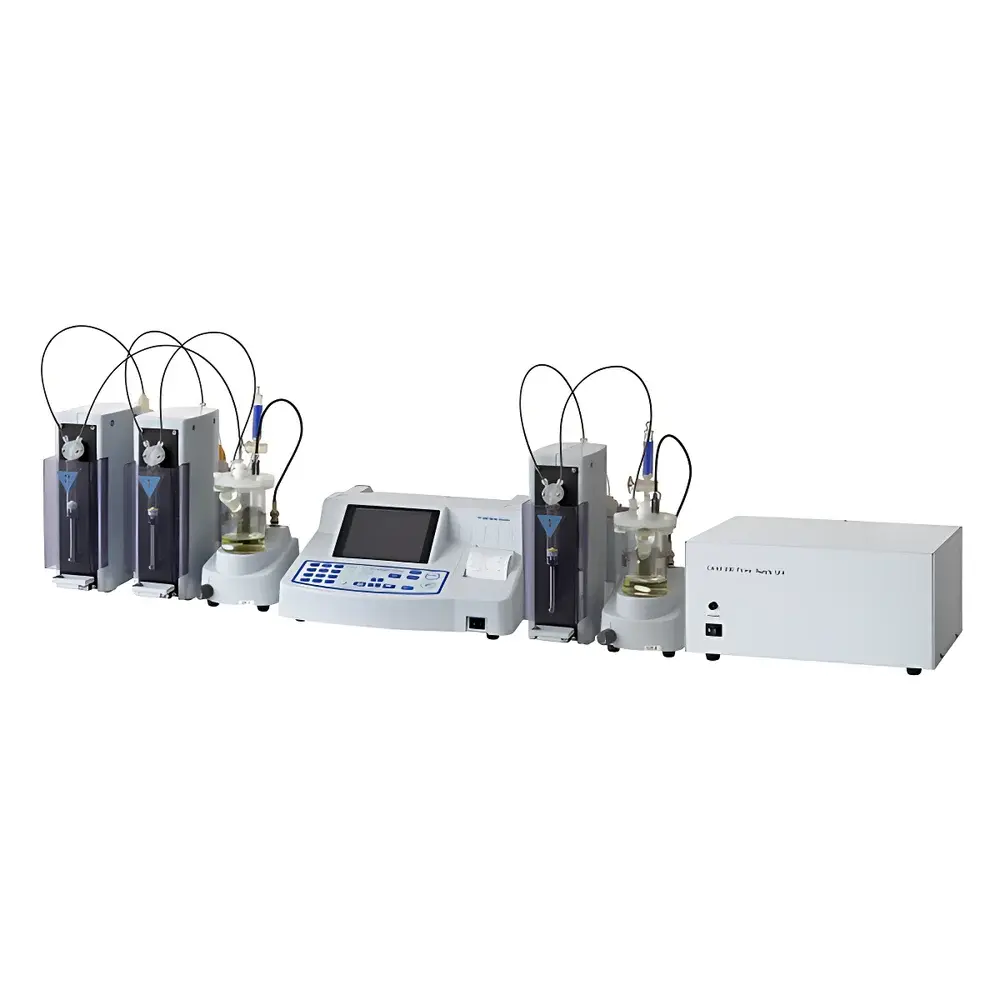
Mitsubishi Chemical KF-200 Volumetric Karl Fischer Moisture Analyzer
| Brand | Mitsubishi Chemical |
|---|---|
| Origin | Japan |
| Model | KF-200 |
| Instrument Type | Volumetric Karl Fischer Titrator |
| Water Content Range | 0.1 mg – 999 mg H₂O |
| Titration Accuracy | ±0.02 mL (with 10 mL syringe) |
| Minimum Dispensing Volume | 1/2000 of burette volume |
| Display | 5.7-inch color LCD |
| Burette Capacity | 10 mL (optional 25 mL) |
| Dispensing Speed | 1 mL / 1.5 sec |
| Data Storage | 20 single files + 50 composite files |
| Interface | RS-232C (optional), USB host (2 ports), balance auto-input, internal/external I/O |
| Power Supply | AC 100–120 V / 230–240 V, 50/60 Hz |
| Dimensions (main unit) | 330 × 320 × 148 mm |
| Weight (main unit) | ~5 kg |
Overview
The Mitsubishi Chemical KF-200 is a high-precision volumetric Karl Fischer (KF) moisture analyzer engineered for trace water quantification in pharmaceuticals, polymers, petrochemicals, and fine chemicals. It operates on the principle of stoichiometric iodine-based redox titration, where water reacts quantitatively with iodine, sulfur dioxide, methanol, and a base (typically imidazole or diethanolamine) in an anhydrous solvent system. The KF-200 employs a motor-driven syringe-type burette to deliver standardized KF reagent—ensuring reproducible, low-drift titrant delivery and minimizing dead-volume errors inherent in piston-driven or solenoid-valve systems. As the direct successor to the KF-100, it integrates enhanced electrode maintenance algorithms, dual-USB data handling, and modular hardware architecture compatible with optional vaporization units (e.g., VA-200, VA-230) for solid, viscous, or thermally labile samples. Its design adheres to core analytical rigor required under ISO 8533, ASTM E203, and USP , supporting validated workflows in regulated environments.
Key Features
- Syringe-type volumetric burette (standard 10 mL; optional 25 mL) with ±0.02 mL accuracy and 1 mL/1.5 sec dispensing speed—optimized for high repeatability and minimal reagent consumption.
- 5.7-inch full-color LCD interface with intuitive navigation, on-screen help system, and real-time titration curve visualization.
- Automated electrode conditioning routine that detects and removes passivating deposits during analysis—eliminating manual cleaning and reducing operator dependency.
- Dual USB host ports: one for external storage (CSV result export, method backup), the other for direct thermal printer connectivity—enabling paper-based audit trails without PC intervention.
- Modular expansion capability: supports up to two independent volumetric burettes and two vaporization units simultaneously, enabling parallel sample processing or method cross-validation.
- GLP/GMP-ready firmware with user-level access control, electronic signature support, and audit-trail logging for critical parameters (reagent batch, titrant concentration, endpoint detection threshold).
- Integrated balance interface (RS-232 or proprietary protocol) for automatic sample weight import—reducing transcription errors and ensuring mass-normalized reporting (e.g., % w/w, ppm).
Sample Compatibility & Compliance
The KF-200 accommodates liquid, solid, paste, and gaseous samples via direct injection or coupling with Mitsubishi’s VA-series vaporizers—including VA-200 (boat-type), VA-230 (vial-type), and VA-122 (dual-temperature furnace). Its closed-system design prevents ambient moisture ingress during analysis, critical for low-moisture samples (<100 ppm). The instrument complies with regulatory expectations for analytical instrumentation: firmware supports 21 CFR Part 11-compliant data integrity when paired with Mitsubishi’s optional validation software package (KFSW-21C); all calibration, maintenance, and error logs are time-stamped and non-erasable. Method files include metadata fields for analyst ID, instrument ID, reagent lot number, and environmental conditions—facilitating traceability per ISO/IEC 17025 and ICH Q2(R2).
Software & Data Management
Data handling is structured around three file types: single-run files (20 max), composite files (50 max), and system configuration backups. Each measurement record stores raw titration data (potential vs. volume), calculated water mass, relative standard deviation (RSD) across replicates, and reagent consumption metrics. USB export generates timestamped CSV files compatible with LIMS integration or statistical process control (SPC) platforms. Optional KFSW-21C software provides electronic signatures, role-based permissions, and change-control logs for method modifications—meeting FDA and EMA requirements for computerized system validation. Internal memory retains all audit events (e.g., password resets, calibration overrides) with immutable timestamps.
Applications
The KF-200 is routinely deployed in QC laboratories for moisture verification of active pharmaceutical ingredients (APIs), excipients, and lyophilized products—where deviations >0.1% w/w may impact stability or dissolution. In polymer manufacturing, it quantifies residual monomer hydration in polyamide or polyester precursors prior to extrusion. Petrochemical labs use it to assess water content in jet fuel (ASTM D6304) and lubricants (ASTM D1744), while battery electrolyte producers rely on its sub-milligram sensitivity for LiPF₆ solutions. Its compatibility with Mitsubishi’s anhydrous reagents (e.g., AQ-103, AQ-203) ensures consistent stoichiometry across diverse matrices—from acetonitrile-based solvents to chlorinated hydrocarbons.
FAQ
What titration method does the KF-200 use?
It employs volumetric Karl Fischer titration, using a calibrated syringe burette to dispense iodine-containing reagent into the titration cell.
Can the KF-200 be used with non-Mitsubishi reagents?
While technically possible, Mitsubishi recommends its certified reagents (e.g., AQ-103, AQ-203) to ensure stoichiometric consistency, endpoint sharpness, and compliance with method validation protocols.
Is the KF-200 compliant with 21 CFR Part 11?
Yes—when equipped with KFSW-21C software and configured with user authentication, electronic signatures, and audit-trail archiving.
What is the minimum detectable water mass?
0.1 mg H₂O, corresponding to ~2 ppm in a 5 g sample, assuming optimal reagent titer (5 mg/mL) and stable endpoint detection.
Does the instrument support automated sample changers?
No native autosampler integration; however, third-party XYZ robotic handlers can be synchronized via RS-232 or digital I/O triggers for unattended operation.
Related Products






