
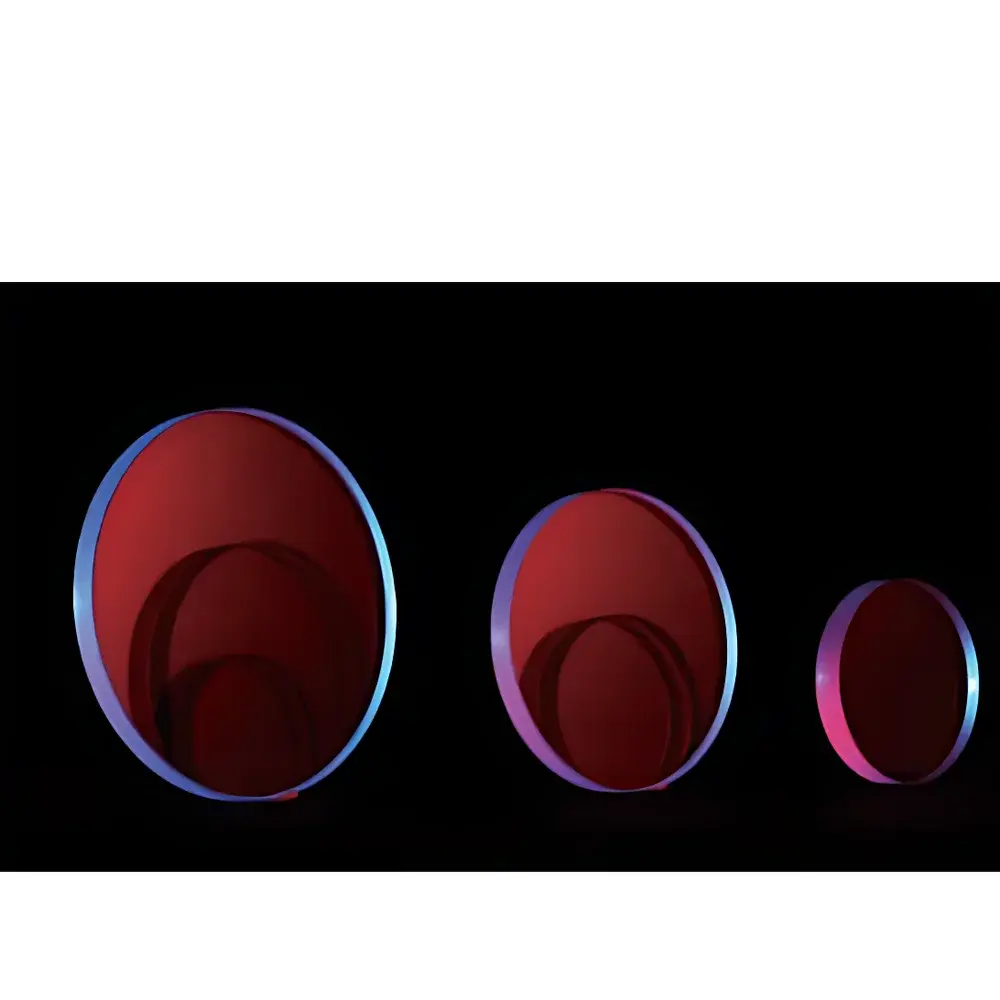
MiXran Meg1070 Barium Fluoride (BaF₂) Plane Optical Window
| Brand | MiXran |
|---|---|
| Model | Meg1070 |
| Material | Barium Fluoride (BaF₂) |
| Surface Quality | 40-20 Scratch-Dig |
| Surface Flatness | λ/4 @ 633 nm |
| Coating | Uncoated (Optional AR Coating Available) |
| Transmission Range | 0.15–12 µm |
| Refractive Index | ~1.47 @ 550 nm |
| Density | 4.89 g/cm³ |
| Thermal Expansion Coefficient | 18.8 × 10⁻⁶ /K |
| Hardness (Knoop) | 82 |
| Operating Temperature | –70 to +500 °C |
| Diameter Options | Φ12.5 mm, Φ12.7 mm, Φ25.0 mm, Φ25.4 mm, Φ40.0 mm, Φ50.0 mm |
| Thickness | 2 mm or 3 mm |
| Compliance | ISO 10110-7, MIL-O-13830A |
Overview
The MiXran Meg1070 Barium Fluoride (BaF₂) Plane Optical Window is a high-purity, single-crystal transmissive optical component engineered for demanding ultraviolet (UV), visible (VIS), and mid-infrared (IR) applications. BaF₂ exhibits exceptional broadband transmission—from 150 nm in the deep UV through the visible spectrum and up to 12 µm in the mid-IR—making it uniquely suited for spectroscopic systems, excimer laser delivery, synchrotron beamlines, and Fourier-transform infrared (FTIR) instrumentation. Unlike fused silica or CaF₂, BaF₂ maintains low absorption and high radiation resistance under intense UV exposure, while offering superior thermal shock tolerance compared to ZnSe or KBr. Its cubic crystal structure ensures isotropic optical behavior and minimal birefringence, critical for polarization-sensitive setups. The Meg1070 series is fabricated from Czochralski-grown BaF₂ boules with controlled stoichiometry and low OH⁻ content (<1 ppm), minimizing water-related absorption bands near 2.9 µm and 6.1 µm.
Key Features
- Ultra-broad spectral transmission (150 nm – 12 µm), validated per ASTM E1335 for UV-VIS-NIR and per ISO 11551 for IR transmittance
- High laser-induced damage threshold (LIDT) of ≥5 J/cm² at 193 nm (10 ns, 20 Hz), suitable for ArF excimer laser windows
- Surface flatness of λ/4 @ 633 nm (measured via phase-shifting interferometry per ISO 10110-5)
- Surface quality rated to 40–20 scratch-dig per MIL-O-13830A, verified by automated dark-field inspection
- Thermally stable design: coefficient of thermal expansion matched to common aluminum and stainless steel mounts for vacuum-compatible flange integration
- Available in six standard diameters (Φ12.5 to Φ50.0 mm) and two precision thicknesses (2.0 ± 0.1 mm and 3.0 ± 0.1 mm), all edge-deburred and chamfered to prevent chipping
Sample Compatibility & Compliance
The Meg1070 window is compatible with high-vacuum (≤10⁻⁷ mbar) and ultra-high-vacuum (UHV, ≤10⁻¹⁰ mbar) environments when properly baked out (outgassing rate <1×10⁻¹² Pa·m³/s·cm² per ISO 11341). It meets material traceability requirements per ISO 9001:2015 and is supplied with a Certificate of Conformance including batch-specific refractive index homogeneity data (Δn < 5×10⁻⁶ over aperture) and residual stress mapping (photoelastic fringe count < 0.5 fringes/mm). All units undergo full spectral transmittance verification across 200–11,000 cm⁻¹ using a calibrated FTIR spectrometer traceable to NIST SRM 1920a. No RoHS-restricted substances are used in crystal growth or polishing processes.
Software & Data Management
While the Meg1070 is a passive optical component, its performance specifications are fully integrated into optical design workflows via Zemax OpticStudio and CODE V component libraries (ZMX and SEQ formats available upon request). Each shipped unit includes a digital QA report in PDF/A-1b format containing interferometric surface maps, spectral transmittance curves, and dimensional metrology data (CMM-traceable). For GMP/GLP-regulated laboratories, optional 21 CFR Part 11-compliant electronic records—including audit trails for calibration certificate generation—are supported through MiXran’s secure portal (valid for 10 years post-shipment).
Applications
- Deep-UV lithography optics and plasma diagnostics in semiconductor process tools
- Beam isolation and viewport windows in high-power excimer laser cavities (193 nm, 248 nm)
- Sample compartment windows in benchtop and synchrotron-based X-ray fluorescence (XRF) and soft X-ray absorption spectroscopy (XAS)
- Reference cells and gas cell windows in environmental monitoring FTIR analyzers (e.g., EPA Method 320 compliance)
- Cryogenic IR spectroscopy windows for liquid nitrogen-cooled detectors (maintains mechanical integrity down to 77 K)
- Space-qualified optical subsystems requiring radiation-hardened materials (tested per MIL-STD-883H, Method 1019.8)
FAQ
Is anti-reflection (AR) coating available for the Meg1070 BaF₂ window?
Yes—custom broadband AR coatings (190–2000 nm or 2–12 µm) can be applied using ion-assisted e-beam deposition. Coating specifications include R<0.5% average reflectance and LIDT ≥3 J/cm² at 193 nm.
Can Meg1070 windows be used in high-humidity environments?
BaF₂ is hygroscopic; prolonged exposure to >60% RH may cause surface clouding. We recommend sealed dry-nitrogen purging or use of desiccant housings. For humidified applications, consider optional hydrophobic SiO₂ overcoat.
What is the maximum operating temperature for continuous use?
Continuous operation is rated to +500 °C in inert atmosphere; short-term excursions to +550 °C are permissible with thermal ramp rates <5 °C/min.
Do you provide mounting hardware or kinematic cells?
Standard unmounted windows are supplied. Custom kinematic mounts (e.g., Thorlabs SM1-threaded cells or CF-40 flanges) are available as OEM options with alignment tolerances ±2 arcsec.
Is batch-level certification available for ISO 17025-accredited labs?
Yes—third-party calibration certificates issued by CNAS-accredited laboratories (ISO/IEC 17025:2017) are available upon order, covering spectral transmittance, surface flatness, and dimensional verification.



