
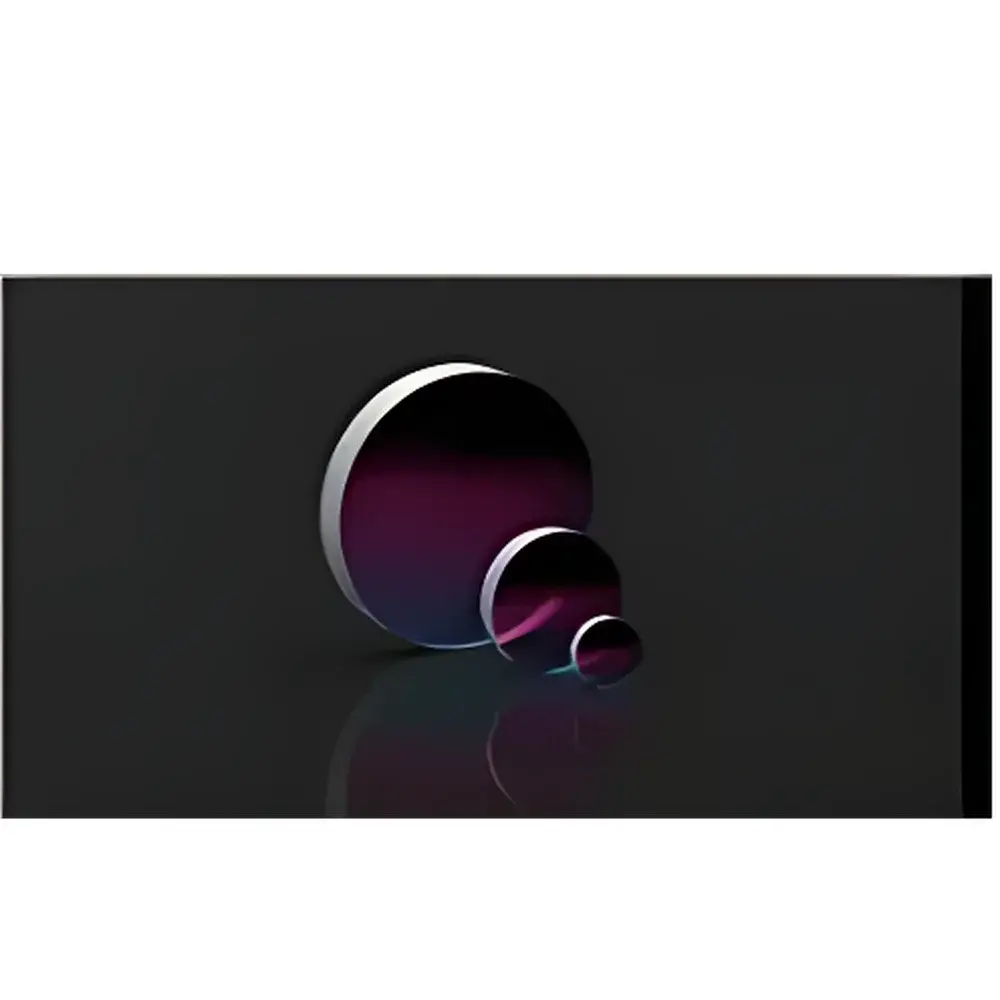
MiXran Meg1071 Calcium Fluoride (CaF₂) Planar Optical Window
| Brand | MiXran |
|---|---|
| Model | Meg1071 |
| Material | Calcium Fluoride (CaF₂) |
| Surface Quality | 20–10 scratch-dig |
| Surface Flatness | λ/4 @ 633 nm |
| Parallelism | < 1 arcmin |
| Coating | Uncoated (optional AR coating available for UV-VIS-NIR) |
| Transmission Range | 0.18–9.0 µm |
| Refractive Index | ~1.43 @ 550 nm |
| Density | 3.18 g/cm³ |
| Thermal Expansion Coefficient | 18.85 × 10⁻⁶ /°C |
| Operating Temperature Range | –100 °C to +200 °C |
| Available Diameters | Φ12.5 mm, Φ12.7 mm, Φ25.0 mm, Φ25.4 mm, Φ40.0 mm, Φ50.0 mm |
| Thickness Options | 3 mm, 5 mm, 8 mm |
Overview
The MiXran Meg1071 is a high-purity, single-crystal calcium fluoride (CaF₂) planar optical window engineered for demanding ultraviolet (UV), visible (VIS), and mid-infrared (IR) transmission applications. Fabricated from synthetic CaF₂ grown via the Bridgman method, this window exhibits exceptional broadband transparency spanning 180 nm to 9,000 nm—making it uniquely suited for spectroscopic systems, excimer laser delivery optics, synchrotron beamlines, and vacuum ultraviolet (VUV) instrumentation where fused silica or BK7 fail due to absorption or solarization. Its low refractive index (~1.43 at 550 nm), negligible birefringence, and high laser-induced damage threshold (LIDT > 5 J/cm² @ 193 nm, 20 ns pulse) ensure stable performance under intense short-wavelength irradiation. The Meg1071 is precision-polished to λ/4 surface flatness (measured at 633 nm HeNe wavelength) and controlled parallelism (< 1 arcmin), enabling use in interferometric and collimation-critical setups without introducing wavefront distortion.
Key Features
- Single-crystal CaF₂ substrate with > 99.99% purity, verified by FTIR and residual gas analysis to minimize OH⁻ and metallic impurities that cause absorption bands near 2.7 µm and 3.4 µm
- Surface quality rated to MIL-PRF-13830B 20–10 scratch-dig standard, ensuring compatibility with high-power laser systems and cleanroom handling protocols
- Controlled thickness tolerance of ±0.1 mm and diameter tolerance of ±0.05 mm, supporting repeatable mechanical integration into OEM optical mounts and vacuum flanges
- Thermally robust architecture: coefficient of thermal expansion (CTE) of 18.85 × 10⁻⁶ /°C enables stable alignment across cryogenic (–100 °C) to elevated (200 °C) operating environments
- Available uncoated for maximum transmission in VUV–MIR regimes; optional broadband anti-reflection (BBAR) coatings can be applied per customer specification (e.g., R < 0.5% average over 200–2000 nm)
Sample Compatibility & Compliance
The Meg1071 window is compatible with ultra-high vacuum (UHV) systems (base pressure ≤ 1 × 10⁻⁹ mbar) following bake-out at 150 °C for 24 hours, with outgassing rates conforming to ASTM E595 requirements (< 1.0% TML, < 0.1% CVCM). It meets ISO 10110–7 standards for surface form and irregularity, and its material certification includes traceable lot documentation per ISO 9001:2015. While not classified as medical or IVD devices, the component complies with RoHS Directive 2011/65/EU and REACH Annex XVII restrictions on hazardous substances. No proprietary firmware or embedded electronics are present; therefore, no FCC or CE electromagnetic compatibility declarations apply.
Software & Data Management
As a passive optical component, the Meg1071 requires no software, drivers, or firmware. Dimensional and metrological data—including interferometric flatness maps, spectral transmittance curves (200–9000 nm), and LIDT test reports—are delivered digitally in PDF and CSV formats upon request. All calibration records and material certificates are archived for 10 years and available for GLP/GMP audit traceability. For integration into automated optical assembly workflows, dimensional specifications are provided in STEP AP214 format compatible with SolidWorks, Zemax OpticStudio, and CODE V.
Applications
- Vacuum-compatible windows for EUV lithography tool monitoring ports and plasma diagnostics chambers
- Output couplers and harmonic separation optics in ArF (193 nm), KrF (248 nm), and F₂ (157 nm) excimer laser systems
- Beam delivery optics in Fourier-transform infrared (FTIR) spectrometers and tunable quantum cascade laser (QCL) platforms
- Cryostat viewports for low-temperature photoluminescence and Raman spectroscopy of 2D materials
- Reference-grade transmission elements in NIST-traceable radiometric calibration chains for UV–IR detector characterization
FAQ
Is the Meg1071 suitable for use below 190 nm in air? Why or why not?
Yes—unlike fused silica, CaF₂ maintains transmission down to ~180 nm in ambient air. However, atmospheric oxygen absorption and surface oxidation may reduce throughput below 190 nm; operation in nitrogen-purged or vacuum environments is recommended for optimal VUV performance.
Can custom diameters or thicknesses be manufactured?
Yes. MiXran offers OEM fabrication services for non-standard dimensions, including wedged variants (≤ 3 arcmin wedge angle) and polished edges (0.2 mm chamfer, 0.1 mm radius). Minimum order quantity applies.
What cleaning protocol is recommended for CaF₂ surfaces?
Use only spectroscopic-grade acetone or methanol with Class 100 cleanroom swabs. Avoid aqueous solutions, ultrasonication, or abrasive cleaners—CaF₂ is slightly water-soluble and susceptible to etching by acids or alkalis.
Does the Meg1071 window require humidity-controlled storage?
Yes. Store in desiccated environments (60% RH may induce surface hydration films, increasing scatter and reducing UV transmission.
Are spectral transmittance data provided for each individual window?
Spectral measurements are performed on representative samples per production lot. Full-lot certification includes FTIR transmission curves (200–9000 nm, 4 cm⁻¹ resolution); individual unit data are available upon request with additional metrology surcharge.





