
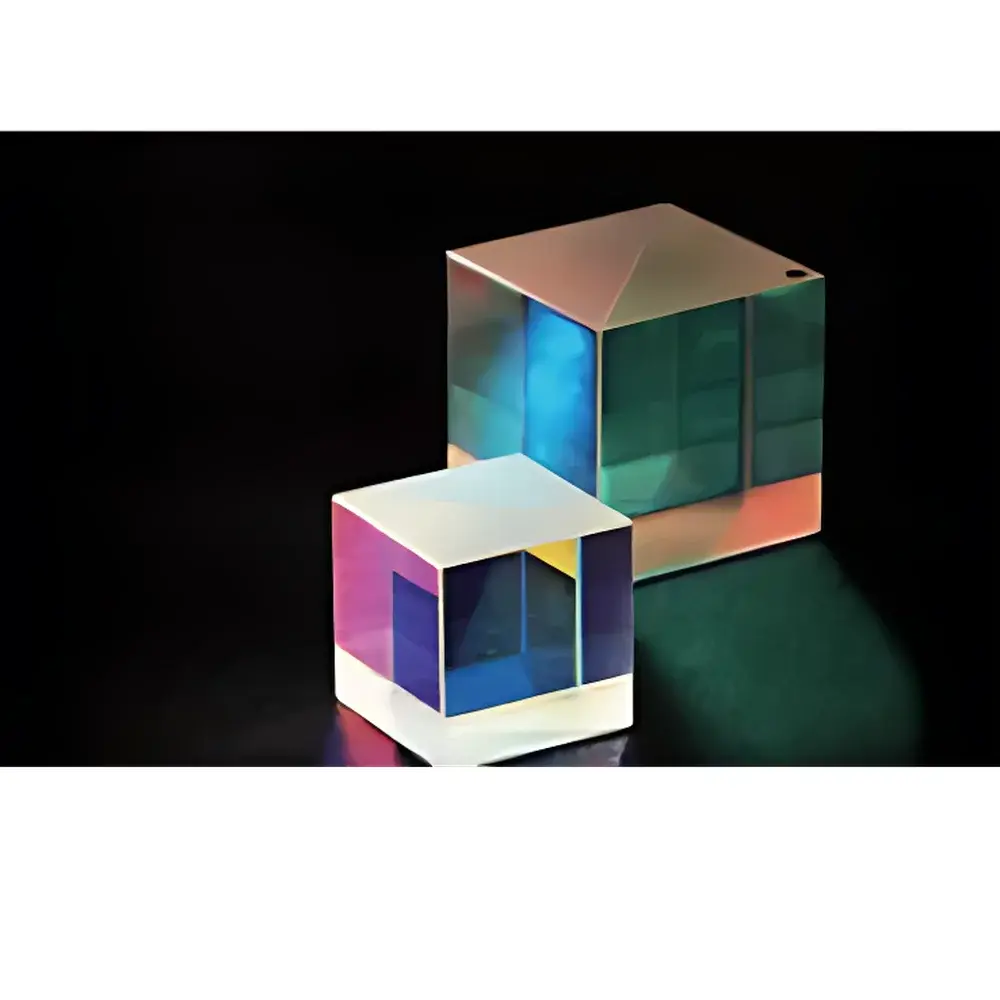
MiXran Meg1100 Polarizing Beam Splitter Cube
| Brand | MiXran |
|---|---|
| Model | Meg1100 |
| Type | Polarizing Beam Splitter Cube |
| Material | UV-Fused Silica / BK7 (depending on wavelength variant) |
| Coating | Dielectric multilayer, high-extinction-ratio polarization separation |
| Cube Side Lengths | 5 mm, 10 mm, 12.5 mm, 12.7 mm, 15 mm, 20 mm, 25 mm, 25.4 mm, 50.0 mm, 50.8 mm |
| Wavelength Ranges | VIS (420–680 nm), NIR (620–1000 nm), SWIR1 (900–1300 nm), SWIR2 (1200–1600 nm) |
| Extinction Ratio | >1000:1 (typical, depending on wavelength band and incident angle) |
| Surface Quality | 20–10 scratch-dig |
| Wavefront Distortion | λ/8 @ 633 nm (per surface) |
| AR Coating | Broadband anti-reflection on input/output faces (R < 0.25% per surface) |
| Operating Temperature | –20 °C to +70 °C |
| Damage Threshold | >5 J/cm² (10 ns, 1064 nm, 10 Hz) |
Overview
The MiXran Meg1100 Polarizing Beam Splitter Cube is a precision optical component engineered for high-fidelity spatial separation of orthogonal linear polarization states in free-space laser and imaging systems. Based on the principle of dielectric thin-film interference, the Meg1100 utilizes a 45°-oriented, high-contrast polarization-selective coating deposited on a precisely aligned internal hypotenuse interface between two optically contacted prisms. Incident unpolarized or mixed-polarization light is split into reflected S-polarized and transmitted P-polarized beams with minimal wavefront distortion and high extinction ratio—enabling robust polarization control in interferometry, ellipsometry, quantum optics, and polarization-sensitive metrology.
Key Features
- High extinction ratio (>1000:1) across four calibrated spectral bands: VIS (420–680 nm), NIR (620–1000 nm), SWIR1 (900–1300 nm), and SWIR2 (1200–1600 nm)
- Standard cube side lengths from 5 mm to 50.8 mm, accommodating compact OEM integration and large-aperture laboratory setups
- UV-fused silica substrate option for deep-UV stability and low thermal expansion; BK7 alternative available for cost-optimized visible applications
- Dual-side broadband anti-reflection (BBAR) coatings reduce Fresnel losses (<0.25% reflectance per surface) and suppress ghost reflections
- λ/8 wavefront accuracy per surface (measured at 633 nm) ensures compatibility with diffraction-limited beam paths
- Surface quality rated to 20–10 scratch-dig per MIL-PRF-13830B, supporting high-power and ultrafast laser use cases
- Thermally stable architecture validated for operation between –20 °C and +70 °C without delamination or coating degradation
Sample Compatibility & Compliance
The Meg1100 is compatible with collimated or moderately focused Gaussian beams (M² < 1.3) and supports incidence angles within ±2° of 0° (normal incidence) or 45° (for optimized polarization splitting). It complies with ISO 10110-7 for surface imperfections and ISO 14997 for coating adhesion testing. While not certified to IEC 61215 or MIL-STD-810G as a standalone system, its construction meets common optical subassembly requirements for GLP-aligned research instrumentation and industrial laser processing platforms. The absence of organic adhesives in the optical contact process eliminates outgassing concerns in vacuum-compatible environments (UHV-rated upon request with fused silica variant).
Software & Data Management
As a passive optical component, the Meg1100 requires no firmware, drivers, or embedded software. However, it is fully compatible with standard optical design and simulation workflows—including Zemax OpticStudio (ZOS), CODE V, and FRED—via provided .ZMX and .SEQ files for all standard sizes and spectral variants. Optical performance data (transmittance/reflectance spectra, extinction ratio vs. wavelength, angular sensitivity curves) are supplied in CSV and ASCII formats for integration into automated test scripts and calibration databases. Traceable NIST-traceable spectral characterization reports (per batch) are available upon request for QA/QC documentation in regulated environments.
Applications
- Laser cavity polarization control and intracavity loss management
- Polarization-resolved confocal and multiphoton microscopy beam routing
- Free-space quantum key distribution (QKD) systems requiring deterministic polarization state separation
- Ellipsometric measurement heads for thin-film thickness and refractive index analysis
- Optical coherence tomography (OCT) reference arm stabilization and polarization diversity detection
- Industrial machine vision systems employing polarization contrast for surface defect detection (e.g., stress birefringence in glass or polymer substrates)
- Calibration standards for polarimetric sensor validation across VIS–SWIR bands
FAQ
What is the maximum laser-induced damage threshold (LIDT) for the Meg1100?
The LIDT is specified at >5 J/cm² for 10 ns pulses at 1064 nm, 10 Hz repetition rate, measured on the fused silica variant. For CW applications, the power density limit is 1 MW/cm² (unfocused, 1/e² beam diameter ≥ 1 mm).
Can the Meg1100 be used at non-normal incidence?
Yes—but polarization extinction ratio degrades beyond ±2° deviation from nominal incidence. For 45° input configurations (e.g., in Mach–Zehnder interferometers), angular alignment tolerance is ±0.5° to maintain >500:1 extinction.
Is custom coating design available?
Yes. MiXran offers application-specific coating optimization—including dual-band, tunable-angle, or high-power pulsed variants—subject to minimum order quantities and lead-time agreement.
Are mounting fixtures or kinematic mounts included?
No. The Meg1100 is supplied as a bare optical cube. Standard SM1-threaded cage-compatible mounts and kinematic rotation stages are recommended and available separately through authorized distributors.
Do you provide spectral measurement reports with each shipment?
Batch-level spectral characterization reports (including Tp, Rs, extinction ratio vs. wavelength) are included by default. NIST-traceable calibration certificates require advance specification and incur additional lead time and cost.





