
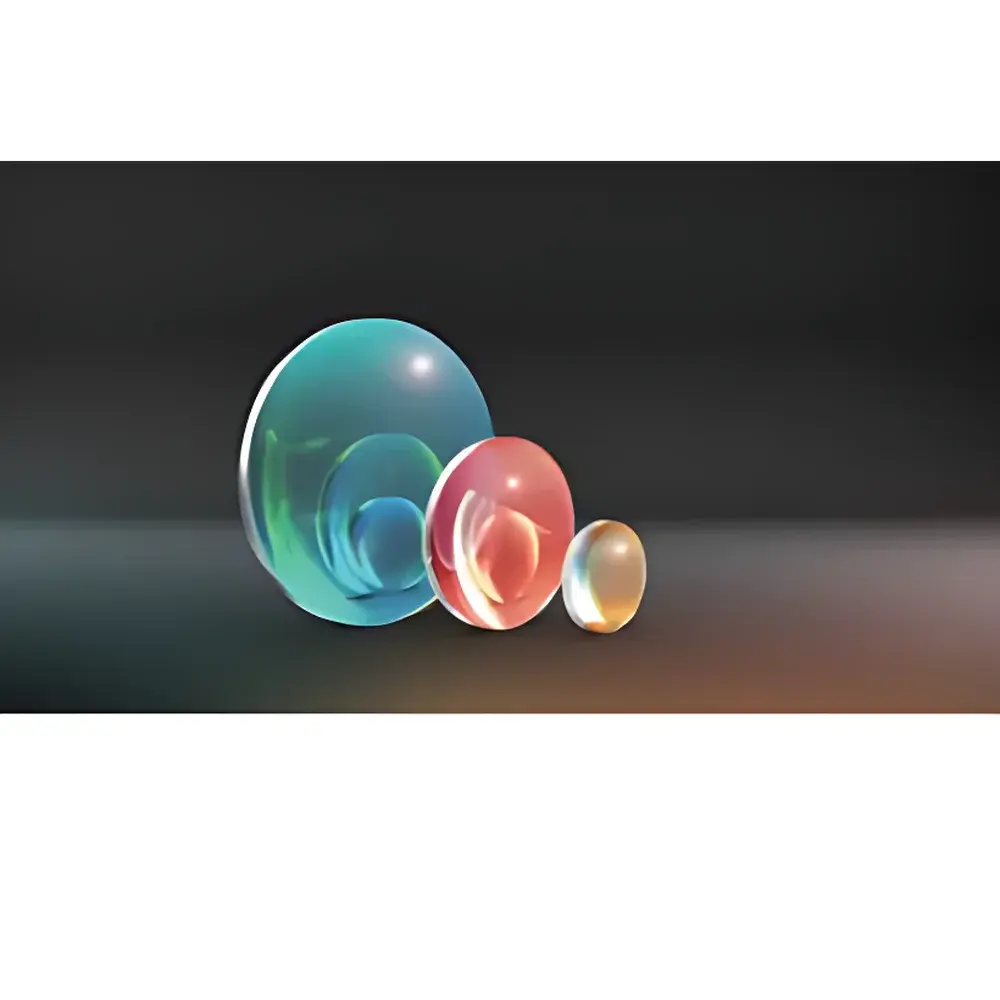
MiXran Meg1111 Economical Shortpass Optical Filter
| Brand | MiXran |
|---|---|
| Model | Meg1111 |
| Filter Type | Shortpass Interference Filter |
| Center Wavelength Options | 400–1100 nm (in 50 nm increments) |
| Transmission Band | e.g., 250–385 nm @ CW 400 nm |
| Cut-off Band | e.g., 420–485 nm @ CW 400 nm |
| Available Diameters | Φ12.5 mm, Φ25 mm, Φ50 mm |
| Substrate Material | Optical-grade fused silica or BK7 (standard) |
| Surface Quality | 60-40 scratch-dig |
| Parallelism | <3 arcmin |
| Clear Aperture | ≥90% of diameter |
| Operating Temperature Range | –20 °C to +70 °C |
| Damage Threshold | >500 mW/cm² (CW), >0.5 J/cm² (10 ns pulse, 1064 nm) |
Overview
The MiXran Meg1111 is an economical shortpass optical filter engineered for precision spectral separation in laboratory and industrial optical systems. Based on dielectric thin-film interference technology, it transmits wavelengths below a defined cut-on edge while sharply attenuating longer wavelengths—enabling effective blocking of infrared (IR) leakage in UV–visible fluorescence setups, laser line cleanup, or broadband source conditioning. Unlike absorptive filters, the Meg1111 achieves high transmission (>90% peak) in the passband with steep transition slopes (typical edge steepness: <15 nm at 10%–90% transmission), minimal wavefront distortion, and negligible fluorescence under UV excitation. Its design follows standard optical mounting conventions and complies with ISO 10110 surface quality specifications.
Key Features
- Multi-wavelength selection: 17 discrete center wavelength options from 400 nm to 1100 nm, in 50 nm steps, each with precisely defined transmission and cut-off bands
- Three standardized aperture sizes: Φ12.5 mm (for compact collimators and fiber-coupled systems), Φ25 mm (general-purpose benchtop integration), and Φ50 mm (imaging and large-beam applications)
- High laser durability: Optimized multilayer coating stack withstands continuous-wave irradiance up to 500 mW/cm² and nanosecond pulsed energy densities exceeding 0.5 J/cm² at 1064 nm
- Low angular sensitivity: Designed for use at 0° ±5° angle of incidence; transmission profile remains stable within ±2 nm spectral shift across this range
- Thermally robust substrate: Fused silica (standard for UV-enhanced variants) or BK7 (for visible–NIR configurations) ensures coefficient of thermal expansion (CTE) compatibility with common optomechanical mounts
- Traceable manufacturing: Each filter carries a unique product code (e.g., GSWPE-500-D25) aligned with MiXran’s internal calibration log, supporting lab inventory traceability and replacement consistency
Sample Compatibility & Compliance
The Meg1111 series is compatible with standard SM1 (1.035″-40) and RMS-threaded filter holders, as well as unmounted cage-system integration. It meets ISO 9001-certified production protocols at MiXran’s Beijing facility and conforms to RoHS 2011/65/EU directive requirements for hazardous substance restriction. While not individually certified to ISO/IEC 17025, the filters are manufactured using process-controlled sputtering and in situ spectral monitoring per MIL-C-48497A practices. For regulated environments (e.g., clinical spectroscopy or GLP-compliant R&D), users may request batch-specific spectral verification reports—including full 200–1300 nm transmission scans referenced to NIST-traceable standards.
Software & Data Management
No proprietary software is required for operation. Spectral performance data (including full transmission curves, edge steepness metrics, and out-of-band OD values) are provided in CSV and PDF formats with every shipment. These files are structured for direct import into common optical design platforms such as Zemax OpticStudio, CODE V, and Thorlabs’ ThorCam SDK. Batch-level spectral logs can be integrated into LIMS or ELN systems via API-accessible metadata endpoints (available upon request for enterprise accounts). All product codes follow a deterministic nomenclature (GSWPE-[CW]-D[Ø]) enabling automated inventory reconciliation and procurement scripting.
Applications
- Laser safety interlocks: Blocking pump leakage in DPSS laser cavities (e.g., 808 nm pump rejection in 532 nm green lasers)
- Fluorescence microscopy: Isolating excitation light in widefield and confocal systems using UV–blue excitation sources
- Spectrophotometer auxiliary filtering: Pre-filtering broadband tungsten-halogen or deuterium lamps to reduce second-order diffraction artifacts
- Machine vision illumination control: Enhancing contrast in semiconductor wafer inspection by suppressing ambient IR radiation
- Educational optics labs: Demonstrating wavelength-selective transmission, interference principles, and filter cascading effects
- Environmental sensor pre-optics: Conditioning solar-spectrum input for UV index or PAR (Photosynthetically Active Radiation) detectors
FAQ
What is the typical transmission efficiency in the passband?
Peak transmission exceeds 90% for all variants when used at normal incidence; measured values are provided in the included spectral report.
Can the Meg1111 be used in vacuum or high-humidity environments?
Yes—fused silica substrates with hermetic dielectric coatings are rated for operation in ≤10⁻⁴ mbar vacuum and 5–95% RH non-condensing environments.
Is there a tolerance specification for cut-on wavelength?
Center wavelength tolerance is ±3 nm for filters with CW ≤ 700 nm, and ±5 nm for CW > 700 nm, verified during final spectral inspection.
Do you offer custom center wavelengths or non-standard diameters?
Custom designs (e.g., CW = 427 nm, Ø = 30 mm) are available under MiXran’s OEM service program with minimum order quantities and extended lead times.
How should the filter be cleaned to avoid coating damage?
Use only spectroscopic-grade acetone or isopropanol applied with nitrogen-purged lens tissue; avoid ultrasonic cleaning or abrasive wipes.





