
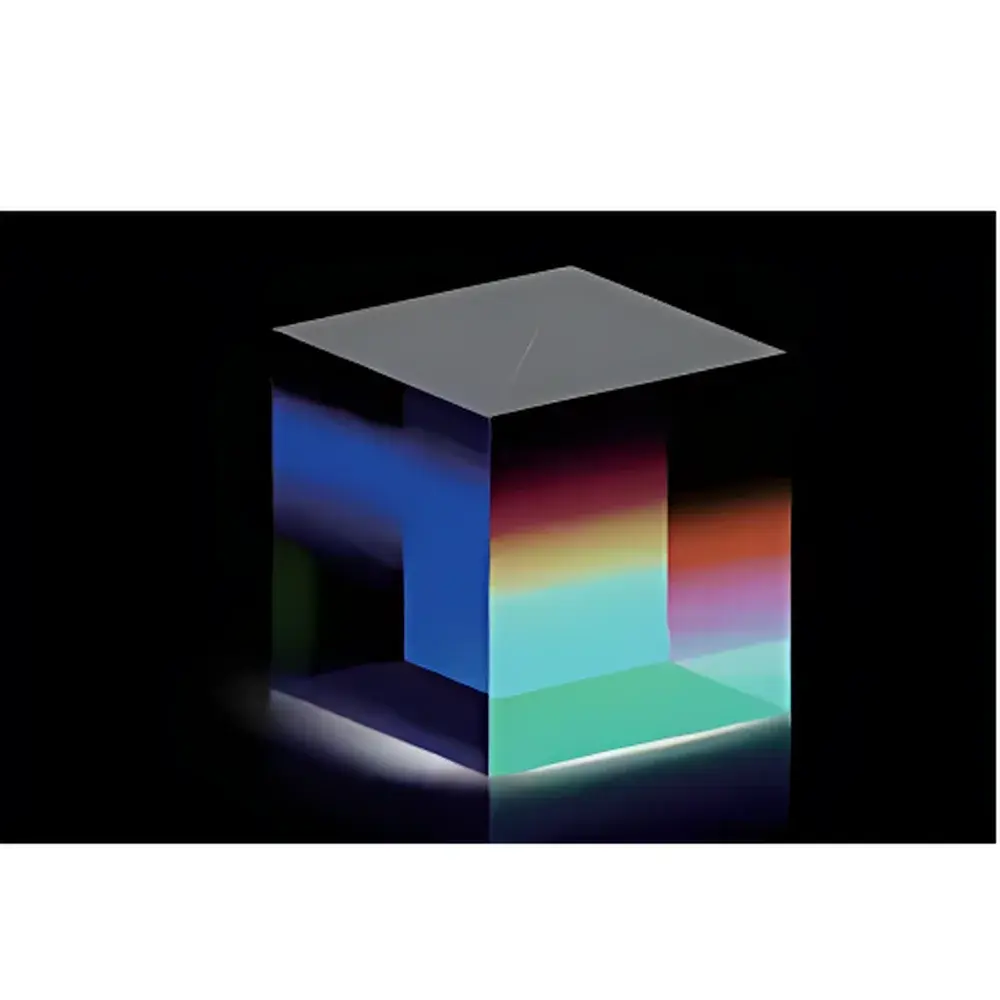
MiXran Meg1126 Laser Polarizing Beam Splitter Cube
| Brand | MiXran |
|---|---|
| Model | Meg1126 |
| Optical Component Type | Polarizing Beam Splitter Cube |
| Dimensions | 10.0 × 10.0 × 10.0 mm / 12.7 × 12.7 × 12.7 mm |
| Design Wavelengths | 532 nm, 633 nm, 780 nm, 1064 nm, 1550 nm |
| Clear Aperture | 8.0 × 8.0 mm / 10.0 × 10.0 mm |
| CW Damage Threshold | 100 W/cm² to 1.5 kW/cm² (wavelength- and spot-size dependent) |
| Pulsed Damage Threshold | 100 mJ/cm² to 2 J/cm² (10 ns pulse width, 10 Hz rep rate, specified beam diameter) |
| Material | UV-grade fused silica substrates with dielectric multilayer coatings |
| Extinction Ratio | >1000:1 (typical, s-polarized reflection / p-polarized transmission) |
| Surface Quality | 20–10 scratch-dig |
| Wavefront Distortion | λ/8 @ 633 nm |
| Coating Type | Hard-dielectric, ion-beam-sputtered (IBS) |
Overview
The MiXran Meg1126 Laser Polarizing Beam Splitter Cube is a precision optical component engineered for high-fidelity polarization state separation in demanding laser-based instrumentation. Based on the cube-type polarizing beam splitter (PBS) architecture, it utilizes a dielectric multilayer coating deposited at the hypotenuse interface between two optically contacted UV-grade fused silica prisms. This design enables deterministic spatial separation of orthogonally polarized light—reflecting the s-polarized component while transmitting the p-polarized component—with minimal wavefront distortion and high polarization extinction. The Meg1126 series is optimized for stable operation across five discrete laser wavelength bands (532 nm, 633 nm, 780 nm, 1064 nm, and 1550 nm), making it suitable for applications ranging from visible interferometry and quantum optics experiments to fiber-coupled telecom systems and ultrafast laser pulse manipulation.
Key Features
- High-extinction-ratio polarization splitting (>1000:1 typical extinction ratio) achieved via ion-beam-sputtered (IBS) hard-dielectric coatings ensuring long-term environmental stability and resistance to laser-induced degradation
- Two standard physical formats: compact 10.0 × 10.0 × 10.0 mm cubes with 8.0 × 8.0 mm clear aperture and larger 12.7 × 12.7 × 12.7 mm cubes with 10.0 × 10.0 mm clear aperture—both compliant with standard optomechanical mounting interfaces
- Specified damage thresholds validated under ISO 21254-1:2011 methodology: CW thresholds range from 100 W/cm² (at 633 nm) to 1.5 kW/cm² (at 1064 nm and 1550 nm); pulsed thresholds span 100 mJ/cm² (8 ns) to 2 J/cm² (10 ns, 10 Hz), all measured with calibrated beam diameters and defined spatial profiles
- Wavefront error controlled to λ/8 RMS @ 633 nm, preserving beam quality in collimated or focused laser paths critical for interferometric stability and mode-matching efficiency
- UV-grade fused silica substrates provide excellent transmission from 190 nm to 2.2 µm, low thermal expansion coefficient (α ≈ 0.55 × 10⁻⁶ /K), and superior homogeneity for low birefringence performance
- Surface quality rated to MIL-PRF-13830B 20–10 scratch-dig specification, minimizing scatter-induced noise in high-sensitivity detection setups
Sample Compatibility & Compliance
The Meg1126 PBS cube is compatible with continuous-wave (CW) and nanosecond-pulsed laser sources operating within its designated wavelength bands. Its optical design supports integration into free-space optical benches, OEM laser modules, polarization-sensitive spectroscopy systems, and cavity-dumping architectures. All variants meet RoHS Directive 2011/65/EU requirements for hazardous substance restrictions. While not certified to ISO 9001 or ISO 13485, manufacturing traceability includes batch-specific coating deposition logs and post-coating spectral verification reports (350–1700 nm). For regulated environments—including GLP-compliant optical calibration labs—the device supports documentation of coating lot numbers, surface inspection records, and damage threshold validation certificates upon request.
Software & Data Management
As a passive optical component, the Meg1126 requires no embedded firmware, drivers, or software control. However, its performance parameters are fully integrable into optical design workflows: spectral reflectance/transmittance data (Rs, Tp) are provided in CSV and .dat formats compatible with Zemax OpticStudio, CODE V, and FRED; coating dispersion models are available as thin-film stack definitions for rigorous polarization ray tracing. Each shipped unit includes a calibration-grade spectral report covering 400–1600 nm at 1 nm resolution, traceable to NIST-traceable spectrophotometers. No data logging, audit trail, or FDA 21 CFR Part 11 compliance is applicable—consistent with industry practice for static optical elements.
Applications
- Laser cavity polarization control and intra-cavity loss management in DPSS and diode-pumped solid-state lasers
- Polarization-resolved confocal microscopy and stimulated emission depletion (STED) systems requiring precise orthogonal beam routing
- Quantum key distribution (QKD) platforms utilizing polarization encoding, where extinction ratio directly impacts quantum bit error rate (QBER)
- Fiber-optic sensor interrogation systems employing polarization-maintaining (PM) fiber coupling and polarization diversity detection
- Optical coherence tomography (OCT) reference arm beam conditioning and polarization multiplexing
- Ultrafast amplifier front-ends requiring high-damage-threshold polarization gating in chirped-pulse amplification (CPA) chains
FAQ
Is the Meg1126 suitable for femtosecond laser applications?
While the Meg1126 is characterized for nanosecond pulses per ISO 21254, its IBS coating structure exhibits low group delay dispersion (GDD) in the near-IR; however, users must independently verify nonlinear effects and spectral phase distortion for sub-100 fs pulses. Custom GDD-matched variants are available upon engineering consultation.
What mounting options are recommended for thermal stability?
We recommend kinematic mounts with low-thermal-conductivity interface materials (e.g., Invar or titanium housings with elastomeric isolation) to minimize stress-induced birefringence. Avoid direct aluminum-to-glass contact without thermal expansion compensation.
Can the cube be cleaned using standard optical protocols?
Yes—use only spectroscopic-grade acetone or isopropanol with Class 100 cleanroom-grade lens tissue. Do not ultrasonicate or apply mechanical pressure exceeding 0.5 N. Refer to MIL-C-48497A cleaning guidelines.
Are custom wavelengths or extinction ratios available?
MiXran offers OEM coating redesign services for non-standard wavelengths (e.g., 355 nm, 980 nm) and enhanced extinction (>5000:1) with lead times of 8–12 weeks and minimum order quantities of 25 units.




