
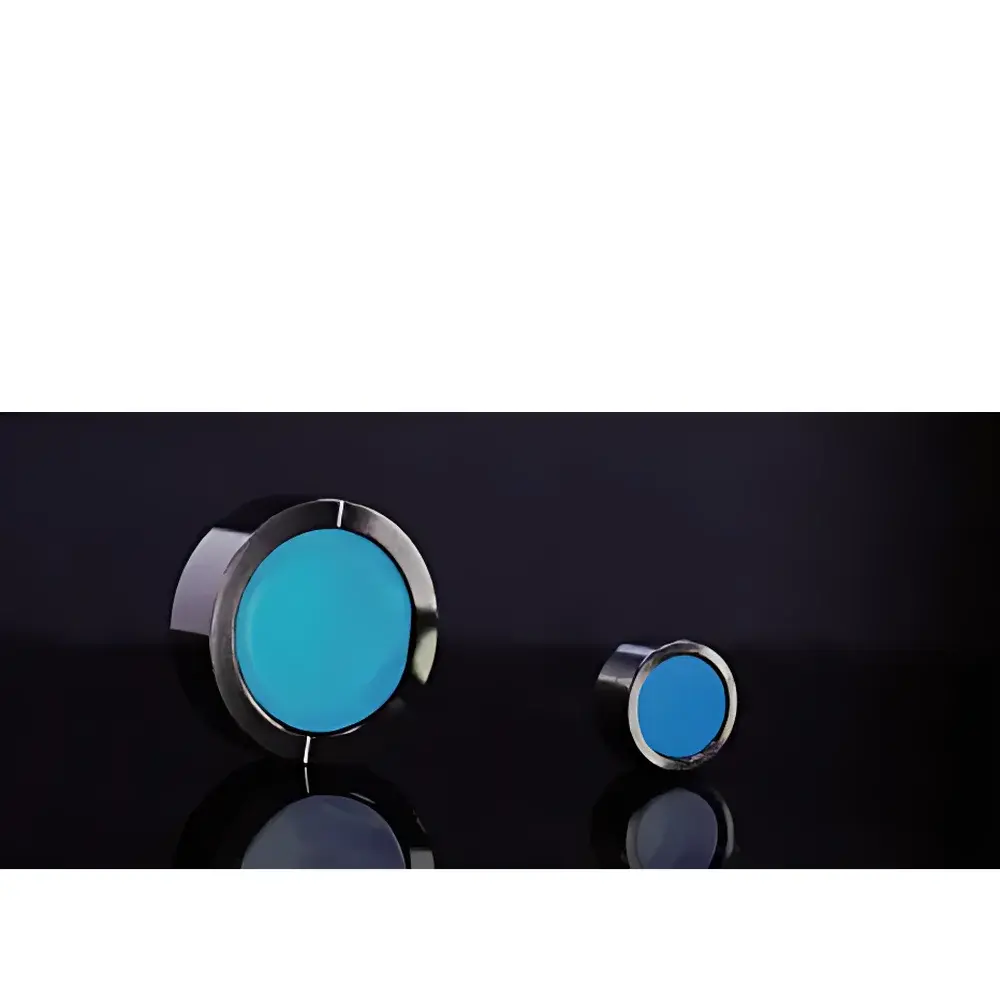
MiXran Meg1127 Air-Gap Zero-Order Half-Wave Plate
| Brand | MiXran |
|---|---|
| Model | Meg1127 |
| Component Type | Optical Element |
| Design Wavelengths | 257 nm, 266 nm, 343 nm, 355 nm, 400 nm, 532 nm, 632.8 nm, 780 nm, 800 nm, 850 nm, 1030 nm, 1064 nm, 1550 nm |
| Retardation | λ/2 |
| Clear Aperture | ≥8.0 mm (for Ø12.7 mm variants) or ≥15.0–18.0 mm (for Ø25.4 mm variants) |
| Thickness | 6.35 mm or 7.92 mm |
| Incident Angle | 0° (optimized for normal incidence) |
| Substrate Material | Fused Silica (standard) |
| Surface Quality | 20–10 scratch-dig |
| Wavefront Distortion | <λ/8 @ 633 nm |
| Damage Threshold | >5 J/cm² (10 ns, 10 Hz, 1064 nm) |
Overview
The MiXran Meg1127 Air-Gap Zero-Order Half-Wave Plate is a precision polarization control component engineered for high-stability phase retardation in demanding optical systems. Unlike multi-order waveplates—whose retardation is highly sensitive to wavelength, temperature, and angle—the Meg1127 employs an air-gap zero-order architecture. This design consists of two precisely oriented birefringent quartz or fused silica plates separated by a sub-micron air gap, effectively canceling higher-order contributions and delivering true λ/2 retardation with minimal dispersion across its specified design wavelengths. The device operates at normal incidence (0°), ensuring consistent polarization rotation (e.g., converting linear polarization at 45° to orthogonal orientation) with high extinction ratio (>30 dB typical) and low polarization-dependent loss (<0.2%). Its robust mechanical construction and hermetically sealed air gap mitigate environmental drift, making it suitable for ultrafast laser systems, quantum optics setups, ellipsometry platforms, and industrial laser processing lines where long-term polarization fidelity is critical.
Key Features
- Air-gap zero-order configuration ensures flat spectral response and reduced temperature sensitivity (typical <0.005 nm/°C shift in retardation)
- Multiple standard design wavelengths spanning deep UV (257 nm) to telecom IR (1550 nm), supporting excimer, DPSS, Ti:sapphire, fiber, and CO2-pumped lasers
- Two aperture options: Ø12.7 mm (clear aperture ≥8.0 mm) and Ø25.4 mm (clear aperture ≥15.0–18.0 mm), both with ≤±0.01 mm diameter tolerance
- High surface quality (20–10 scratch-dig) and λ/8 wavefront distortion (measured at 633 nm) minimize beam degradation and wavefront error
- Optimized for 0° incidence; angular field of view limited to ±1.5° for <±2% retardation deviation
- AR-coated variants available upon request (R<0.25% per surface, broadband or laser-line optimized)
Sample Compatibility & Compliance
The Meg1127 is compatible with free-space optical benches, kinematic mounts (e.g., SM1-threaded lens tubes), and OEM integration into laser cavities or polarization-sensitive interferometers. All units are manufactured under ISO 9001-certified processes and undergo 100% spectral retardation verification using calibrated photoelastic modulator (PEM)-based metrology. Each plate is supplied with a traceable test report including measured retardation at the design wavelength (±0.5° accuracy), transmitted wavefront error, and surface inspection documentation. While not classified as medical or safety-critical hardware, the Meg1127 conforms to RoHS 2011/65/EU directives and meets IEC 61290-1-3 for passive optical component testing methodology. For GLP/GMP-aligned labs, batch-level calibration certificates and material traceability (substrate lot, coating run ID) can be provided upon order specification.
Software & Data Management
As a passive optical component, the Meg1127 requires no embedded firmware or driver software. However, MiXran provides downloadable technical documentation packages—including Zemax-compatible .ZBF files (birefringent crystal model), MATLAB scripts for Jones matrix simulation, and spectral transmittance datasets (CSV format)—via secure customer portal access. These resources support system-level modeling of polarization state evolution in complex optical trains. For integration into automated alignment workflows, the Meg1127’s standardized outer diameter (SM1 or M25 threading options available) enables compatibility with motorized rotation stages (e.g., Thorlabs K10CR1, Newport URS100CC) controlled via LabVIEW, Python (PyVISA), or EPICS. Audit trails for calibration data are retained for 10 years and accessible under NDA for regulated environments.
Applications
- Ultrafast laser pulse shaping: polarization gating, cross-polarized wave generation (XPW), and optical parametric amplification seeding
- Quantum information experiments: qubit state preparation (e.g., H/V ↔ D/A conversion), Bell-state analysis, and polarization entanglement verification
- Ellipsometric characterization: rotating analyzer/compensator configurations for thin-film thickness and refractive index extraction
- Laser material processing: controlling circular/elliptical polarization states for ablation threshold optimization and surface microstructure modulation
- Spectroscopic polarimetry: high-accuracy Stokes parameter measurement in astronomical instrumentation and remote sensing payloads
- Industrial metrology: real-time birefringence monitoring in polymer extrusion and glass tempering lines
FAQ
What is the difference between zero-order and multi-order waveplates?
Zero-order waveplates (like the Meg1127) use compound retarder designs to eliminate dependence on higher-order interference terms—resulting in broader spectral bandwidth, lower temperature sensitivity, and superior angular acceptance compared to single-plate multi-order equivalents.
Can the Meg1127 be used at non-normal incidence?
It is optimized for 0° incidence. At angles >±1.5°, retardation deviates nonlinearly due to effective path-length change and birefringent walk-off; custom wedged variants for oblique applications are available on request.
Is vacuum-compatible mounting supported?
Standard versions use epoxy-free metallic spacers and fused silica substrates, enabling bake-out to 80°C in <10⁻⁶ Torr environments. Vacuum-compatible versions with indium-sealed gaps and CF-flange mounting kits are offered under part suffix “-VAC”.
How is retardation verified during manufacturing?
Each unit undergoes point-by-point retardation mapping using a PEM-based null ellipsometer referenced to NIST-traceable standards, with full-spectrum verification at ±10 nm around the design wavelength.
Do you provide custom design wavelengths or apertures?
Yes—custom center wavelengths (±1 nm resolution), clear apertures up to Ø50.8 mm, and substrate materials (MgF₂, sapphire, YVO₄) are available with lead times of 6–8 weeks and MOQ of 5 units.





