
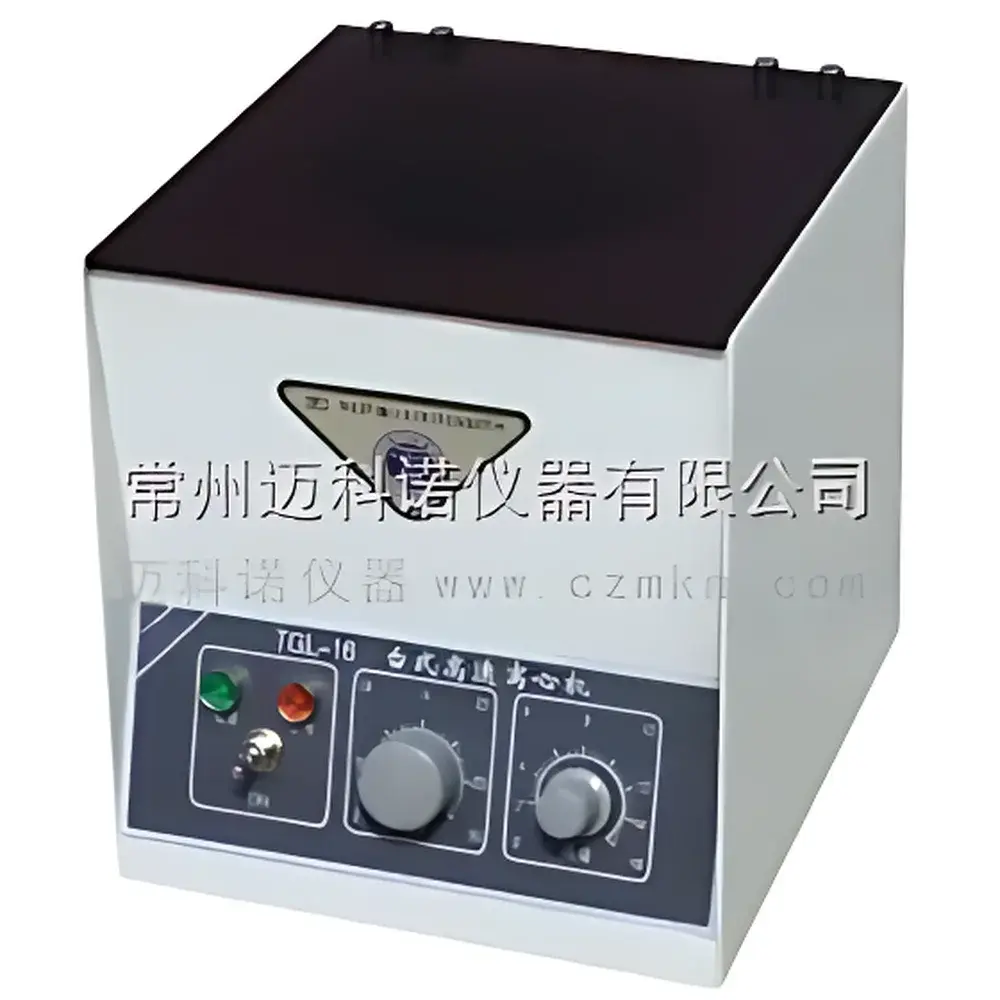
MKN TGL-16 Benchtop High-Speed Centrifuge
| Brand | MKN |
|---|---|
| Model | TGL-16 |
| Max Speed | 16,000 rpm (infinitely variable) |
| Relative Centrifugal Force (RCF) | 17,000 × g |
| Capacity | 12 × 1.5 mL or 12 × 0.5 mL or 8 × 5 mL tubes |
| Timer Range | 0–30 min |
| Noise Level | ≤60 dB(A) |
| Power Supply | AC 220 V, 50 Hz, 5 A |
| Rotor Material | Anodized Aluminum Alloy |
| Compliance | CE-marked per IEC 61010-1 for laboratory equipment safety |
Overview
The MKN TGL-16 Benchtop High-Speed Centrifuge is an engineered solution for rapid, reliable separation of biological and chemical samples via sedimentation under controlled centrifugal force. Based on the principle of differential sedimentation—where particles separate according to mass, density, shape, and medium viscosity—the TGL-16 delivers reproducible RCF up to 17,000 × g at a maximum rotational speed of 16,000 rpm. Its compact footprint and robust mechanical architecture make it suitable for routine use in clinical diagnostics, molecular biology, immunology, and analytical chemistry laboratories. Designed for continuous operation under standard ambient conditions (10–30 °C), the unit features a thermally optimized brushless motor, precision-machined aluminum rotor assembly, and passive heat dissipation to maintain low operational temperature rise—critical for preserving labile analytes such as antibodies, nucleic acids, and enzyme complexes.
Key Features
- Infinitely variable speed control (0–16,000 rpm) with digital display and real-time rpm/RCF readout
- Automatic rotor imbalance compensation system ensures vibration-free operation across all speed ranges
- Anodized aluminum alloy rotor with precision-balanced cavities—resistant to corrosion and compatible with common disinfectants (e.g., 70% ethanol, 0.5% sodium hypochlorite)
- Microprocessor-controlled timer (0–30 minutes) with audible end-of-run alert and automatic deceleration
- Low-noise design (<60 dB[A] at 1 m distance) achieved through acoustic damping housing and dynamic rotor balancing
- Integrated safety interlock: lid remains locked during operation; automatic brake engagement upon lid opening or power interruption
- Compliance with IEC 61010-1:2010 for electrical safety and mechanical stability in laboratory environments
Sample Compatibility & Compliance
The TGL-16 accommodates standard microcentrifuge tubes (0.5 mL, 1.5 mL) and conical 5 mL tubes without adapters, supporting protocols involving serum/plasma separation, cell pellet recovery, nucleic acid precipitation, and immunoassay sample preparation. Rotors are calibrated to ISO 21501-4 for particle size distribution consistency and validated for repeated sterilization cycles (autoclave-compatible up to 121 °C for 20 min). The instrument meets essential requirements for GLP-compliant workflows: traceable speed calibration, non-volatile timer memory, and mechanical lock integrity verification prior to each run. While not FDA 21 CFR Part 11–certified out-of-the-box, its deterministic control logic and immutable run logs support audit-ready documentation when integrated into validated laboratory information management systems (LIMS).
Software & Data Management
The TGL-16 operates as a standalone instrument with no embedded software or network interface—intentionally designed to minimize firmware dependencies and maximize long-term operational reliability. All parameters (speed, time, acceleration/deceleration profiles) are set manually via front-panel controls and retained in volatile memory only for the current session. For laboratories requiring electronic recordkeeping, optional external data loggers (RS-232 or USB TTL interfaces available via third-party modules) can capture timestamped rpm, duration, and fault codes. This architecture aligns with ISO/IEC 17025:2017 Clause 7.7 on equipment control, enabling straightforward validation of performance verification procedures (e.g., annual speed accuracy checks using NIST-traceable tachometers).
Applications
- Clinical laboratories: Separation of serum from whole blood (e.g., for ELISA, CRP, or lipid panel analysis) within <5 minutes at 12,000 rpm
- Molecular biology: Pellet recovery of plasmid DNA from bacterial lysates, RNA isolation post-phenol-chloroform extraction
- Immunology: Isolation of peripheral blood mononuclear cells (PBMCs) using density gradient media (e.g., Ficoll-Paque™)
- Quality control labs: Clarification of reagent solutions, particulate removal from buffer stocks prior to filtration
- Educational settings: Demonstrating sedimentation kinetics, Stoke’s law validation, and centrifugal force–velocity relationships
FAQ
What is the maximum relative centrifugal force (RCF) achievable with the TGL-16?
The TGL-16 achieves a maximum RCF of 17,000 × g when operating at its rated speed of 16,000 rpm with the standard 12-position rotor.
Is rotor calibration required before first use?
Yes—users must verify rotor balance using empty tubes prior to initial operation; full-load calibration is recommended quarterly or after any impact event.
Can this centrifuge be used for viral pellet concentration?
It is suitable for concentrating enveloped viruses (e.g., influenza, SARS-CoV-2 pseudovirions) at ≥100,000 × g equivalents using appropriate swing-out rotors—not included with the base TGL-16 configuration.
Does the unit include a refrigeration system?
No—the TGL-16 is a non-refrigerated model; ambient temperature control is advised for heat-sensitive samples.
What safety certifications does the TGL-16 hold?
It carries CE marking per Directive 2014/30/EU (EMC) and 2014/35/EU (LVD), and conforms to IEC 61010-1:2010 for protection against electric shock, mechanical hazards, and abnormal temperature rise.



