
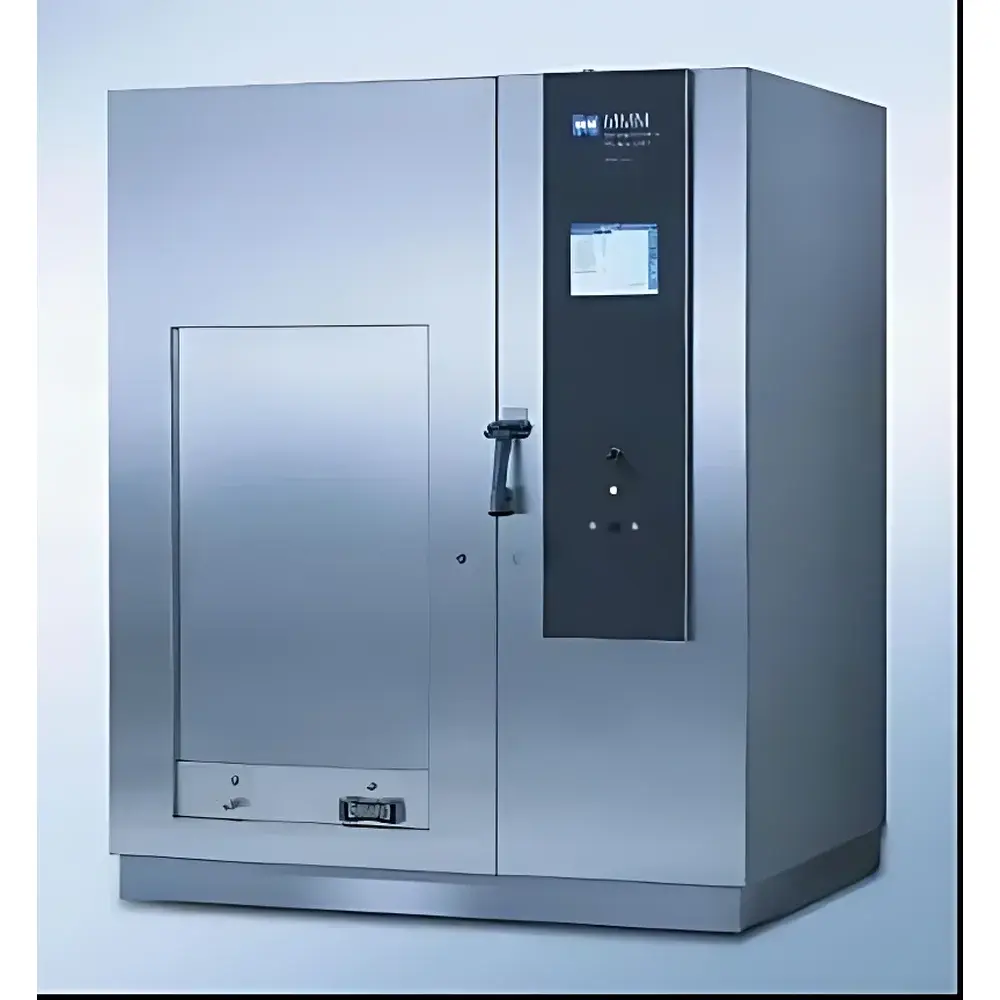
MMM Vaculab PL Pulsed Vacuum High-Pressure Steam Sterilizer
| Brand | MMM |
|---|---|
| Origin | Germany |
| Manufacturer Type | Authorized Distributor |
| Product Category | Imported |
| Model | Vaculab PL |
| Instrument Type | Vertical |
| Max. Sterilization Temperature | 134 °C |
| Chamber Dimensions | 710 × 650 × 690 mm (318 L) |
| External Dimensions | 1818 × 1600 × 970 mm |
| Chamber Volume Options | 318 L, 456 L, 644 L, 1020 L, 1300 L, 1600 L, 3520 L, 4160 L |
| Chamber Material | Electropolished 316L Stainless Steel (Ra ≤ 0.4 µm) |
| Jacket Material | 316Ti Stainless Steel |
| Steam Source Options | External Steam Supply or Integrated Electric Steam Generator |
| Door Configuration | Single or Double Motorized 316L Stainless Steel Door |
| Vacuum System | Siemens Two-Stage Vacuum Pump |
| Control System | Programmable Logic Controller (PLC) — configurable with Siemens or Allen-Bradley platform |
| Data Recording | Built-in Thermal Printer (batch ID, cycle parameters, real-time temperature/pressure curves), Audit Trail Storage, USB Export Interface |
| Validation Ports | Dedicated Temperature & Pressure Probe Ports per EN 285 and ISO 17665-1 |
| Sensors | JUMO-certified PT100 Class A temperature sensors and high-stability pressure transducers |
| Filtration | PALL 0.2 µm Hydrophobic Sterile Vent Filter |
| Cooling System | Optional Integrated High-Efficiency Fan Module (reduces liquid load cooldown from 121 °C to 80 °C in ≤40 min) |
Overview
The MMM Vaculab PL is a vertically configured, pulsed vacuum high-pressure steam sterilizer engineered for rigorous compliance with international pharmaceutical and biomedical sterilization standards. It operates on the validated principle of fractional air removal via repeated vacuum/steam pulses—ensuring complete air evacuation from porous loads, wrapped instruments, and fluid-filled containers prior to saturated steam exposure. This methodology meets the thermodynamic requirements of EN 285:2015 (large steam sterilizers), ISO 17665-1:2017 (sterilization by moist heat), and supports alignment with FDA 21 CFR Part 11, EU Annex 1, and WHO TRS 986 Annex 2 for sterile product manufacturing environments. The system’s chamber is constructed from electropolished 316L stainless steel (surface roughness Ra ≤ 0.4 µm), minimizing biofilm retention and enabling reproducible cleaning validation. Its jacketed design—using corrosion-resistant 316Ti stainless steel—provides uniform thermal distribution and mechanical stability during repeated pressurization cycles up to 2.2 bar(g).
Key Features
- Pulsed vacuum technology with ≥3 programmable vacuum/steam cycles ensures >99.999% air removal efficiency across heterogeneous loads—including multi-layered packaging, hollow devices, and liquid media in sealed vessels.
- Integrated Siemens two-stage vacuum pump delivers rapid, low-noise evacuation (<2.5 mbar absolute residual pressure) while reducing water consumption by up to 40% compared to single-stage systems.
- Configurable PLC control architecture (Siemens S7-1200 or Allen-Bradley CompactLogix) supports fully customizable cycle logic, alarm management, and user-level access control (up to 4 privilege tiers).
- Motorized 316L stainless steel door with pneumatic sealing and position feedback enables safe, repeatable closure verification and interlocked operation per EN 61000-6-2 EMC and EN 61000-6-4 emission standards.
- Optional high-capacity cooling fan module accelerates post-sterilization cooldown of liquid loads without compromising container integrity—validated for PET, PP, and glass vials under ICH Q5C stability conditions.
- Built-in thermal printer logs full cycle data (time, temperature, pressure, vacuum depth, phase transitions) with batch-specific identifiers and digital signature support for 21 CFR Part 11 compliance.
- Dedicated validation ports accommodate third-party calibrated probes (e.g., Fluke, Ellab) for IQ/OQ/PQ execution per ASTM E2200 and ISO 13408-2 protocols.
Sample Compatibility & Compliance
The Vaculab PL accommodates diverse sterilization substrates without compromise: liquid culture media (up to 10 L per vessel), nested instrument trays, Tyvek-wrapped surgical kits, ventilator circuits, animal cage bedding, feed pellets, and pre-assembled filtration assemblies (e.g., 0.22 µm PES membrane cassettes). All wetted surfaces contact only 316L stainless steel or FDA-compliant elastomers (EPDM, silicone). The integrated PALL 0.2 µm hydrophobic vent filter prevents microbial ingress during vacuum and drying phases. Regulatory documentation includes CE marking per Directive 2014/68/EU (PED), MDR 2017/745 conformity assessment, and GMP-compliant Factory Acceptance Test (FAT) reports aligned with EU GMP Annex 15 and PIC/S PI 006-3.
Software & Data Management
Cycle programming and monitoring occur via a 10.1″ capacitive touchscreen HMI with multilingual support (including English, German, Chinese, Spanish). All operational events—including door actuation, phase transitions, sensor deviations, and maintenance alerts—are timestamped and stored in non-volatile memory for ≥10,000 cycles. Data export is supported via USB 2.0 interface to external storage or networked LIMS systems using CSV or XML schema compliant with ASTM E2500-13. Audit trail functionality records user ID, action timestamp, parameter change history, and electronic signature metadata—fully traceable for FDA inspection readiness and internal GLP/GMP audits.
Applications
- Terminal sterilization of aqueous pharmaceutical preparations (buffers, saline, APIs) in stainless steel or glass containers.
- Depyrogenation and bioburden reduction of primary packaging components (rubber stoppers, aluminum seals, syringe barrels).
- Pre-sterilization conditioning of cell culture consumables (pipette tips, flasks, bioreactor bags) prior to aseptic processing.
- Decontamination of biohazardous waste streams (Biosafety Level 2/3 laboratory effluents, infected animal bedding) per WHO Biorisk Management guidelines.
- Validation support for autoclave mapping studies (temperature uniformity, Bowie-Dick testing, Helix test) in quality control laboratories.
FAQ
What vacuum level does the Vaculab PL achieve during pulsed evacuation cycles?
The system achieves a minimum absolute pressure of 2.5 mbar during each vacuum pulse, verified by redundant JUMO pressure transducers calibrated annually per ISO/IEC 17025.
Can the Vaculab PL be integrated into a central steam utility system?
Yes—dual configuration options are available: direct connection to plant-supplied saturated steam (3–5 bar(g), dryness fraction ≥0.95) or self-contained electric steam generation (3.5 kW/h per 100 L chamber volume).
Is the built-in printer compliant with 21 CFR Part 11 requirements for electronic records?
The thermal printer generates human-readable hard copies with embedded digital signatures and cycle hash codes; electronic records stored internally include full audit trails, user authentication logs, and cryptographic checksums for integrity verification.
How is temperature uniformity validated across the chamber volume?
Chamber mapping follows ISO 17665-1 Annex C procedures using ≥15 calibrated PT100 sensors distributed across three axial planes, with maximum deviation ≤±0.5 °C at 121 °C and ≤±1.0 °C at 134 °C during hold phases.
What maintenance intervals are recommended for the vacuum pump and steam valves?
Siemens vacuum pump oil replacement every 3,000 operating hours; pneumatic valve actuators inspected quarterly; JUMO sensors recalibrated annually or after 500 cycles—maintenance logs are auto-generated and exportable.
Related Products



