
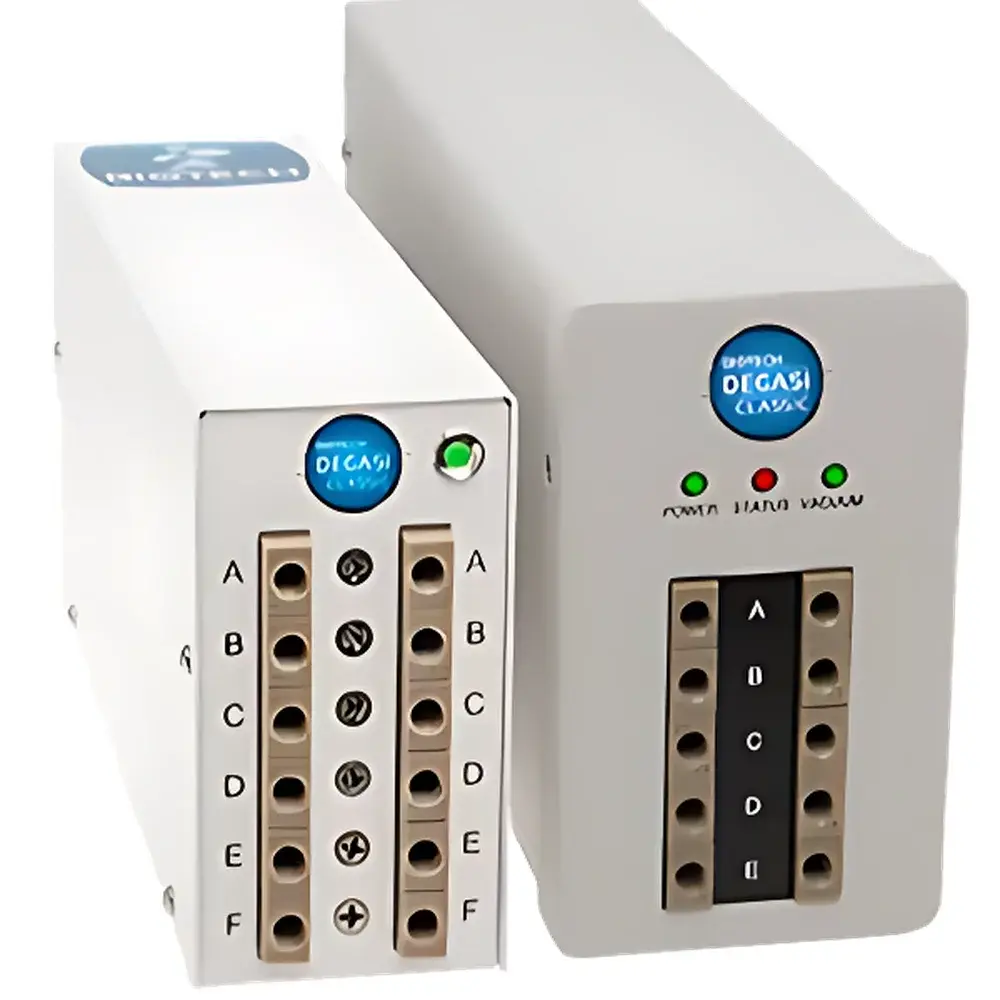
MNK BIOTECH Series Vacuum Degasser
| Brand | MNK |
|---|---|
| Origin | Sweden |
| Model | BIOTECH Series Vacuum Degasser |
| Internal Volume | 480 µL per Channel |
| Max. Channel Pressure | 70 PSI |
| Wetted Materials | Systec AF™ Membrane, PEEK, Glass-Filled PTFE |
| Dimensions (L×H×W) | 245 × 111 × 59 mm |
| Power Supply | 110–240 V, 50/60 Hz |
| Operating Mode | Continuous 7×24 |
| Design Life | ≥5 Years Fault-Free Operation |
| Vacuum Control | Closed-Loop with ZHCR® Stepper Motor Drive |
| Leak & Error Pre-Diagnosis | Yes |
| Channel Options | 1–6 Channels |
| Chemical & Biological Compatibility | Fully Validated for HPLC Mobile Phases and Biopharmaceutical Buffers |
Overview
The MNK BIOTECH Series Vacuum Degasser is an engineered solution for continuous, membrane-based solvent degassing in high-performance liquid chromatography (HPLC), ultra-high-performance liquid chromatography (UHPLC), and related analytical workflows. It operates on the principle of vacuum-driven gas permeation through a hydrophobic, chemically inert Systec AF™ microporous membrane—enabling selective removal of dissolved oxygen, nitrogen, and other volatile gases from aqueous and organic mobile phases without solvent loss, phase separation, or flow interruption. Unlike batch-style or ultrasonic degassers, this system integrates seamlessly into pressurized LC flow paths and maintains stable baseline performance even during gradient elution or rapid pump speed modulation—critical for low-detection-limit UV, fluorescence, and mass spectrometric detection.
Key Features
- Patented ZHCR® (Zero-Hysteresis Constant Rotation) stepper motor technology ensures vacuum stability across dynamic flow conditions—eliminating baseline drift associated with conventional vacuum pump cycling.
- Closed-loop vacuum regulation actively compensates for temperature fluctuations, solvent composition changes, and pressure transients—delivering consistent degassing efficiency across multi-solvent gradients.
- Ultra-low internal volume (480 µL per channel) minimizes hold-up time and dead volume, reducing carryover risk and enabling rapid solvent switching in method development and QC environments.
- Systec AF™ membrane modules are pre-validated for compatibility with common HPLC solvents—including acetonitrile, methanol, water, TFA, ammonium acetate, and phosphate buffers—and demonstrate no extractables or leachables under ICH Q5A/Q5B guidelines.
- No purge valves or manual maintenance required; pump head cleaning is achieved passively via continuous solvent flow—supporting uninterrupted 7×24 operation with ≥5-year MTBF (Mean Time Between Failures).
- Integrated diagnostic firmware continuously monitors membrane integrity, vacuum response time, and pressure differentials—issuing preemptive alerts for potential leaks, clogging, or membrane saturation before system-level anomalies occur.
Sample Compatibility & Compliance
The BIOTECH Series is compatible with all major HPLC/UHPLC platforms—including Agilent, Waters, Shimadzu, Thermo Fisher, and PerkinElmer—without requiring hardware modification or firmware updates. All wetted surfaces conform to USP Class VI biocompatibility standards and comply with ISO 10993-5 cytotoxicity testing. The device meets CE marking requirements under the EU Medical Device Regulation (MDR) Annex I essential requirements for ancillary equipment used in GxP environments. When deployed in regulated laboratories, its embedded diagnostics and non-volatile event logging support audit readiness for FDA 21 CFR Part 11, EU Annex 11, and GLP/GMP data integrity frameworks.
Software & Data Management
While the degasser operates autonomously without host software, optional RS-232 or USB-C interface enables integration with laboratory information management systems (LIMS) and chromatography data systems (CDS) such as Empower, Chromeleon, and OpenLab. Logged events—including vacuum setpoint deviations (>±2 mbar), membrane saturation warnings, and power cycle history—are timestamped and exportable in CSV format. Firmware updates are performed via signed binary packages validated against SHA-256 checksums, ensuring traceability and integrity per IEC 62443-3-3 cybersecurity requirements for lab instrumentation.
Applications
- Routine QC analysis of pharmaceutical actives and excipients where baseline noise from outgassing compromises LOD/LOQ in UV detection at 210 nm.
- Method transfer between labs using different LC instrument generations—ensuring identical degassing performance regardless of pump design or dwell volume.
- Biopharmaceutical characterization workflows involving low-concentration monoclonal antibody aggregates detected by SEC-MALS, where dissolved oxygen-induced oxidation must be suppressed prior to injection.
- Environmental analysis of polar pesticides in LC-MS/MS, where residual nitrogen bubbles cause ion suppression and retention time shifts.
- Academic research requiring long-duration gradient runs (e.g., proteomics fractionation), where uninterrupted degassing prevents column overpressure and detector saturation.
FAQ
Is the BIOTECH Series compatible with aggressive solvents such as THF or DMSO?
Yes—Systec AF™ membranes and PEEK/glass-filled PTFE fluidic paths are rated for continuous exposure to THF, DMSO, DMF, and chlorinated solvents per ASTM D543-20 chemical resistance standards.
Can it be installed post-pump in an existing HPLC system?
Yes—the unit supports both pre- and post-pump configurations; however, installation upstream of the proportioning valve is recommended for optimal gradient stability.
Does it require periodic membrane replacement?
No—Systec AF™ membranes are designed for the full 5-year operational lifespan under typical lab usage; replacement is only necessary if diagnostic logs indicate irreversible hydrophobicity loss or physical damage.
How does it handle mixed aqueous/organic mobile phases?
Closed-loop vacuum control dynamically adjusts pump torque to maintain constant permeation flux across viscosity and surface tension gradients—validated per ISO 11542-2 for multi-component solvent systems.
Is remote monitoring supported?
Yes—via optional Ethernet module (MNK-ETH-01), enabling SNMPv3-based status polling and SNMP trap alerts integrated into enterprise IT infrastructure.



