
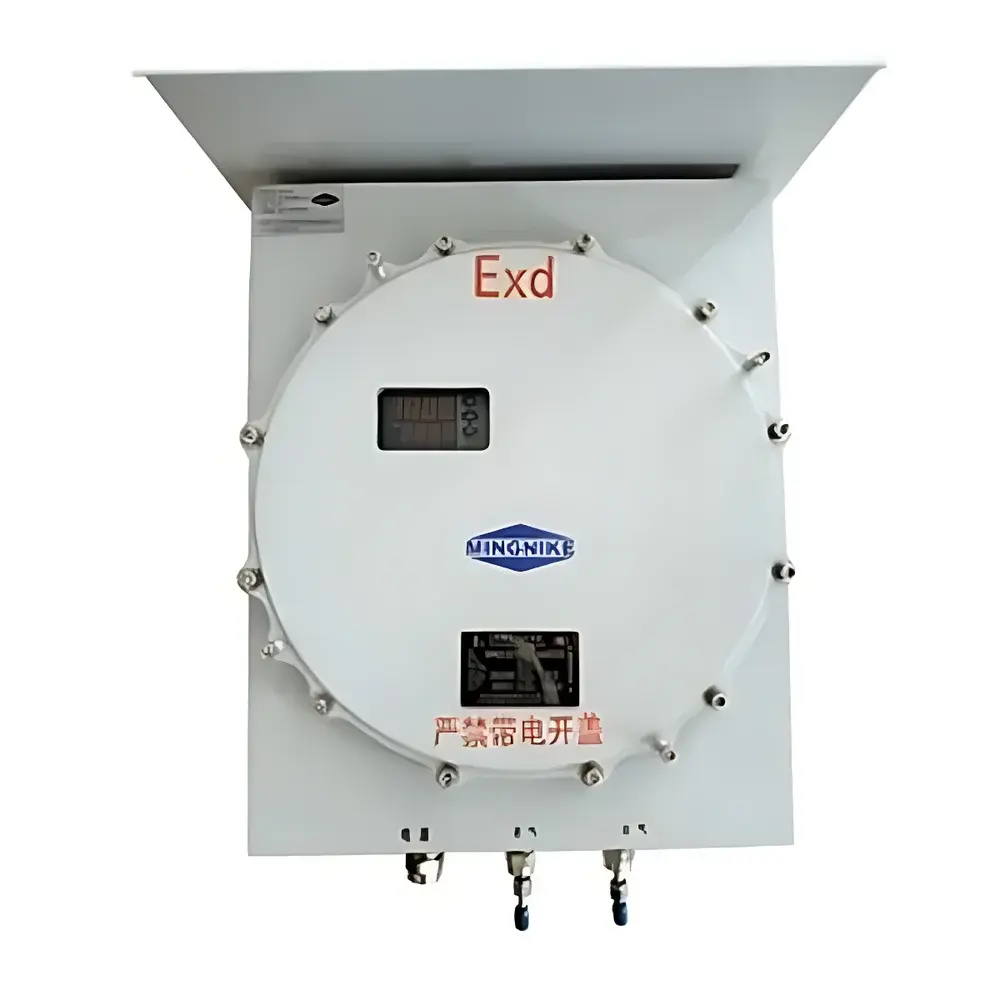
MNK M-EAO Intrinsically Safe Online Dew Point Analyzer
| Brand | MNK |
|---|---|
| Origin | Beijing, China |
| Model | M-EAO |
| Product Type | Online Dew Point Analyzer |
| Operating Temperature Range | −110 °C to +20 °C (dew point) |
| Accuracy | ±1 °C dew point |
| Repeatability | ±0.5 °C |
| Response Time | 5 min to T90 (dry-to-wet transition) |
| Output Signal | 4–20 mA |
| Power Supply | 24 VDC |
| Sensor | Imported high-stability chilled-mirror or aluminum oxide sensor (application-optimized) |
| Enclosure Rating | Ex db IIC T6 Gb |
Overview
The MNK M-EAO Intrinsically Safe Online Dew Point Analyzer is engineered for continuous, real-time measurement of moisture content in industrial process gases—delivering trace-level dew point detection from −110 °C to +20 °C. Based on a robust chilled-mirror or metal-oxide sensing principle (configurable per application requirements), the instrument provides thermodynamically grounded dew point determination with direct physical calibration traceability. Unlike relative humidity-based proxies, this analyzer reports absolute dew point temperature—a primary thermodynamic parameter directly linked to water vapor partial pressure and condensation risk. Its design meets stringent safety demands in hazardous areas classified under IEC 60079-0 and IEC 60079-1, making it suitable for deployment in Zone 1 and Zone 2 gas environments where flammable vapors (e.g., hydrogen, natural gas, nitrogen, argon, compressed air, SF₆) may be present.
Key Features
- Intrinsically safe construction certified to Ex db IIC T6 Gb per IEC 60079-1, enabling safe operation in explosive atmospheres containing Group IIC gases (e.g., hydrogen, acetylene) with maximum surface temperature limited to 85 °C.
- Wide operational dew point range: −110 °C to +20 °C—enabling monitoring across ultra-dry processes (e.g., semiconductor purge lines, cryogenic nitrogen systems) and moderately humid applications (e.g., compressed air distribution).
- High metrological stability: ±1 °C dew point accuracy (at reference conditions per ISO 8503-1 calibration protocol) and ±0.5 °C repeatability over 12-month intervals without recalibration under controlled flow and pressure conditions.
- Standard 4–20 mA analog output with HART® capability (optional), supporting integration into DCS, PLC, and SCADA systems with linear scaling across the full measurement span.
- 24 VDC loop-powered architecture—eliminating need for auxiliary power distribution in field installations and simplifying compliance with SELV (Safety Extra-Low Voltage) requirements.
- Robust stainless-steel process connection (typically 1/4″ NPT or VCR) and temperature-compensated sampling path to minimize thermal lag and adsorption artifacts during low-flow or high-purity gas analysis.
Sample Compatibility & Compliance
The M-EAO analyzer is validated for use with non-corrosive, non-condensing process streams including nitrogen, argon, helium, hydrogen, oxygen, synthetic air, and purified natural gas. It is not recommended for direct installation in streams containing heavy hydrocarbons, siloxanes, or particulate loads exceeding 1 µm without upstream filtration and coalescing. The device complies with electromagnetic compatibility standards IEC 61326-1 (industrial environment) and functional safety guidelines aligned with IEC 61508 SIL 2 for basic safety integrity. Documentation supports audit readiness for ISO 9001, ISO 14001, and pharmaceutical manufacturing environments operating under EU GMP Annex 1 and USP water activity control frameworks.
Software & Data Management
While the M-EAO operates as a stand-alone transmitter, its 4–20 mA output enables seamless logging via third-party historian platforms (e.g., Siemens Desigo CC, Honeywell Experion PKS, Emerson DeltaV). Optional HART-enabled variants support configuration, diagnostics, and firmware updates using standard handheld communicators (e.g., AMS Device Manager). All configuration parameters—including damping time, zero/span offset, and unit selection (°C dp / ppmv / g/m³)—are stored in non-volatile memory with write-protection logic to prevent unauthorized modification. Audit trails for calibration events and configuration changes can be maintained externally per FDA 21 CFR Part 11 requirements when integrated with compliant data acquisition software.
Applications
- Semiconductor fabrication: Monitoring purge gas dew point in lithography tool cabinets and wafer handling environments to prevent microcondensation on optics and masks.
- Hydrogen refueling stations: Ensuring fuel-grade hydrogen meets SAE J2719 moisture limits (<8.3 ppmv at −40 °C dp) prior to compression and dispensing.
- Pharmaceutical inerting: Verifying nitrogen blanketing gas dryness during lyophilization and powder transfer to inhibit hydrolysis and microbial growth.
- Additive manufacturing: Controlling argon or nitrogen atmosphere moisture in metal powder bed fusion chambers to avoid oxide inclusion and porosity.
- Membrane and adsorption dryer validation: Providing continuous feedback for regeneration cycle optimization and performance trending against ISO 8573-1 Class 1–4 purity specifications.
FAQ
What certification standards does the M-EAO meet for hazardous area installation?
It carries Ex db IIC T6 Gb marking per IEC 60079-1, indicating flameproof enclosure protection for Group IIC gases with maximum surface temperature of 85 °C.
Can the analyzer measure dew point in hydrogen gas without catalytic interference?
Yes—the sensor architecture is chemically inert to H₂; no catalytic oxidation or signal drift occurs under typical hydrogen service conditions.
Is field calibration possible without removing the unit from the process line?
Zero calibration using dry nitrogen (−70 °C dp or drier) is supported in-situ; span verification requires traceable chilled-mirror reference standard per ISO/IEC 17025 accredited procedure.
What is the recommended sample flow rate and pressure range?
Optimal performance is achieved at 0.5–2 L/min at line pressure (up to 1.6 MPa); pressure regulation and particulate filtration are required upstream if exceeding 5 µm particle load.
Does the device support digital communication protocols beyond 4–20 mA?
HART 7 is available as an optional firmware upgrade; Modbus RTU and Foundation Fieldbus are not natively supported but may be implemented via external protocol converters.
Related Products




