
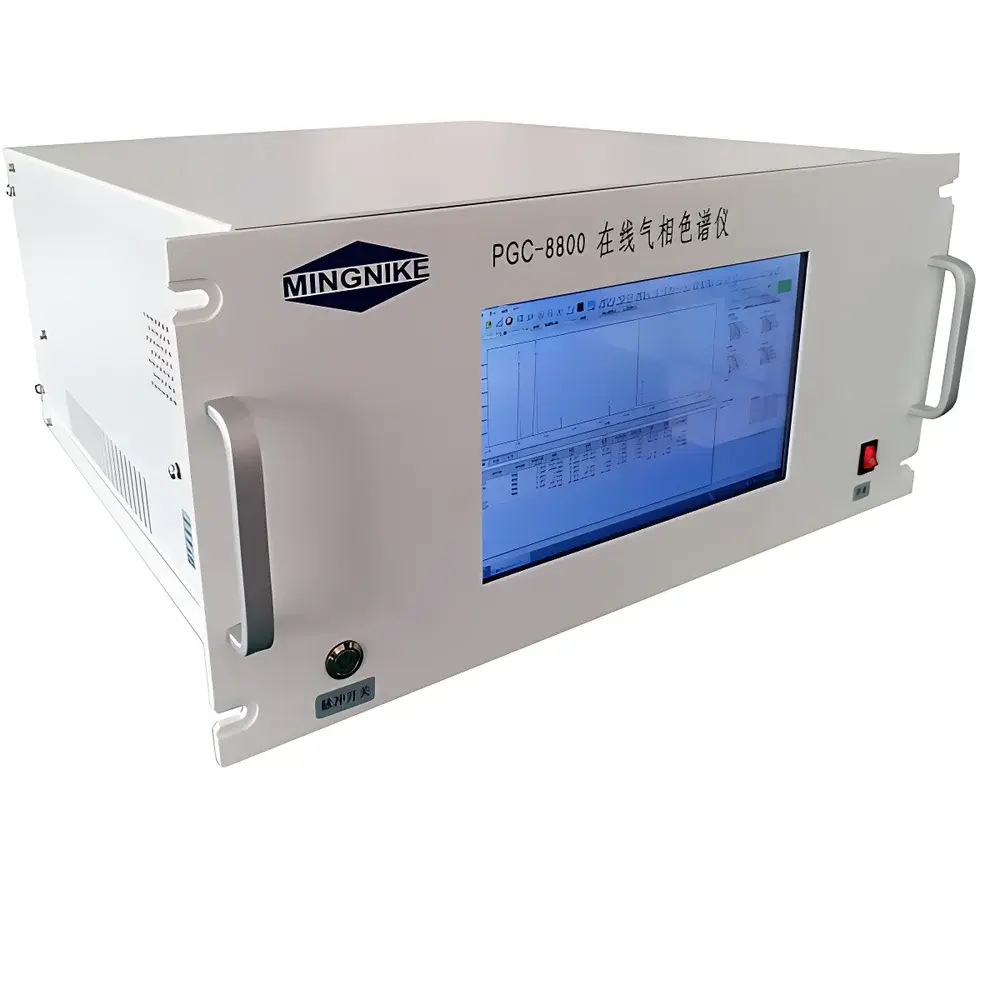
MNK PGC-8800 Online Gas Chromatograph with Pulsed Discharge Helium Ionization Detector
| Brand | MNK |
|---|---|
| Model | PGC-8800 |
| Type | Online Gas Chromatograph |
| Primary Application | High-Purity Gas Analysis |
| Detection Principle | Pulsed Discharge Helium Ionization Detection (PDHID) |
| Detection Limits (PDHID) | H₂ (5 ppb), He (5 ppb), O₂ (10 ppb), N₂ (10 ppb), Ar (10 ppb), Ne (500 ppb), CO (25 ppb), CO₂ (5 ppb), CH₄ (5 ppb), CF₄ (10 ppb), C₂F₆ (20 ppb), SO₂F₂ (20 ppb), C₃F₈ (20 ppb) |
| Complementary Detectors | TCD, FID |
| Sample Phase | Gaseous |
| Operating Mode | Continuous Unattended Online Monitoring |
| Origin | Beijing, China |
Overview
The MNK PGC-8800 is an industrial-grade online gas chromatograph engineered for continuous, real-time trace impurity analysis in high-purity gases. It employs pulsed discharge helium ionization detection (PDHID) as its primary analytical method—a non-destructive, universal detection technique particularly suited for permanent gases and low-molecular-weight compounds that exhibit poor response on conventional detectors such as FID or TCD. PDHID operates by generating a stable, low-power helium plasma pulse, which produces metastable He* species capable of ionizing nearly all gaseous analytes except helium itself—enabling sub-ppb detection sensitivity across a broad spectrum of inorganic and organic volatiles. The system integrates thermally controlled capillary columns, precision mass flow controllers, and automated valving to support unattended 24/7 operation in process environments including semiconductor fab gas delivery systems, electronic specialty gas production lines, and high-purity hydrogen refueling infrastructure.
Key Features
- Triple-detector architecture: PDHID (primary), thermal conductivity detector (TCD), and flame ionization detector (FID) for cross-validated, multi-analyte quantification
- Pre-configured, application-optimized column sets for permanent gas separation (e.g., molecular sieve 5A + Plot Q), VOC profiling, and SF₆ decomposition product resolution
- Integrated sample conditioning: heated stainless-steel sampling lines, particulate filtration, moisture removal via Nafion™ or chilled trap, and pressure regulation to ≤100 kPa absolute
- Auto-calibration capability using certified multi-component gas standards (certified to ISO 6141 and ISO 6142) with programmable calibration intervals (1–72 hours)
- Ruggedized enclosure rated IP54 for deployment in industrial control rooms or near process skids; operating ambient temperature range: 5–40 °C
- Embedded real-time OS with deterministic acquisition timing; data logging at ≤1 second intervals with timestamped metadata (pressure, temperature, valve status)
Sample Compatibility & Compliance
The PGC-8800 is validated for direct injection and quantitative analysis of gaseous samples including hydrogen, helium, nitrogen, oxygen, argon, neon, krypton, xenon, sulfur hexafluoride (SF₆), and synthetic air matrices. It meets the analytical requirements of ASTM D7607 (Standard Test Method for Trace Impurities in High-Purity Hydrogen by GC), IEC 60376 (Specifications for New SF₆), and SEMI F57 (Specification for Electronic Grade Gases). All firmware and data handling routines are designed to support audit-ready compliance with GLP and GMP environments—including full electronic record retention, user access control (role-based authentication), and FDA 21 CFR Part 11–compliant audit trails when deployed with optional secure network integration.
Software & Data Management
The instrument is operated via MNK ChromaControl™ v4.2 software—a Windows-based platform supporting method development, sequence scheduling, peak integration (with customizable baseline algorithms), and automated report generation (PDF/CSV/XLSX). Raw chromatograms and processed results are stored in a relational SQLite database with SHA-256 hashing for data integrity verification. Remote monitoring is enabled through OPC UA server interface, allowing seamless integration into DCS/SCADA systems (e.g., Siemens Desigo, Honeywell Experion). Data export supports ASTM E1394 and ASTM E1461 compliant formats for laboratory information management system (LIMS) ingestion.
Applications
- Trace-level impurity profiling in ultra-high-purity (UHP) hydrogen for PEM fuel cell feedstock qualification
- Monitoring decomposition byproducts (SO₂F₂, SOF₂, CF₄, C₂F₆) in SF₆-insulated switchgear for predictive maintenance
- Electronic specialty gas certification: detection of CO, CO₂, CH₄, and H₂O in silane, phosphine, arsine, and NF₃ at ≤10 ppb levels
- Residual solvent and additive screening in food-grade nitrogen and carbon dioxide per USP and EU Pharmacopoeia 2.4.24
- Continuous emissions monitoring of VOCs (e.g., benzene, toluene, xylene) in semiconductor cleanroom purge streams
FAQ
What gases can be analyzed with the PDHID configuration?
The PDHID module is optimized for permanent gases (H₂, He, O₂, N₂, Ar, Ne, Kr, Xe), light hydrocarbons (CH₄, C₂H₆), halogenated compounds (CF₄, C₂F₆, SF₆), and reactive species (CO, CO₂, SO₂F₂), with typical detection limits ranging from 5 to 500 ppb depending on compound ionization efficiency.
Is method transfer possible from lab-based GC systems?
Yes—chromatographic methods developed on standard benchtop GC platforms (e.g., Agilent 7890, Thermo ISQ) can be ported to the PGC-8800 with minor retention time adjustments due to differences in column dimensions and carrier gas velocity profiles.
Does the system support remote diagnostics and firmware updates?
The embedded controller includes SSH-enabled secure shell access and TLS 1.2 encrypted web interface for authenticated remote troubleshooting; firmware updates are delivered as signed binary packages with version rollback capability.
How is calibration traceability maintained?
Each calibration event logs the certified reference material lot number, certificate expiration date, and uncertainty budget per ISO/IEC 17025; calibration gas certificates must be issued by ISO 17034-accredited providers.
Can the PGC-8800 operate in hazardous areas?
The base configuration is rated for non-hazardous locations; ATEX/IECEx-certified explosion-proof variants (PGC-8800-EX) are available upon request, featuring intrinsically safe signal conditioning and purged enclosures.





