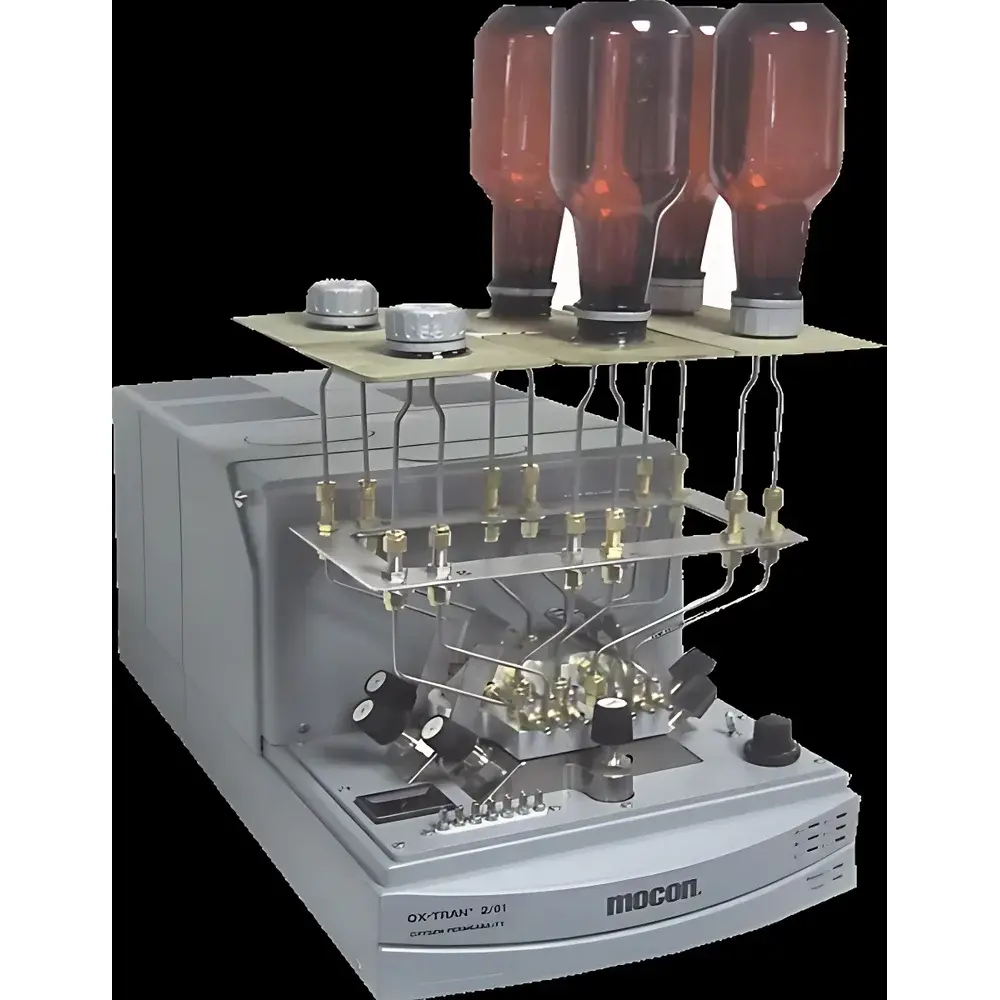
MOCON OX-TRAN® Model 2/61 Oxygen Transmission Rate Analyzer
| Brand | MOCON |
|---|---|
| Origin | USA |
| Model | OX-TRAN® Model 2/61 |
| Test Chambers | 6 × 10 cm² |
| Sample Types | Films & Rigid/ Flexible Packages (up to 3 L) |
| OTR Range (per chamber) | 0.5–1000 cm³/m²·day |
| Combined 6-chamber range | 0.1–200 cm³/m²·day |
| RH Control | 0–90% RH (film), 100% RH on O₂ side only |
| Temperature Range | Ambient to 65°C |
Overview
The MOCON OX-TRAN® Model 2/61 is a high-precision, fully automated oxygen transmission rate (OTR) analyzer engineered for quantitative measurement of oxygen permeation through polymeric films, laminates, coated substrates, and rigid or semi-rigid packaging containers. It operates on the principle of coulometric detection — utilizing MOCON’s proprietary electrochemical oxygen sensor to quantify molecular oxygen flux across a test specimen under controlled temperature and relative humidity conditions. The instrument conforms rigorously to ASTM D3985 (“Standard Test Method for Oxygen Gas Transmission Rate Through Plastic Film and Sheeting Using a Coulometric Sensor”), and supports method validation per ISO 15105-2, ASTM F1307 (for packages), and relevant sections of USP and FDA 21 CFR Part 11 when integrated with compliant software workflows. Each of its six independent test chambers features identical 10 cm² diffusion area, enabling parallel evaluation of heterogeneous materials or replicate testing under identical environmental parameters — a critical capability for QC laboratories performing accelerated shelf-life studies or regulatory submissions.
Key Features
- Six independently controlled test chambers (10 cm² each), allowing concurrent OTR measurement of up to six film specimens or packaged units — significantly improving throughput without compromising inter-chamber reproducibility.
- Integrated RH generation and monitoring system capable of delivering and maintaining 0–90% RH on the test side; 100% RH may be applied exclusively to the oxygen-side reservoir for asymmetric humidity profiling, supporting real-world barrier performance assessment.
- Coulometric oxygen sensor with NIST-traceable calibration verification protocol — users may perform routine performance qualification using certified reference membranes supplied by MOCON, ensuring long-term measurement integrity and audit readiness.
- Automated atmospheric pressure compensation algorithm that adjusts OTR calculations in real time based on local barometric readings, eliminating manual correction and enhancing data comparability across global laboratory sites.
- Modular architecture supports expansion to ten OX-TRAN modules (totaling 60 test stations) via standardized communication interfaces, enabling seamless integration into centralized packaging R&D or high-volume quality control environments.
- Thermal control system maintains stable test temperatures from ambient to +65°C, with optional integration into external environmental chambers for container testing under dynamic climatic profiles.
Sample Compatibility & Compliance
The OX-TRAN® Model 2/61 accommodates both flat film specimens (10.8 cm × 10.8 cm) and three-dimensional packages with volumes up to 3 liters. Film testing follows standard clamp-seal methodology with elastomeric gasketing to ensure leak-tight integrity. For package testing, optional custom fixtures and purge manifolds are available to accommodate vials, pouches, trays, and blister cards. All hardware and operational procedures align with Good Laboratory Practice (GLP) and current Good Manufacturing Practice (cGMP) documentation requirements. When configured with MOCON’s validated software suite and electronic signature functionality, the system satisfies FDA 21 CFR Part 11 criteria for audit trails, user access control, and data integrity — essential for pharmaceutical, medical device, and food safety applications subject to regulatory inspection.
Software & Data Management
The instrument is operated via MOCON’s proprietary OX-TRAN Software Suite, installed on a dedicated Windows-based control PC with color display and thermal printer. The interface supports customizable test protocols including static, dynamic, and step-change RH/temperature profiles. Real-time OTR curves, permeation onset times, and steady-state slope calculations are generated automatically. Raw sensor current, resistance values, and environmental metadata are logged at user-defined intervals and stored in structured .csv and .txt formats. Exported datasets are compatible with LIMS integration via RS-232, USB, or Ethernet (TCP/IP). Audit trail functionality records all operator actions, parameter modifications, and calibration events with timestamps and user IDs — fulfilling traceability mandates under ISO/IEC 17025 and internal quality management systems.
Applications
- Quantitative barrier characterization of flexible packaging structures used in pharmaceutical blister packaging, sterile medical device pouches, and retortable food pouches.
- Accelerated aging studies correlating OTR with product oxidation kinetics in lipid-rich formulations (e.g., nutraceuticals, infant formula, injectables).
- Comparative evaluation of metallized PET, SiOx-coated films, EVOH laminates, and bio-based barrier polymers under standardized climatic conditions.
- Validation of seal integrity and material homogeneity across production lots via multi-point chamber replication.
- Supporting ICH Q5C stability protocol development where oxygen ingress is a known degradation pathway.
FAQ
What standards does the OX-TRAN® Model 2/61 comply with?
ASTM D3985 (films), ASTM F1307 (packages), ISO 15105-2, and ISO 2556 — with full traceability to NIST Standard Reference Materials for sensor calibration.
Can the system test both films and finished packages simultaneously?
No — each chamber must be configured uniformly for either film or package mode; however, different chambers within the same unit may operate in parallel under identical or distinct environmental setpoints.
Is temperature and humidity control fully automated?
Yes — RH is generated and monitored in real time via integrated humidification and dew-point sensors; temperature is regulated via Peltier-based heating/cooling with ±0.2°C stability over the full operating range.
How is data integrity ensured for regulated environments?
Through configurable audit trails, role-based user authentication, electronic signatures, and immutable raw data archiving — all implemented in accordance with FDA 21 CFR Part 11 and EU Annex 11 requirements.
What is the smallest detectable OTR value per chamber?
The lower limit of quantitation (LLOQ) is 0.5 cm³/m²·day at 23°C and 0% RH; sensitivity improves under elevated RH due to enhanced polymer chain mobility and oxygen solubility.