
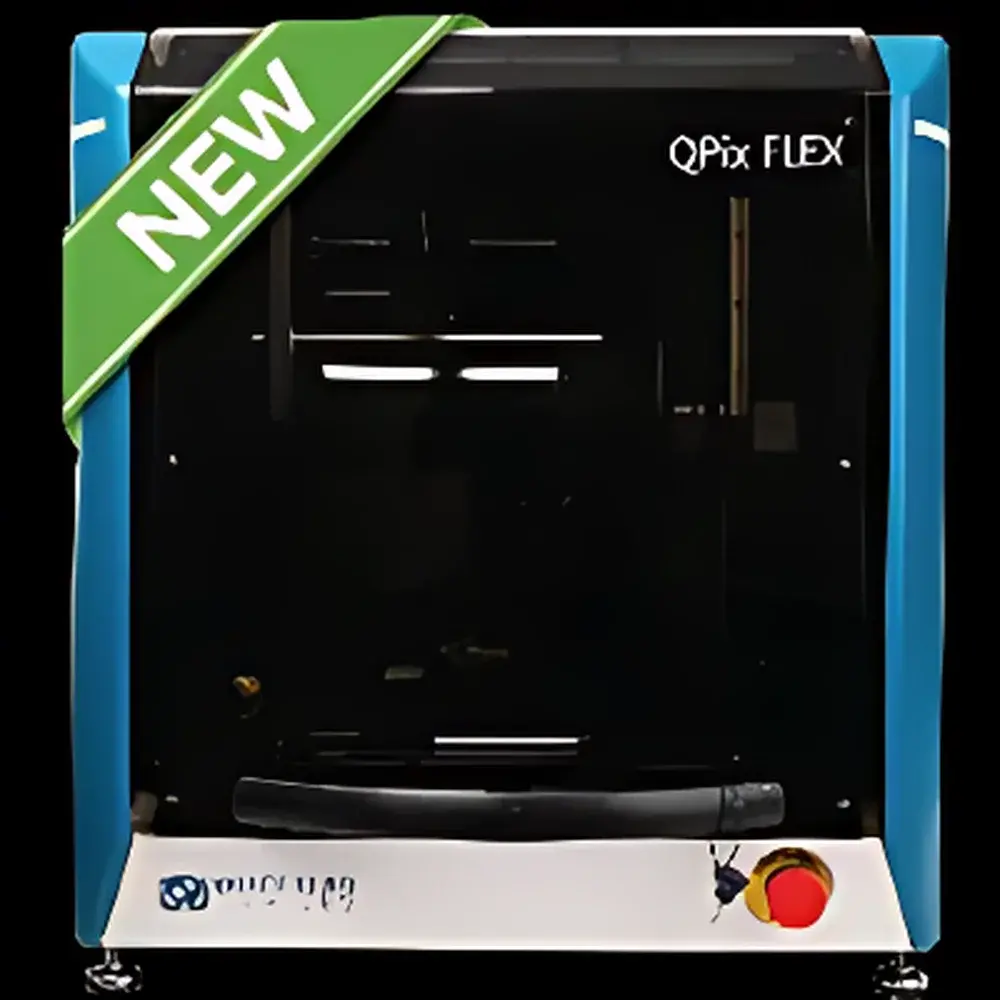
Molecular Devices QPix FLEX Microbial Colony Picking System
| Brand | Molecular Devices |
|---|---|
| Origin | Shanghai, China |
| Model | QPix FLEX |
| Detection Method | Fluorescence Intensity |
| Functionality | Multimodal |
| Automation Level | Fully Automated |
| Assay Type | Automated Microbial Identification & Colony Isolation |
| Detector Type | Fluorescence Imaging Sensor |
| Sample Handling | Integrated Liquid Handling, Streaking, Plating, and Colony Picking |
| Dimensions | Compact Footprint (Designed for Benchtop & Anaerobic Chamber Integration) |
| Traceability | 2D Barcode Scanning for Microplate & Pick Log Registration |
| Compliance Context | Supports GLP/GMP-aligned workflows with full audit trail capability |
Overview
The Molecular Devices QPix FLEX Microbial Colony Picking System is a fully integrated, benchtop-scale automation platform engineered for high-fidelity microbial colony isolation, phenotypic screening, and strain archiving. Unlike conventional microplate readers or standalone colony pickers, the QPix FLEX operates on a dual-principle architecture: high-resolution brightfield and fluorescence imaging coupled with precision robotic colony picking—enabling morphology- and fluorescence-guided selection directly from solid agar media. It is not a microplate reader in the traditional sense; rather, it is a dedicated colony handling instrument that performs automated inoculation, streaking, plating, and pick-and-transfer operations without requiring external liquid handlers or incubators. Its compact form factor (W × D × H: <60 × 65 × 55 cm) permits seamless integration into standard biosafety cabinets, anaerobic chambers (<2% O₂), or hypoxic workspaces—eliminating manual transfer steps that compromise sterility and reproducibility. The system implements a closed-loop workflow: image acquisition → algorithmic colony segmentation → user-defined selection criteria (size, circularity, intensity, color, fluorescence threshold) → coordinated pick-and-spot execution using sterilizable or disposable pins.
Key Features
- High-fidelity colony imaging: 5-megapixel color camera with adjustable white-light and fluorescence excitation (470/525 nm standard; optional filter sets available) for simultaneous morphological and fluorescent phenotype assessment.
- Adaptive pin-handling system: Switch between autoclavable stainless-steel pins and single-use polymer pins via software command—no mechanical recalibration or tool change required.
- Integrated 4-channel positive-displacement pipettor: Enables precise dispensing of culture media, glycerol stocks, antibiotics, or reagents (volume range: 1–200 µL) during plate preparation and post-pick archival steps.
- Benchtop-compatible design: Operates under ambient, low-oxygen, or anaerobic conditions without external gas supply or chamber modification—validated for use inside Coy, Baker, or Don Whitley anaerobic workstations.
- Real-time image-based QC: On-the-fly colony viability estimation via edge sharpness, optical density gradient, and fluorescence signal-to-noise ratio—flagging overgrown, confluent, or non-fluorescent colonies pre-pick.
- Modular workflow scripting: Drag-and-drop protocol builder supports conditional logic (e.g., “if fluorescence > X, then pick; else discard”), multi-step plate mapping, and dynamic plate rotation alignment.
Sample Compatibility & Compliance
The QPix FLEX accommodates standard SBS-format Petri dishes (90 mm, 100 mm), rectangular plates (120 × 80 mm), and deep-well microplates (96- and 384-well) with agar thicknesses up to 8 mm. It supports both nutrient-rich (LB, TSA) and selective media (X-Gal/IPTG, chromogenic substrates, antibiotic-containing formulations). All hardware surfaces contacting samples are ISO 13485-compliant polished stainless steel or medical-grade polymers. Data integrity adheres to ALCOA+ principles: each pick event is timestamped, geotagged (plate coordinate + pin ID), and linked to raw image metadata. Audit trails meet FDA 21 CFR Part 11 requirements for electronic records and signatures when deployed with validated network storage and user access controls. System validation documentation (IQ/OQ/PQ templates) and risk assessments (per ISO 14971) are provided for GxP-regulated environments.
Software & Data Management
QPix Control Software v4.x (Windows 10/11 64-bit) provides a unified interface for imaging, analysis, and robotic control. Image processing leverages machine learning–enhanced segmentation (U-Net trained on >50,000 annotated colony images) to distinguish individual colonies in dense lawns or heterogeneous morphologies. Export formats include TIFF (raw), CSV (pick coordinates, intensity metrics), JSON (structured workflow logs), and PDF (compliance-ready reports). Integration with LIMS (e.g., LabVantage, STARLIMS) and ELN systems (Benchling, LabArchives) is supported via RESTful API and HL7-compliant messaging. All data—including calibration logs, maintenance history, and user session records—is stored in an encrypted local SQLite database with optional synchronization to secure cloud repositories (AWS S3 or on-premise NAS with AES-256 encryption).
Applications
- Synthetic biology: High-throughput screening of CRISPR-edited strains, promoter libraries, or metabolic pathway variants based on fluorescent reporter output (e.g., GFP, mCherry, BFP) and colony morphology.
- Microbiome research: Isolation of anaerobic isolates from fecal, soil, or marine samples—directly within anaerobic chambers—to preserve oxygen-sensitive phenotypes.
- Antibiotic resistance profiling: Automated pick-and-replicate workflows for MIC determination across 96-well gradient plates, minimizing cross-contamination and operator bias.
- Food & environmental safety: Rapid identification and archiving of pathogenic colonies (e.g., Salmonella, Listeria) from chromogenic agar, with full traceability from isolation to sequencing submission.
- Strain banking: Generation of glycerol stocks with positional fidelity and digital annotation—enabling direct retrieval of legacy isolates by phenotype tags rather than physical plate location.
FAQ
Can the QPix FLEX operate inside an anaerobic chamber without performance degradation?
Yes—the system’s electronics are thermally managed for stable operation at 2–8% O₂; all moving components are sealed against moisture ingress, and no outgassing materials are used in its construction.
Does it support custom fluorescence filter sets beyond the standard 470/525 nm configuration?
Yes—optional filter cubes (405/450 nm, 561/600 nm, 640/680 nm) are available as field-upgrade kits, compatible with the same optical path and software calibration framework.
How is colony picking accuracy validated and maintained over time?
Accuracy is verified daily via NIST-traceable polystyrene bead arrays; system self-calibration routines correct for thermal drift and pin wear using onboard fiducial markers and closed-loop stepper motor feedback.
Is method transfer possible between QPix FLEX and legacy QPix 400/420 systems?
Protocol scripts and image analysis parameters are backward-compatible with QPix 400-series instruments, enabling seamless migration of established workflows without re-validation.
What level of IT infrastructure is required for compliance in regulated laboratories?
For 21 CFR Part 11 compliance, the system requires domain-joined Windows hosts, role-based access control (RBAC), electronic signature capture, and periodic backup of the embedded database to a validated archive server—with annual review of audit logs mandated by internal SOPs.





