
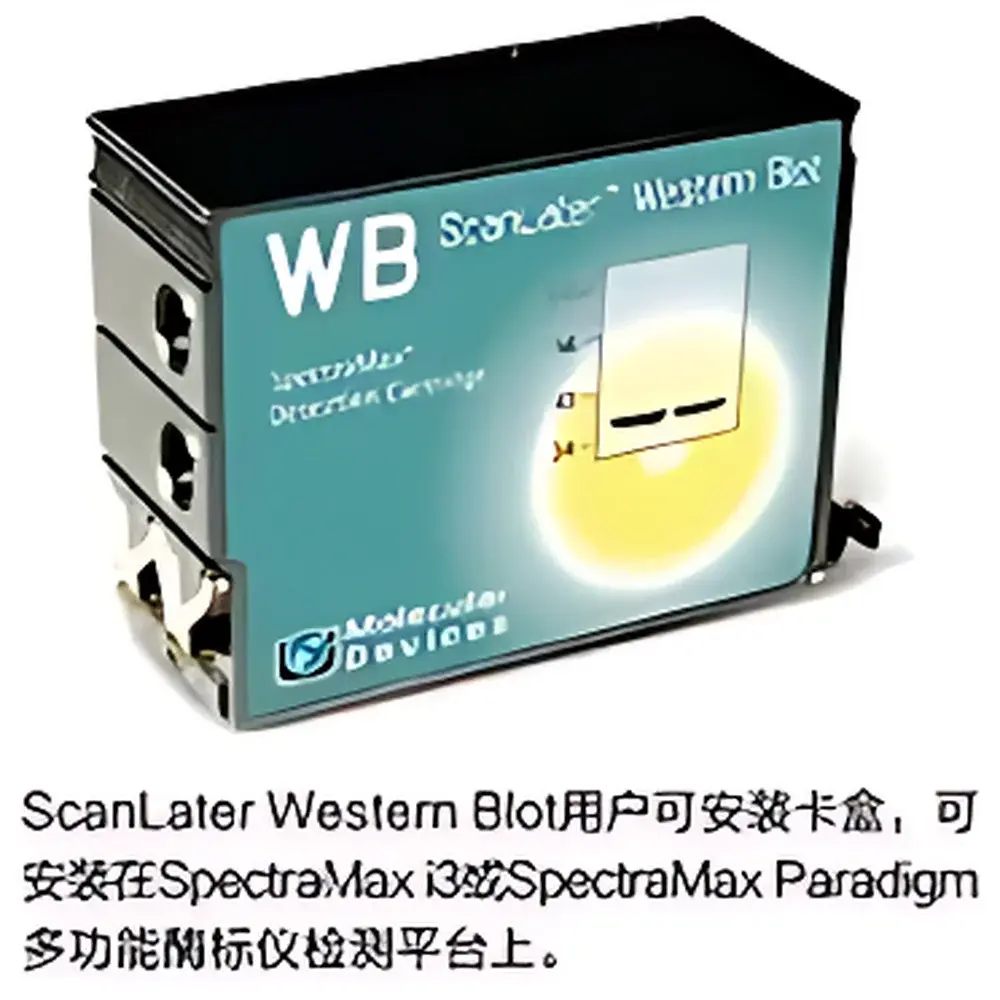
Molecular Devices ScanLater Western Blot Detection System
| Brand | Molecular Devices |
|---|---|
| Origin | USA |
| Manufacturer Type | Original Equipment Manufacturer (OEM) |
| Product Origin | Imported |
| Model | ScanLater Western Blot |
| Pricing | Available upon Request |
| Detection Principle | Time-Resolved Fluorescence (TRF) |
| Sensitivity | Sub-femtogram (fg) level |
| Dynamic Range | 3–4 logs |
| Compatible Readers | SpectraMax i3, SpectraMax Paradigm Multi-Mode Microplate Readers |
| Detection Format | Membrane-based TRF imaging on standard 8.5 × 13.5 cm nitrocellulose or PVDF blots |
| Excitation Source | High-Energy Xenon Flash Lamp |
| Reading Mode | Top-Read |
| Cartridge Capacity | Dual-position (2-blots per run) |
| Software | SoftMax Pro v7.1+ with Image-J plugin support |
| Regulatory Compliance | Designed for GLP-compliant workflows |
Overview
The Molecular Devices ScanLater Western Blot Detection System is the world’s first integrated membrane scanning solution engineered exclusively for multi-mode microplate readers. Unlike conventional chemiluminescent or standard fluorescence Western blot imagers—requiring dedicated hardware—the ScanLater system transforms existing SpectraMax i3 and SpectraMax Paradigm platforms into high-performance blot scanners via a modular cartridge-based architecture. At its core, the system leverages time-resolved fluorescence (TRF), a photophysical detection strategy that eliminates short-lived autofluorescence and scattered light by employing lanthanide chelates (e.g., europium) with microsecond-scale emission decay kinetics. This principle enables exceptional signal-to-noise ratios, sub-femtogram sensitivity, and a linear dynamic range spanning three to four orders of magnitude—critical for quantitative comparison across samples with widely varying target abundance.
Key Features
- Modular integration: Installs in under two minutes without tools or service engineer support—no firmware upgrade or reader modification required.
- TRF-native detection: Eliminates enzymatic substrates (e.g., ECL reagents), enabling stable signal acquisition over extended time windows (minutes to hours) without signal decay or saturation.
- Dual-position cartridge: Accommodates two standard-sized Western blot membranes (8.5 × 13.5 cm) simultaneously, supporting parallel processing while maintaining positional calibration integrity.
- High-energy xenon flash lamp: Delivers consistent, broadband excitation optimized for Eu³⁺ chelate excitation at ~340 nm, ensuring reproducible signal generation across instrument lifetime.
- Top-read optical path: Engineered for uniform illumination and collection geometry across membrane surface—minimizing edge artifacts common in wide-field CCD-based systems.
- Pre-validated reagent kits: Includes Eu-labeled secondary antibodies (anti-rabbit IgG, anti-mouse IgG, streptavidin), blocking buffer, and wash buffer—all lot-tested on SpectraMax platforms for inter-batch consistency.
Sample Compatibility & Compliance
The ScanLater system is compatible with nitrocellulose and PVDF membranes following standard electrophoretic transfer protocols. It does not require membrane stripping or specialized surface treatments. All reagents are formulated for low background and minimal cross-reactivity, meeting performance criteria outlined in ISO 13485–aligned quality control documentation. The system supports GLP-compliant operation when used with SoftMax Pro v7.1+ configured for electronic signatures and full 21 CFR Part 11 audit trails—including user action logging, data integrity verification, and immutable image metadata embedding (timestamp, gain, integration time, reader ID). No validation scripts or third-party software modifications are needed to meet FDA-regulated QC/QA requirements.
Software & Data Management
SoftMax Pro software serves as the unified control interface for both microplate assays and membrane scanning. Its blot-specific acquisition module provides intuitive controls for exposure time, PMT gain, and spatial binning—without requiring scripting expertise. Acquired images are saved in lossless TIFF format with embedded EXIF-style metadata (including instrument serial number, date/time stamp, and acquisition parameters). Native integration with ImageJ via one-click export ensures seamless transition to open-source quantification pipelines (e.g., Fiji-based densitometry, background subtraction, and normalization workflows). Raw image files retain full bit-depth (16-bit), preserving quantitative fidelity during downstream analysis.
Applications
This system is routinely deployed in academic core facilities, biopharmaceutical process development labs, and regulatory QC environments where reproducibility, traceability, and throughput are critical. Typical use cases include: comparative expression profiling of phosphorylated signaling proteins under dose-response conditions; verification of CRISPR/Cas9 knockout efficiency across clonal isolates; batch-to-batch consistency assessment of recombinant therapeutic antibodies; and multiplexed detection using sequential probing strategies enabled by TRF’s stability. Its compatibility with existing SpectraMax infrastructure reduces capital expenditure while extending instrument utility beyond plate-based assays into membrane-based protein analytics.
FAQ
Can the ScanLater cartridge be used on non-Molecular Devices readers?
No. The mechanical interface, optical alignment, and firmware-level communication protocol are proprietary to SpectraMax i3 and Paradigm platforms.
Is stripping and reprobing possible with TRF detection?
Yes—membranes may be stripped using mild glycine-based buffers and re-probed without signal carryover, due to the absence of covalent substrate deposition inherent to chemiluminescence.
What is the minimum detectable band intensity?
Under standardized conditions (10 µg total lysate, 1 h primary incubation, 30 min TRF secondary), detection limits reach ≤0.5 fg of target protein, verified using calibrated BSA standards and certified reference materials.
Does SoftMax Pro support automated lane/region-of-interest (ROI) quantification?
Yes—integrated blot analysis tools enable auto-detection of molecular weight markers, band alignment correction, and background-subtracted densitometry with coefficient-of-variation (CV) reporting per lane.
Are reagent kits supplied with expiration dating and stability data?
Yes—each kit includes a Certificate of Analysis listing lot-specific stability profiles (≥12 months refrigerated, ≥3 freeze-thaw cycles), verified per ICH Q5C guidelines.



