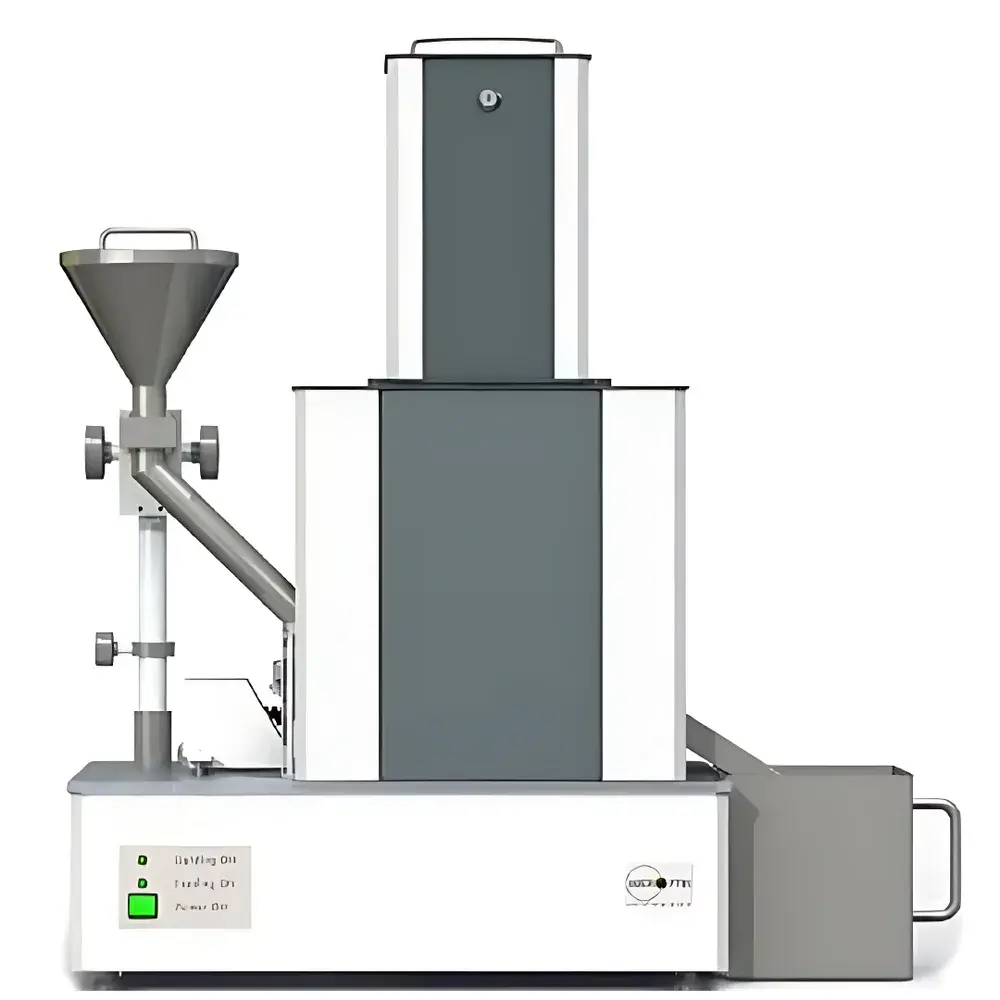
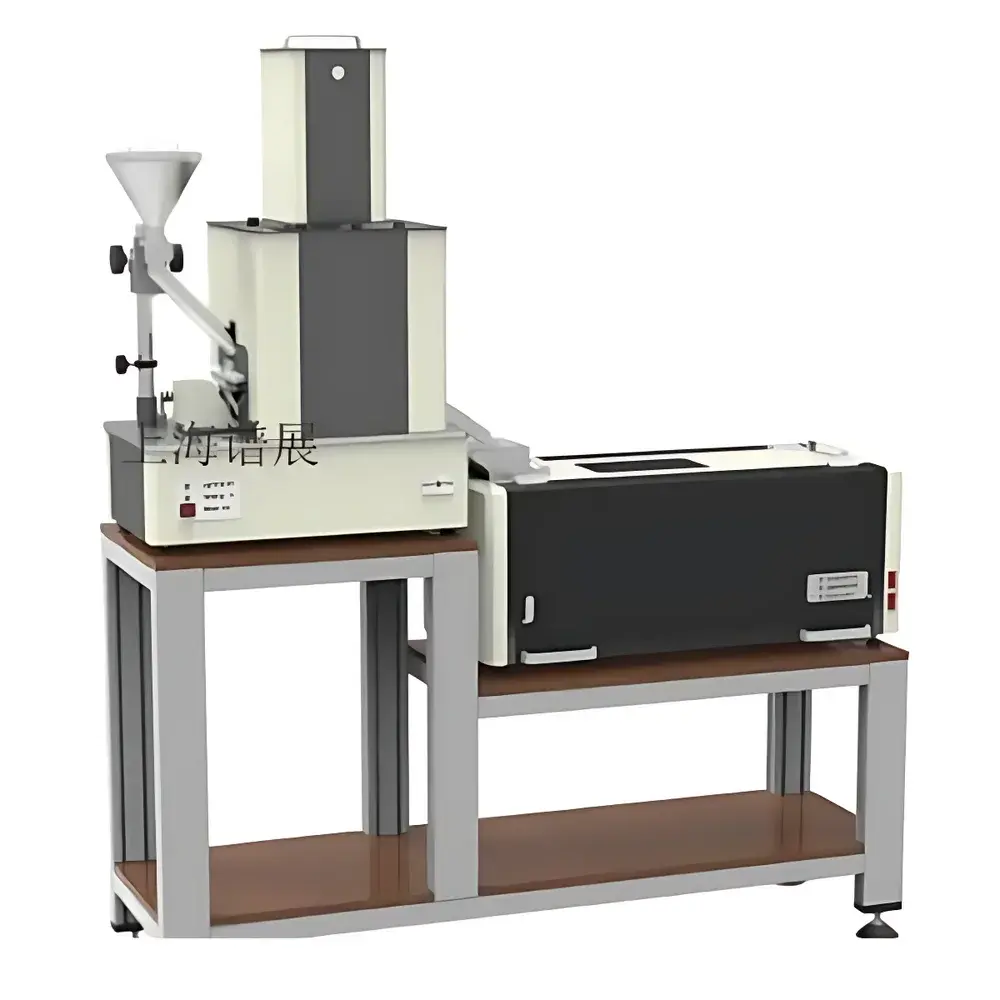
Morphious C1 Polyolefin Particle & Contaminant Scanning Analysis System
| Brand | Morphious |
|---|---|
| Origin | Italy |
| Model | Morphious C1 |
| Detection Principle | High-Resolution Color Imaging + Real-Time Image Processing |
| Pixel Resolution | 1600 × 1200 @ 60 fps |
| Pixel Size | 4.5 µm |
| Minimum Detectable Particle Size | 20 µm |
| Throughput Range | 2–60 kg/h (material- and size-dependent) |
| Optical Configuration | Triple-CCD Color Calibration Module |
| Software Platform | Windows 10 or later, Mishell®-powered analysis engine |
| System Dimensions | 500 × 600 × 500 mm (L×W×H) |
| Weight | 32 kg |
| Power Consumption | 18 W |
| Operating Temperature | 15–40 °C |
| Integrated Auto-Cleaning Unit | Yes |
| Connectivity | Gigabit Ethernet, USB 3.0, HDMI |
| Display | 17″ Low-Emission Monitor |
| Data Export | CSV, PDF, PNG, Excel-compatible reports |
| Compliance Ready | ASTM D7269, ISO 1874-2, USP <788>, GLP/GMP audit trail support (software-configurable) |
Overview
The Morphious C1 Polyolefin Particle & Contaminant Scanning Analysis System is an industrial-grade optical inspection platform engineered for quantitative, high-throughput characterization of particulate contaminants and morphological defects in polyolefin resins—including PP, PE, and copolymers—across laboratory R&D, incoming raw material verification, and in-line production monitoring. It operates on a robust colorimetric imaging principle: particles are dispersed as a monolayer on a moving conveyor belt under calibrated LED illumination; a triple-CCD color camera captures high-fidelity RGB images at 60 frames per second; and proprietary image processing algorithms perform real-time segmentation, classification, and metrology based on size, shape, color deviation (ΔE*ab), transparency, and spatial distribution. Unlike conventional sieving or manual microscopy, the Morphious C1 delivers trace-level detection down to 20 µm with statistical repeatability (CV < 3.5% for ≥50 µm particles across 5 replicate runs), enabling root-cause analysis of extrusion die contamination, catalyst residue carryover, or cross-polymer blending anomalies.
Key Features
- Triple-CCD color imaging system with factory-calibrated color module ensuring consistent ΔE*ab measurement across batches and operator shifts
- Real-time particle classification into user-defined categories: black specks, gels, oxidized fragments, metal shavings, foreign polymer inclusions, and translucent haze zones
- Configurable detection thresholds: adjustable minimum size (20–200 µm), aspect ratio (1.0–10.0), circularity (0.2–1.0), and chromatic distance from reference resin baseline
- Integrated auto-cleaning unit with programmable intervals (1–24 h) for optical chamber and feed chute—reducing downtime and operator intervention
- Dual-mode operation: offline batch scanning (2–60 kg/h, dependent on particle density and morphology) and inline integration via conveyor interface (optional OEM kit)
- Hardware-accelerated GPU processing ensures sub-second latency between image capture and defect annotation—critical for process feedback loops
- Modular PC architecture with Intel Core i7-4790K, 16 GB DDR3 RAM, dual SSD/HDD storage, and Windows 10 LTSB for long-term stability in regulated environments
Sample Compatibility & Compliance
The Morphious C1 accommodates granules, pellets, flakes, and ground powders from all major polyolefin families—including homopolymers, impact copolymers, and metallocene-catalyzed grades—as well as filled compounds (CaCO₃, talc, glass fiber). It reliably distinguishes opaque contaminants (e.g., carbonized polymer, rust, silicone oil residues) from semi-transparent gel fractions and surface-oxidized particles without sample dissolution or staining. The system supports compliance workflows per ISO 1874-2 (plastics—polyolefins—specifications), ASTM D7269 (standard test method for quantifying black specks in polyolefin resins), and USP (particulate matter in injectables, when adapted for pharmaceutical-grade polymer excipients). Audit trail functionality—including user login logs, parameter change timestamps, report generation history, and electronic signatures—is configurable to meet FDA 21 CFR Part 11 and EU Annex 11 requirements.
Software & Data Management
The Mishell® analysis suite provides a deterministic, non-proprietary data architecture: all raw images, processed masks, metadata (timestamp, operator ID, batch ID, instrument settings), and final statistics are stored in folder-based hierarchical structure with SHA-256 checksums. Reports export natively to CSV (for LIMS ingestion), PDF (with embedded calibration certificates), and Excel-compatible pivot tables. Trend analysis tools enable longitudinal SPC charting of defect counts per kg, size distribution shifts over time, and correlation with extruder temperature profiles or catalyst lot numbers. The system exposes RESTful API endpoints and OPC UA compatibility for seamless integration into MES/SCADA platforms (e.g., Siemens SIMATIC IT, Rockwell FactoryTalk). All software updates undergo version-controlled validation per ICH Q9/Q10 principles.
Applications
- Raw material acceptance testing: verifying supplier compliance against internal specs for black specks, gels, and foreign polymers
- Process troubleshooting: correlating spike events in particle count with screw speed changes, barrel zone temperatures, or screen pack pressure differentials
- Quality gate monitoring: real-time pass/fail decision logic at pelletizer discharge or bagging station
- Stability studies: tracking oxidative degradation onset via progressive increase in yellow-indexed particles over accelerated aging cycles
- Regulatory documentation: generating GMP-compliant evidence packages for polymer grade registration (e.g., EMA, PMDA submissions)
- R&D formulation screening: quantifying dispersion quality of masterbatches or nanofillers through shape factor and agglomerate size distribution
FAQ
What is the smallest particle size the Morphious C1 can reliably detect?
The system achieves statistically validated detection down to 20 µm under standard configuration (40 µm pixel resolution mode); performance is verified using NIST-traceable polystyrene microsphere standards.
Can the Morphious C1 distinguish between carbonized polymer and metallic contaminants?
Yes—via spectral reflectance profiling: metallic particles exhibit sharp specular highlights and narrow-band reflectivity, while carbonized organics show broadband absorption with matte texture; both are classified independently in the output report.
Is the system suitable for use in explosive atmospheres (ATEX zones)?
The base Morphious C1 is rated for Zone 2/22; ATEX-certified variants (II 2G Ex db IIB T4 Gb / II 2D Ex tb IIIC T135°C Db) are available with purged enclosure and intrinsically safe lighting modules.
How is calibration maintained across extended operation?
Daily automated self-check includes white balance verification using integrated ceramic reference tile, dark current subtraction, and focus drift compensation via motorized lens actuator—all logged with timestamp and pass/fail status.
Does the software support multi-user role-based access control?
Yes: administrator, analyst, reviewer, and auditor roles are preconfigured with granular permissions for method editing, report approval, audit log viewing, and database backup execution.