
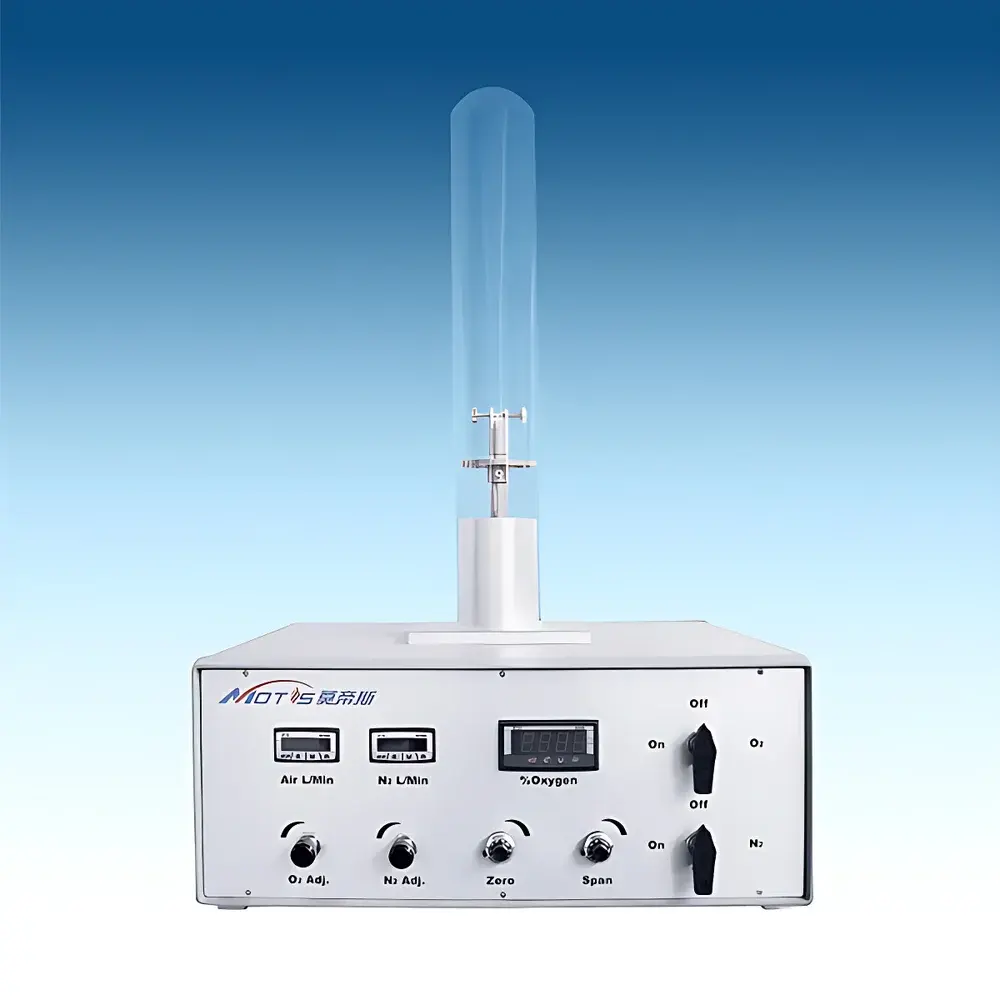
MOTIS COI Oxygen Index Tester
| Brand | MOTIS |
|---|---|
| Origin | Jiangsu, China |
| Manufacturer Type | Authorized Distributor |
| Country of Origin | China |
| Model | COI |
| Price Range | USD 1,400 – 7,000 |
| Power Supply | 115 V AC 60 Hz / 230 V AC 50 Hz |
| Operating Temperature | 10°C to 35°C |
| Dimensions (W×H×D) | 450 mm × 750 mm × 450 mm |
| Gas Requirements | Oxygen, Nitrogen, Propane |
| Oxygen Measurement Range | 0–100% vol |
| Oxygen Accuracy | ±0.1% vol |
| Oxygen Repeatability | ±0.1% vol |
| Oxygen Sensor Type | Paramagnetic |
| Flow Display | Digital N₂ flow, mixed gas flow, and O₂ concentration |
| Sample Holders | Self-supporting & non-self-supporting fixtures |
| Ignition System | Adjustable propane flame with gas shutoff |
| Chamber Material | High-temperature quartz glass tube |
Overview
The MOTIS COI Oxygen Index Tester is a precision benchtop instrument engineered for the quantitative determination of the Limiting Oxygen Index (LOI) — defined as the minimum volume percent of oxygen in an oxygen–nitrogen mixture required to support candle-like combustion of a material under specified test conditions. Based on the principle of controlled atmospheric combustion in a vertical diffusion flame environment, the COI complies fully with ISO 4589-2, ASTM D2863 (formerly D2843), and GB/T 2406.1–2008 / GB/T 2406.2–2009, enabling standardized comparative flammability assessment across polymer, textile, foam, cable insulation, and composite materials. The system operates by introducing a conditioned O₂/N₂ gas mixture into a vertically oriented quartz combustion chamber; a standardized propane pilot flame ignites the specimen, and the LOI value is determined through iterative adjustment of oxygen concentration until sustained burning ceases after 3 minutes or self-extinguishes within 3 seconds post-ignition.
Key Features
- High-stability paramagnetic oxygen sensor with ±0.1% vol accuracy and repeatability, ensuring traceable, long-term calibration integrity without frequent recalibration;
- Digital mass flow control and real-time display of nitrogen flow rate, total mixed gas flow, and oxygen concentration — eliminating manual calculation and reducing operator error;
- Robust high-purity quartz glass combustion column rated for continuous operation up to 1,000°C, resistant to thermal shock and halogen acid corrosion from decomposing specimens;
- Integrated propane ignition module with adjustable flame height (10–20 mm) and fail-safe solenoid valve for immediate gas cutoff upon test completion or emergency stop;
- Dual-purpose specimen holders: precision-machined brass clamps for self-supporting rods/strips and spring-loaded horizontal supports for flexible foams, films, or non-rigid substrates;
- Optimized gas manifold architecture minimizing dead volume and response lag, achieving <5-second stabilization time for oxygen concentration changes during stepwise testing;
- Compliance-ready design: all electrical components meet IEC 61010-1 safety standards; gas pathways conform to ISO 8503-2 leak integrity requirements.
Sample Compatibility & Compliance
The COI accommodates standard specimen geometries per ISO 4589-2: rectangular bars (80–150 mm × 10 mm × 4 mm) and thin sheets (≤10.5 mm thick). It supports both rigid and semi-rigid materials including thermoplastics (e.g., ABS, PC, PP), thermosets (epoxy, phenolic), elastomers, natural/synthetic fibers, and laminated composites. All test procedures align with regulatory frameworks governing fire safety evaluation: ASTM E84 for surface burning characteristics, UL 94 HB/V classification pre-screening, and EU Construction Products Regulation (CPR) Annex ZA referencing EN 13501-1. Data outputs satisfy GLP documentation requirements, with timestamped test logs suitable for FDA 21 CFR Part 11–compliant audit trails when paired with validated software extensions.
Software & Data Management
While the base COI operates via standalone front-panel controls, optional USB-connected firmware enables data export to CSV or Excel-compatible formats. Test records include ambient temperature/humidity stamps, gas flow profiles, ignition timing, burn duration, drip behavior annotation, and final LOI calculation. For laboratories implementing digital quality systems, MOTIS provides a validated Windows-based configuration tool supporting user access levels, electronic signatures, and change-controlled method templates aligned with ISO/IEC 17025 clause 7.7 (method validation) and ISO 9001:2015 clause 8.5.2 (identification and traceability).
Applications
- Flammability ranking of polymer formulations during R&D stage;
- Quality conformance verification for wire & cable jacketing compounds (IEC 60332-1-2, UL 1581);
- Fire performance screening of automotive interior trim per FMVSS 302;
- Regulatory submission support for CE marking of construction materials (EN 13501-1 Class B–D);
- Evaluation of flame-retardant additive efficacy (e.g., phosphinates, metal hydroxides, intumescents);
- Academic research on combustion kinetics and char formation mechanisms in condensed-phase fire models.
FAQ
What standards does the COI fully comply with?
ISO 4589-2:2017, ASTM D2863-22, GB/T 2406.1–2008 & GB/T 2406.2–2009, and JIS K 7201-2.
Is calibration traceable to national standards?
Yes — the paramagnetic sensor is factory-calibrated against NIST-traceable gas standards (O₂ in N₂ blends), with certificate of calibration included.
Can the instrument be integrated into a LIMS environment?
Via optional RS-232/USB interface and MODBUS RTU protocol support, enabling bidirectional communication with major laboratory information management systems.
What maintenance is required for long-term accuracy?
Annual verification using certified reference gases (e.g., 18.0%, 21.0%, and 25.0% O₂ in N₂) and quarterly inspection of quartz tube integrity and seal compression.
Does the system support automated LOI calculation?
Yes — the embedded algorithm applies the ASTM D2863 interpolation method (Equation 1) directly from observed extinction points across at least five oxygen concentration trials, outputting final LOI to 0.1% resolution.



