
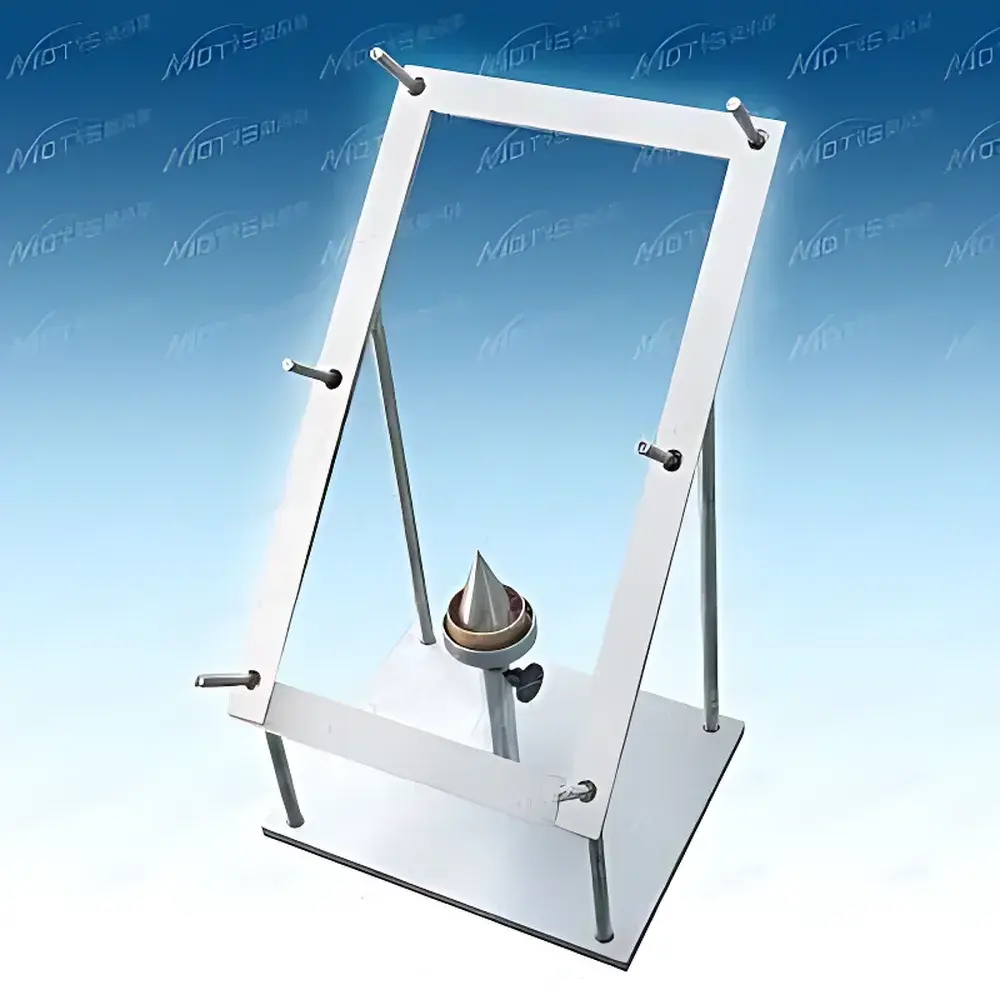
MOTIS UIC-4 45-Degree Alcohol Cup Burner for TB/T 3237 and UIC 564-2 Compliance
| Brand | MOTIS |
|---|---|
| Origin | Shanghai, China |
| Model | UIC-4 |
| Standards Compliance | TB/T 3237, UIC 564-2 |
| Sample Holder | Dual stainless-steel clamps with adjustable support stand |
| Ignition System | Electric spark igniter |
| Burner Type | Bunsen burner with 45° and 90° angular adjustment |
| Flame Height Gauge | Integrated calibrated gauge |
| Construction | Stainless-steel frame and combustion chamber components |
Overview
The MOTIS UIC-4 45-Degree Alcohol Cup Burner is a precision-engineered combustion test apparatus designed to evaluate the flame propagation resistance of interior textile materials used in railway passenger coaches. It operates in strict accordance with the Chinese national railway standard TB/T 3237 and the international Union Internationale des Chemins de fer (UIC) specification UIC 564-2, both of which define stringent criteria for surface flammability, afterflame time, afterglow duration, and char length measurement under controlled 45-degree inclined exposure. Unlike general-purpose vertical flame testers, the UIC-4 implements a defined alcohol-fueled cup burner configuration that delivers reproducible flame geometry, thermal flux, and impingement angle—critical parameters for assessing real-world fire initiation behavior in upholstered and coated fabrics such as seat covers, curtains, wall linings, and ceiling panels.
Key Features
- Stainless-steel dual specimen clamping system with precision-machined holders and an adjustable support stand, ensuring consistent 45° sample inclination per TB/T 3237 Clause 5.2 and UIC 564-2 Annex A.
- Calibrated Bunsen-type alcohol cup burner capable of precise angular positioning at both 45° and 90°, enabling direct comparative testing across multiple regulatory frameworks without hardware modification.
- Integrated flame height gauge conforming to UIC 564-2 Section 4.3.1, allowing on-the-fly verification of 20 ± 1 mm blue flame height prior to each test cycle—essential for maintaining thermal input consistency.
- Electric spark ignition system eliminating manual match or pilot flame handling, thereby improving operator safety, reducing inter-test variability, and supporting GLP-compliant test documentation workflows.
- Corrosion-resistant stainless-steel construction throughout the burner assembly, sample stage, and base frame—optimized for long-term stability in laboratory environments subject to repeated ethanol exposure and thermal cycling.
Sample Compatibility & Compliance
The UIC-4 accommodates flat textile specimens measuring 500 mm × 150 mm (L × W), including coated, laminated, or multi-layered fabrics commonly specified for rail interior applications. It supports both conditioned (23 °C ± 2 °C, 50 % RH ± 5 % RH per ISO 139) and unconditioned samples, with mounting fixtures engineered to prevent edge curling or slippage during flame exposure. The instrument satisfies all mechanical and procedural requirements outlined in TB/T 3237–2010 “Fire Resistance Test Method for Interior Materials of Railway Passenger Cars” and UIC 564-2:2017 “Rules concerning the fire behaviour of materials used in railway vehicles”. Its design enables traceable alignment with ASTM D6413 (vertical flame) and ISO 6941 (ignitability under radiant heat), though formal certification for those standards requires supplementary calibration and validation per ISO/IEC 17025.
Software & Data Management
While the UIC-4 is a manually operated benchtop combustion tester with no embedded microprocessor or digital interface, it is fully compatible with third-party GLP/GMP-compliant data acquisition systems. Users may integrate high-speed thermal imaging cameras (e.g., FLIR A655sc), digital timers with audit-trail logging, and electronic char-length measurement tools to generate 21 CFR Part 11–compliant test records. All mechanical adjustments—including burner angle, clamp position, and flame height—are documented via standardized test worksheets aligned with internal quality management systems (QMS) and notified body audit requirements.
Applications
- Qualification testing of flame-retardant treated polyester, wool-blend, and acrylic upholstery fabrics prior to OEM railcar procurement.
- Batch release verification for textile suppliers operating under EN 45545-2 HL2 or HL3 hazard level compliance programs.
- Root cause analysis of non-conforming char length results through controlled parameter variation (e.g., flame height, exposure duration, substrate tension).
- Interlaboratory comparison studies coordinated under CNAS (China National Accreditation Service) or EA (European Cooperation for Accreditation) multilateral recognition arrangements.
- Training and method transfer for QC technicians requiring hands-on familiarity with UIC-specified ignition protocols and pass/fail decision logic.
FAQ
What flame fuel is required for the UIC-4, and what purity specifications apply?
Ethanol (≥99.5 % v/v, anhydrous) is the sole approved fuel per TB/T 3237 and UIC 564-2. Fuel batches must be certified for water content ≤0.1 % and absence of halogenated additives.
Is calibration of the flame height gauge traceable to national metrology institutes?
Yes—the included stainless-steel gauge is supplied with a manufacturer’s calibration certificate referencing ISO/IEC 17025-accredited dimensional metrology; users are advised to verify gauge integrity annually using certified slip gauges.
Can the UIC-4 be used for testing non-railway materials such as aircraft seat fabrics?
No—its mechanical configuration and procedural sequence are explicitly optimized for TB/T 3237/UIC 564-2. Aircraft applications require FAA AC 20-135 or EN 14250-compliant apparatus with distinct burner geometry and airflow control.
Does the instrument include flame extinction controls or automatic shutdown features?
No—extinguishing is performed manually using a flame cap or CO₂ extinguisher per lab safety SOPs; this reflects the intentional design philosophy of UIC 564-2, which mandates operator presence and real-time observation.
How is repeatability ensured across different operators and laboratories?
Through strict adherence to the 12-step test sequence in TB/T 3237 Section 6, mandatory use of the provided clamps and support stand, and pre-test verification of flame height, sample conditioning, and ambient temperature/humidity conditions.



