
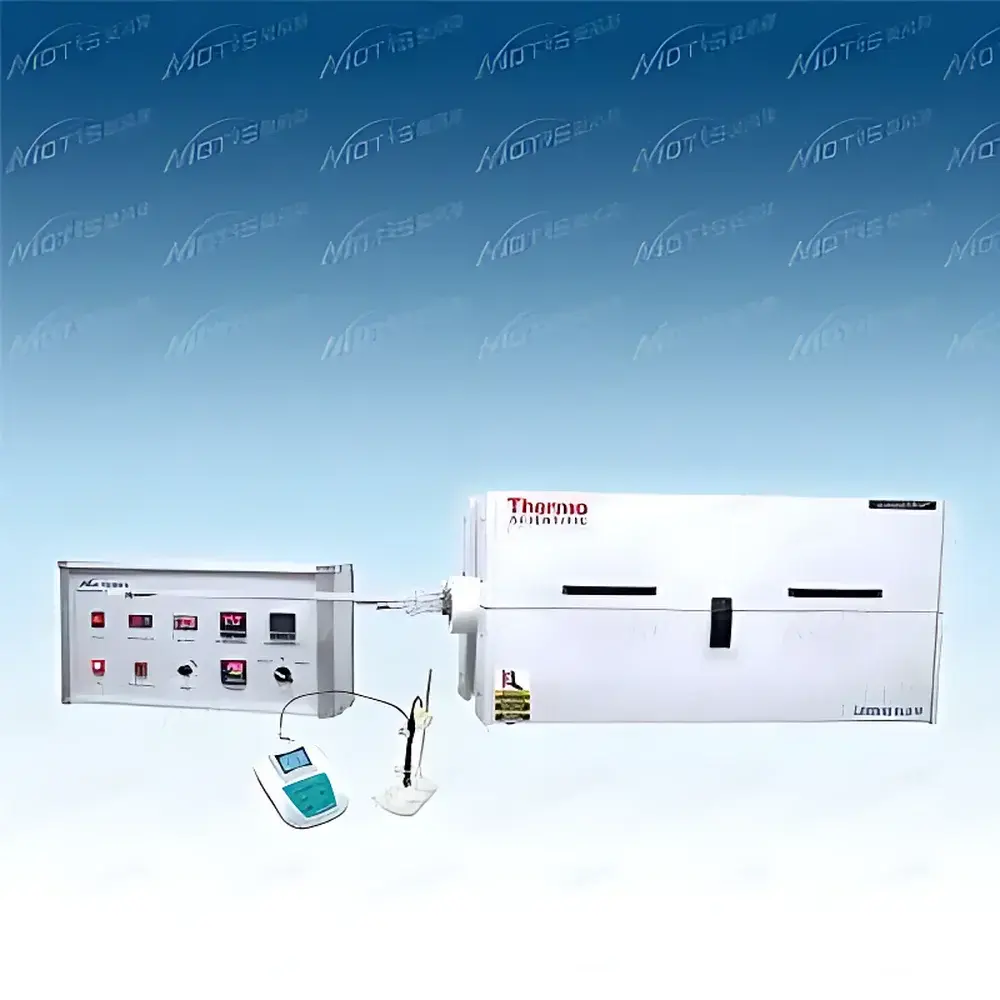
MOTIS CTA Halogen Acid Gas Release Tester
| Brand | MOTIS |
|---|---|
| Origin | Jiangsu, China |
| Model | CTA |
| Air Flow Range | 0–3 L/min (digital display, ±0.1 L/min resolution) |
| Temperature Control | Dual-mode PID (programmable ramp & single-point setpoint) |
| Max Furnace Temp | 1100 °C with over-temperature cutoff |
| Furnace Type | Openable quartz tube furnace with imported thermocouple-based heating system |
| Auxiliary Instruments | Magnetic stirrer, pH meter, conductivity meter |
| Filtration | Activated carbon + silica gel dual-column air filter |
| Standards Compliance | GB/T 17650.1–2, IEC 60754-1/2:1994, EN 50305, BS 6853 Annex B |
Overview
The MOTIS CTA Halogen Acid Gas Release Tester is a precision-engineered combustion analysis system designed to quantify halogen acid gas emissions—primarily hydrogen chloride (HCl), hydrogen bromide (HBr), and hydrofluoric acid (HF)—evolved during the controlled thermal decomposition of electric cables and wire insulation materials. It operates on the principle of gravimetric and electrochemical quantification: test specimens are combusted under standardized airflow conditions in a high-temperature quartz tube furnace; evolved acidic gases are absorbed in deionized water, and the resulting solution is analyzed for pH (indicative of H⁺ concentration) and specific conductivity (correlating to total halide ion concentration). This methodology aligns directly with the stoichiometric basis of IEC 60754-1 and -2, enabling trace-level detection and reproducible quantification essential for compliance verification in low-smoke zero-halogen (LSZH) material development and quality assurance.
Key Features
- Programmable dual-mode PID temperature control: supports both linear ramp profiles (for simulating real-world fire progression) and fixed-temperature holds (for ISO/IEC standard-compliant isothermal combustion)
- Digital mass flow controller with 0–3 L/min range and 0.1 L/min resolution ensures precise, repeatable oxidative airflow—critical for consistent gas evolution kinetics and stoichiometric absorption efficiency
- Openable quartz tube furnace assembly facilitates rapid maintenance, quartz tube replacement, and residue removal without disassembly of thermal or electrical subsystems
- Integrated over-temperature protection circuit automatically de-energizes heating elements upon detection of furnace temperatures exceeding 1100 °C, safeguarding furnace integrity and operator safety
- Dual-stage air purification system: pre-filtration via activated carbon (removes organic volatiles and sulfur compounds) followed by silica gel (eliminates moisture), ensuring baseline purity of carrier gas
- Onboard auxiliary instrumentation suite—including calibrated magnetic stirrer, laboratory-grade pH meter, and conductivity meter—enables direct, real-time analysis of absorption solution without external lab dependency
Sample Compatibility & Compliance
The CTA system accommodates solid polymeric cable jacketing and insulation samples per IEC 60754-1 (1.0 g ±0.01 g) and IEC 60754-2 (0.5 g ±0.01 g), with optional sample holders for stranded conductors or sheathed assemblies. Its design conforms to the mechanical, thermal, and analytical requirements of GB/T 17650.1–2–1998, IEC 60754-1/2:1994, EN 50305 (Clause 11.3), and BS 6853 Annex B (toxicity assessment via halogen acid yield). The system supports GLP-aligned documentation workflows, including instrument calibration logs, raw data capture (pH/conductivity/time stamps), and furnace temperature profile recording—facilitating audit readiness for ISO/IEC 17025-accredited laboratories and regulatory submissions under EU CPR (Construction Products Regulation) and RoHS II.
Software & Data Management
While the CTA operates as a hardware-integrated benchtop analyzer without proprietary PC software, all measurement outputs—airflow rate, furnace temperature (real-time and logged), pH value, conductivity (µS/cm), and calculated halogen acid content (mg/g)—are recorded manually or via external digital loggers compliant with FDA 21 CFR Part 11 requirements (when paired with validated electronic lab notebooks). Calibration certificates for the pH meter and conductivity probe are traceable to NIST standards; furnace thermocouple calibration follows ASTM E230 protocols. The modular architecture permits integration into LIMS environments via RS-232 or analog 4–20 mA output interfaces (optional add-on).
Applications
- Quantitative validation of LSZH cable formulations for rail transit (EN 50305), metro systems (BS 6853), and marine applications (IEC 60092)
- QC release testing of halogen-free ethylene propylene rubber (EPR), cross-linked polyolefin (XLPO), and thermoplastic elastomer (TPE) insulations
- Root cause analysis of unexpected smoke acidity in flame-retardant compound batches
- Supporting UL 1685 vertical tray flame test correlation studies where halogen acid yield influences toxicity modeling
- Research into synergistic flame-retardant systems (e.g., aluminum trihydrate + phosphinate blends) where acid gas suppression is a key performance metric
FAQ
What standards does the CTA system fully support out-of-the-box?
GB/T 17650.1–2–1998, IEC 60754-1/2:1994, EN 50305 Clause 11.3, and BS 6853 Annex B.
Is the quartz tube furnace replaceable without specialized tools?
Yes—the openable furnace design allows full access to the quartz tube using only standard hex keys; no furnace recalibration is required after replacement.
Can the system be used for non-cable materials such as building insulation foams?
It may be adapted for other polymeric solids under method validation per ISO 1716 or ASTM D5865, but specimen geometry, mass, and combustion kinetics must be requalified to ensure representative gas evolution and absorption efficiency.
Does the system include certified reference materials for calibration?
No—certified pH buffer solutions (pH 4.01, 7.00, 10.01) and KCl conductivity standards (1413 µS/cm) must be procured separately per ISO 8655 and ASTM D1125 guidelines.
What maintenance intervals are recommended for the air filtration system?
Activated carbon and silica gel columns should be replaced after every 50 test cycles or when breakthrough is observed via baseline conductivity drift (>2 µS/cm in blank absorption water).



