
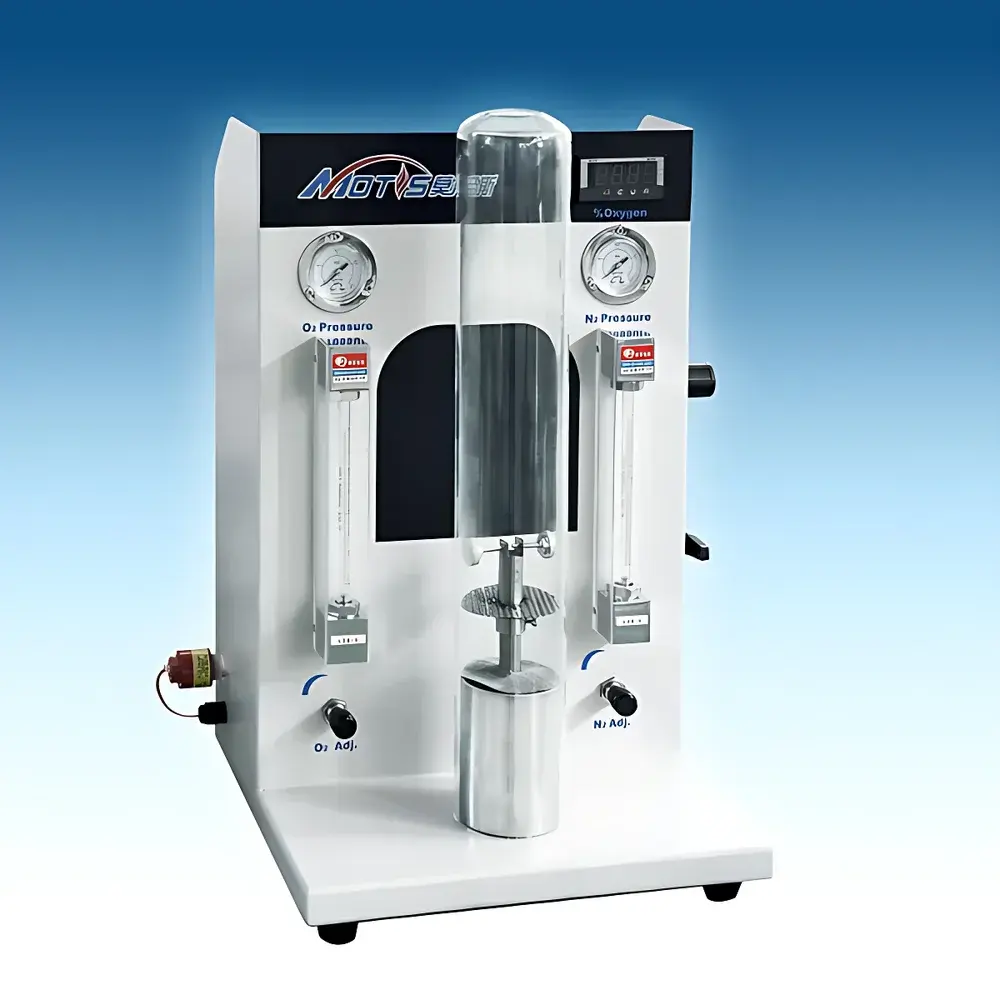
MOTIS OI Oxygen Index Tester
| Brand | MOTIS |
|---|---|
| Origin | Jiangsu, China |
| Manufacturer Type | Authorized Distributor |
| Country of Origin | China |
| Model | OI |
| Price | USD 1,150 (FOB Jiangsu) |
| Measurement Principle | Limiting Oxygen Concentration (LOC) via upward flame propagation in vertical specimen under controlled O₂/N₂ mixture |
| Standards Compliance | ISO 4589-2, ISO 4589-3, GB/T 2408 |
| Oxygen Sensor Type | Electrochemical |
| O₂ Range | 0–100 vol% |
| Resolution | 0.1 vol% |
| Gas Flow Control | Dual mass flow controllers (O₂ and N₂), adjustable from 0–10 L/min, step resolution ≤ 0.1 L/min |
| Combustion Chamber | High-purity quartz glass tube (max. operating temp: 800 °C) |
| Ignition Source | Adjustable butane micro-flame igniter with gas cutoff |
| Humidity & Particulate Filtration | Integrated desiccant + sintered stainless-steel filter |
| Specimen Holders | Two sets — self-supporting and non-self-supporting clamps |
| Data Display | Digital dual-channel O₂% and total flow readout |
| Power Supply | 220 V AC, 50 Hz |
Overview
The MOTIS OI Oxygen Index Tester is a precision benchtop instrument engineered for the quantitative determination of the Limiting Oxygen Index (LOI)—defined as the minimum volume percentage of oxygen in an oxygen–nitrogen mixture required to support candle-like combustion of a vertically oriented solid material under specified laboratory conditions. Based on the fundamental principle of upward flame propagation kinetics, the system measures the critical oxygen concentration at which a standardized specimen sustains flaming combustion for ≥60 seconds or propagates flame over a defined length (typically 50 mm), per ISO 4589-2 and GB/T 2408. For elevated-temperature applications, the instrument supports high-temperature LOI testing per ISO 4589-3 using preheated gas streams and thermally stabilized quartz chamber architecture. Unlike empirical flammability screening tools, the MOTIS OI delivers traceable, repeatable LOI values essential for regulatory documentation, material qualification, and fire safety engineering workflows in polymer R&D, cable insulation validation, aerospace composites testing, and building material certification.
Key Features
- Electrochemical oxygen sensor with 0.1 vol% resolution and factory-calibrated traceability to NIST-traceable reference gases
- Dual-channel mass flow control system (MFCs) for independent, linear regulation of O₂ and N₂ streams—achieving flow stability ±0.5% of setpoint across 0.1–10 L/min range
- High-purity fused quartz combustion column (ID 100 mm × H 500 mm), rated for continuous operation up to 800 °C and resistant to thermal shock and halogen corrosion
- Adjustable butane micro-flame igniter with ergonomic thumbwheel control and integrated solenoid gas shutoff for operator safety and ignition repeatability
- Integrated humidity and particulate filtration: desiccant cartridge + sintered stainless-steel pre-filter ensures consistent gas composition and eliminates condensation-induced measurement drift
- Dual digital display interface showing real-time O₂ concentration (%) and total mixed gas flow (L/min), with backlighting for low-ambient-light environments
- Modular clamp assembly: includes ASTM/ISO-compliant self-supporting holder (for rigid rods/sheets) and non-self-supporting holder (for foams, films, and flexible substrates)
Sample Compatibility & Compliance
The MOTIS OI accommodates specimens conforming to ISO 4589-2 dimensions (typically 150 mm × 10 mm × 4 mm or 10 mm × 10 mm × 3 mm), including thermoplastics, thermosets, elastomers, fiber-reinforced composites, textiles, and coated substrates. It supports both ambient-temperature (23 ± 2 °C) and high-temperature (up to 300 °C preheated gas stream) test modes. The system is fully compliant with ISO 4589-2:2017 (Plastics — Determination of burning behaviour by oxygen index — Part 2: Ambient-temperature test), ISO 4589-3:2017 (Part 3: Elevated-temperature test), and GB/T 2408–2008 (Plastics — Determination of burning behaviour — Horizontal and vertical burning tests). All hardware components—including quartz tube geometry, gas inlet configuration, and specimen holder positioning—meet dimensional tolerances specified in Clause 5 of ISO 4589-2. The electrochemical O₂ sensor conforms to IEC 60751 Class B accuracy requirements for industrial gas sensing.
Software & Data Management
While the MOTIS OI operates as a stand-alone analog-digital hybrid instrument, its modular sensor and MFC architecture enables optional RS-485 or USB-to-serial integration with third-party data acquisition platforms (e.g., LabVIEW, MATLAB, or custom Python-based logging). All displayed parameters—O₂ %, total flow, and elapsed test time—are accessible via ASCII protocol. For GLP/GMP-regulated environments, users may implement external audit-trail-capable software to record timestamps, operator IDs, calibration logs, and raw sensor outputs. The instrument’s mechanical design and gas path layout facilitate full traceability per FDA 21 CFR Part 11 when paired with compliant electronic record systems. Calibration certificates (including zero/span verification reports) are provided with each unit and align with ISO/IEC 17025-accredited metrology practices.
Applications
- Quantitative ranking of flame retardancy in halogen-free engineering plastics (e.g., polyamide 66, PBT, PC/ABS blends)
- Validation of intumescent additive efficacy in cable jacketing compounds per IEC 60332-3 and UL 1685
- Fire performance benchmarking of interior automotive trim materials against FMVSS 302 and UN ECE R118
- Development and QC testing of fire-retardant coatings for structural steel and wood substrates
- Regulatory submission support for CE marking (EN 13501-1), CPR classification, and FAA AC 20-135A compliance
- Academic research in combustion kinetics, pyrolysis gas analysis, and condensed-phase flame inhibition mechanisms
FAQ
What standards does the MOTIS OI comply with?
ISO 4589-2:2017, ISO 4589-3:2017, and GB/T 2408–2008.
Is calibration verification required before each test?
Daily zero-check with ambient air (20.9% O₂) is recommended; full two-point calibration (0% and 100% O₂) is advised weekly or after sensor replacement.
Can the instrument be used for testing thin films or foams?
Yes—using the included non-self-supporting clamp assembly, per ISO 4589-2 Annex C for low-density or flexible materials.
What maintenance intervals are recommended for the quartz tube and sensors?
Quartz tube inspection every 200 tests; electrochemical O₂ sensor replacement every 12–18 months depending on cumulative exposure to combustion byproducts.
Does the system support automated oxygen concentration ramping?
No—the MOTIS OI is manually tuned per standard procedure; however, its precise MFCs and high-resolution O₂ readout enable rapid manual convergence to LOI within ≤5 test iterations.



