
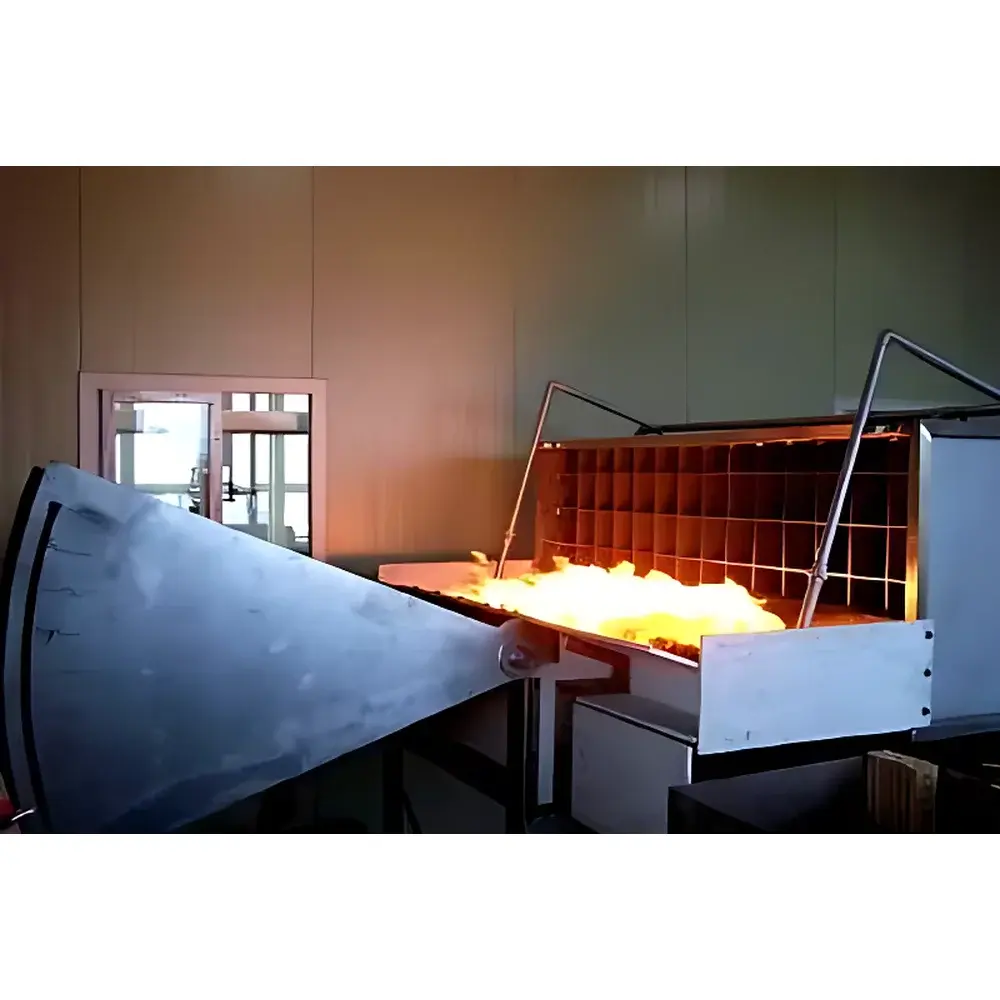
MOTIS SCF2009 Roof Covering Combustibility Test System
| Brand | MOTIS |
|---|---|
| Origin | Shanghai, China |
| Model | SC F |
| Compliance Standards | ASTM E108, UL 790, NFPA 256, IEC 61730-2 Annex A |
| Test Chamber Dimensions (L×W×H) | 1020 × 1000 × 1473 mm |
| Test Panel Size | 1300 × 1000 × 120 mm (plywood substrate) |
| Flame Impingement Burner | 1.12 m long × 60.3 mm OD, 12.7 mm × 910 mm slot |
| Heat Release Rate | Class A/B: 21,000–22,000 Btu/min (369–387 kWh) |
| Class C | 18,000–19,000 Btu/min (316–334 kWh) |
| Airflow Velocity | 5.5 ± 2.2 m/s (19 ± 8 km/h) |
| Exhaust Fan Capacity | ≥300 m³/min, variable-speed (0–100%), 220 V / 50 Hz / 3-phase |
| Ignition Voltage | ≥1.8 kVp |
| Burner Surface Temperature | 880 ± 10 °C |
| Data Acquisition | NI-based LabVIEW system with 16-bit thermocouple input, 16-bit and 12-bit analog I/O modules, real-time & Ethernet communication support |
Overview
The MOTIS SCF2009 Roof Covering Combustibility Test System is a fully engineered, standards-compliant fire performance evaluation platform designed to assess the flame spread, ember resistance, and ignition resistance of roof coverings and photovoltaic (PV) module assemblies under controlled, reproducible conditions. It operates on the principle of calibrated radiant and convective heat exposure—simulating realistic fire exposure scenarios such as wind-driven flame impingement and lateral flame propagation across sloped surfaces. The system implements the standardized test protocols defined in ASTM E108 (Standard Test Methods for Fire Tests of Roof Coverings), UL 790 (Standard for Tests for Fire Resistance of Roof Coverings), NFPA 256 (Standard Method of Test for Fire Tests of Roof Coverings), and IEC 61730-2 Annex A (Safety qualification of photovoltaic modules—Part 2: Requirements for testing). Unlike generic combustion chambers, the SCF2009 replicates critical boundary conditions—including defined airflow velocity, burner geometry, thermal flux profile, and substrate configuration—to generate classification outcomes aligned with regulatory A-, B-, or C-grade determinations per U.S. and international building codes.
Key Features
- Modular stainless-steel structural frame (1020 × 1000 × 1473 mm) with corrosion-resistant finish, engineered for long-term thermal and mechanical stability during repeated high-heat cycles
- Adjustable fan-fold test panel mount with precision angular positioning (0°–45°), enabling simulation of varying roof pitches per ASTM E108 Clause 7.3
- Dual-function gas burner assembly: 1.12 m linear burner with 12.7 mm × 910 mm flame slot; capable of delivering precisely regulated heat fluxes at 369–387 kWh (Class A/B) or 316–334 kWh (Class C) over defined durations
- Integrated air management subsystem: 300 m³/min variable-speed exhaust fan with zero-backlash reverse-drive control, honeycomb flow straightener, turbulence-reducing baffle plates, and NIST-traceable anemometry (5.5 ± 2.2 m/s at test surface)
- Non-combustible front fascia assembly (330 × 2130 × 584 mm) replicating eave geometry to direct flame path and enforce standardized flame impingement angles
- Automated ignition sequence with high-voltage electrode (≥1.8 kVp) and fail-safe flame supervision circuitry compliant with NFPA 86 requirements
- Real-time data acquisition architecture based on National Instruments hardware and LabVIEW RT software, supporting synchronized thermal profiling, gas flow monitoring, and event-triggered logging
Sample Compatibility & Compliance
The SCF2009 accommodates standard-sized roof covering specimens (1300 mm W × 1000 mm D × up to 120 mm H) mounted on a certified plywood substrate per ASTM E108 Section 6.2. It supports both traditional roofing materials—including asphalt shingles, clay tiles, metal panels, and modified bitumen—and integrated PV systems tested per IEC 61730-2 Annex A. All operational parameters—including burner temperature (880 ± 10 °C), airflow uniformity, and flame residence time—are validated against the metrological traceability requirements of ISO/IEC 17025-accredited laboratories. The system design inherently satisfies mechanical and environmental prerequisites for GLP-compliant fire testing facilities and supports audit-ready documentation generation for FDA 21 CFR Part 11 and EU CPR (Construction Products Regulation) conformity assessments.
Software & Data Management
Data acquisition and test orchestration are managed through a custom LabVIEW Real-Time application deployed on an industrial-grade controller. The system integrates 16-bit thermocouple inputs for surface and ambient temperature mapping, dual-range analog input/output modules for gas mass flow regulation and fan speed feedback, and deterministic Ethernet communication for remote supervision. All acquired signals—including burner thermocouple readings, airflow velocity, gas pressure, and flame detection status—are timestamped with microsecond resolution and archived in HDF5 format for post-test analysis. Audit trails record operator actions, calibration events, and parameter changes in accordance with 21 CFR Part 11 electronic record requirements. Export functions support CSV, MATLAB .mat, and PDF report generation with embedded pass/fail decision logic per selected test standard.
Applications
- Classification testing of roof coverings for compliance with International Building Code (IBC) Chapter 15 and FM Global Property Loss Prevention Data Sheets
- Fire performance verification of rooftop-mounted PV arrays under combined wind-flame exposure per UL 1703 and IEC 61730-2
- R&D validation of fire-retardant coatings, intumescent membranes, and underlayment systems
- Third-party certification testing for Underwriters Laboratories (UL), Intertek (ETL), and TÜV Rheinland accreditation programs
- Comparative flame-spread analysis across material batches and manufacturing lots in quality assurance workflows
FAQ
What fire test standards does the SCF2009 fully support?
ASTM E108 (Classes A, B, C), UL 790, NFPA 256, and IEC 61730-2 Annex A for PV modules.
Is the airflow velocity independently verifiable and adjustable during test execution?
Yes—air velocity is continuously monitored via calibrated hot-wire anemometer and actively regulated by the variable-frequency drive controlling the 300 m³/min exhaust fan.
Can the system be configured for non-standard test geometries or custom flame profiles?
The modular burner, adjustable test panel angle, and programmable LabVIEW control architecture permit limited customization under engineering supervision, subject to revalidation per ISO/IEC 17025 Clause 7.2.2.
Does the data acquisition system meet regulatory requirements for electronic records?
Yes—the LabVIEW RT environment includes user authentication, audit trail logging, electronic signatures, and data integrity safeguards aligned with FDA 21 CFR Part 11 and EU Annex 11.
What maintenance intervals are recommended for sustained compliance?
Burner orifice inspection every 50 test cycles; thermocouple calibration annually or per ISO/IEC 17025 internal procedure; airflow straightener cleaning quarterly; full system performance verification biannually.



