
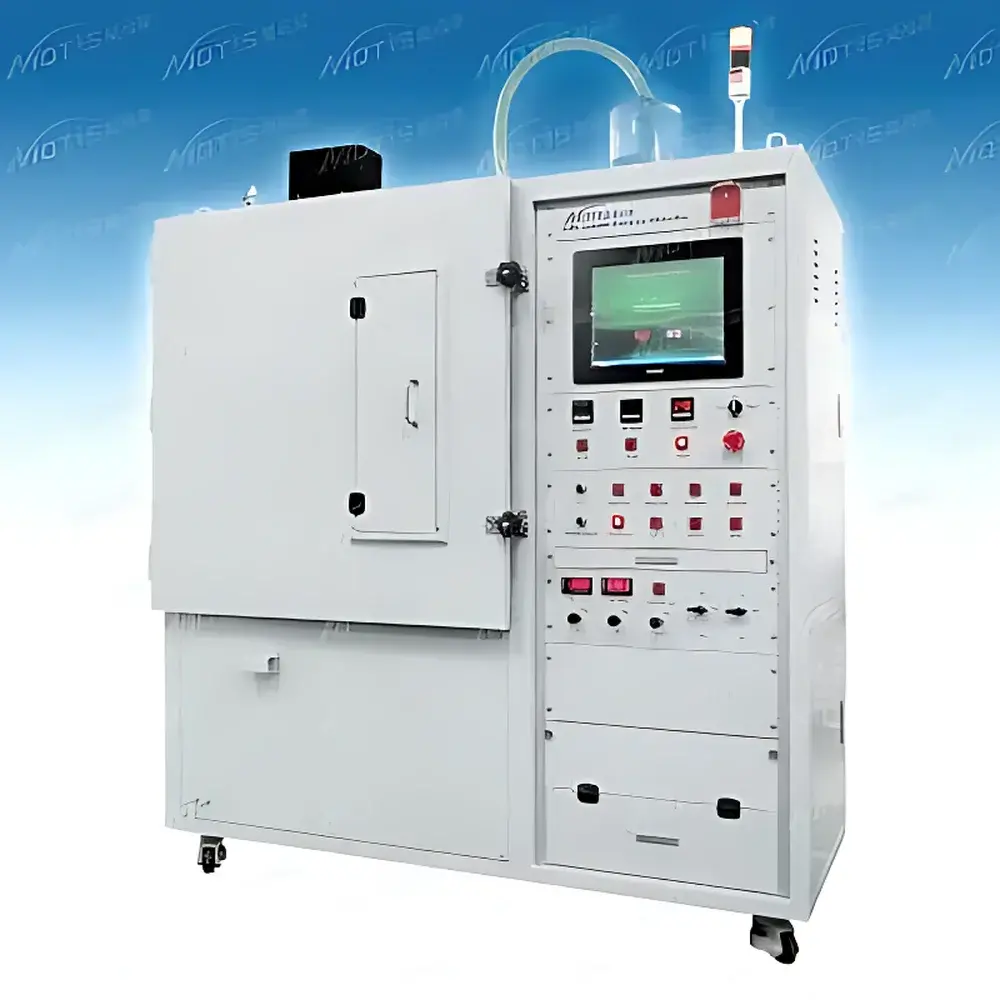
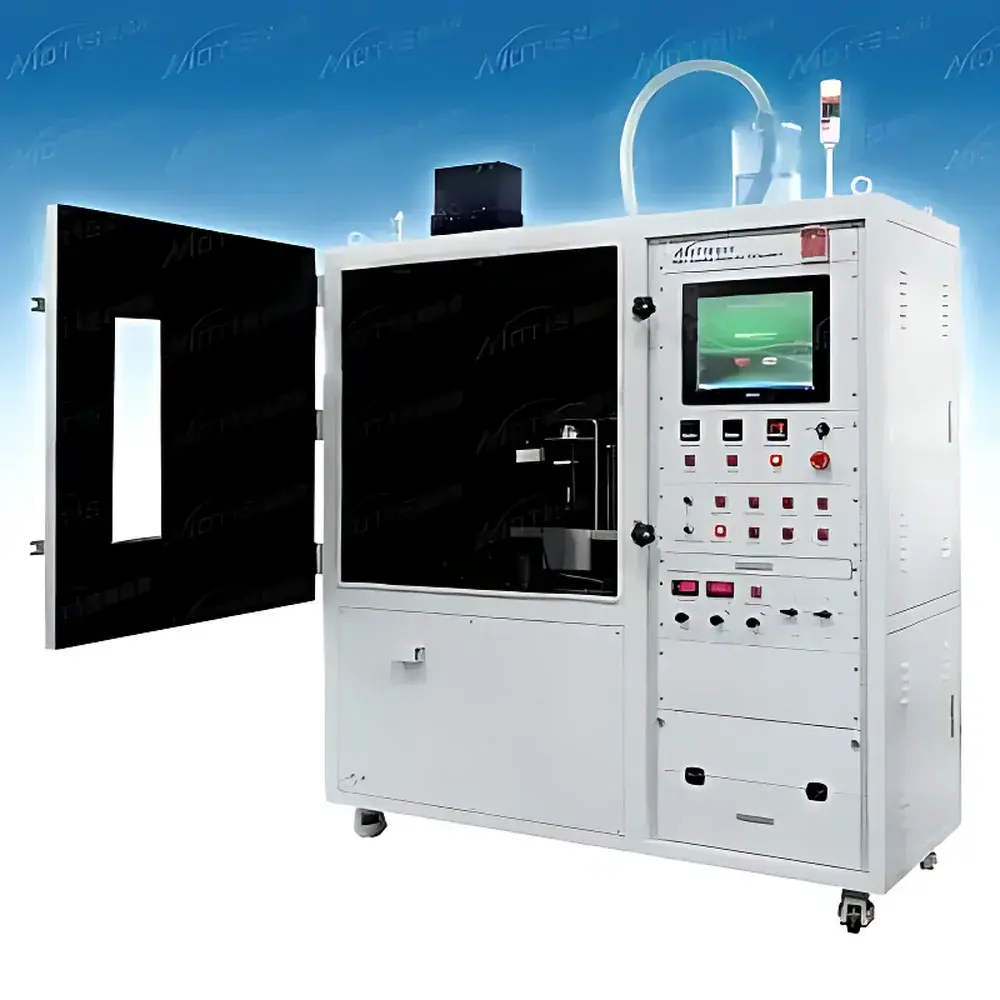
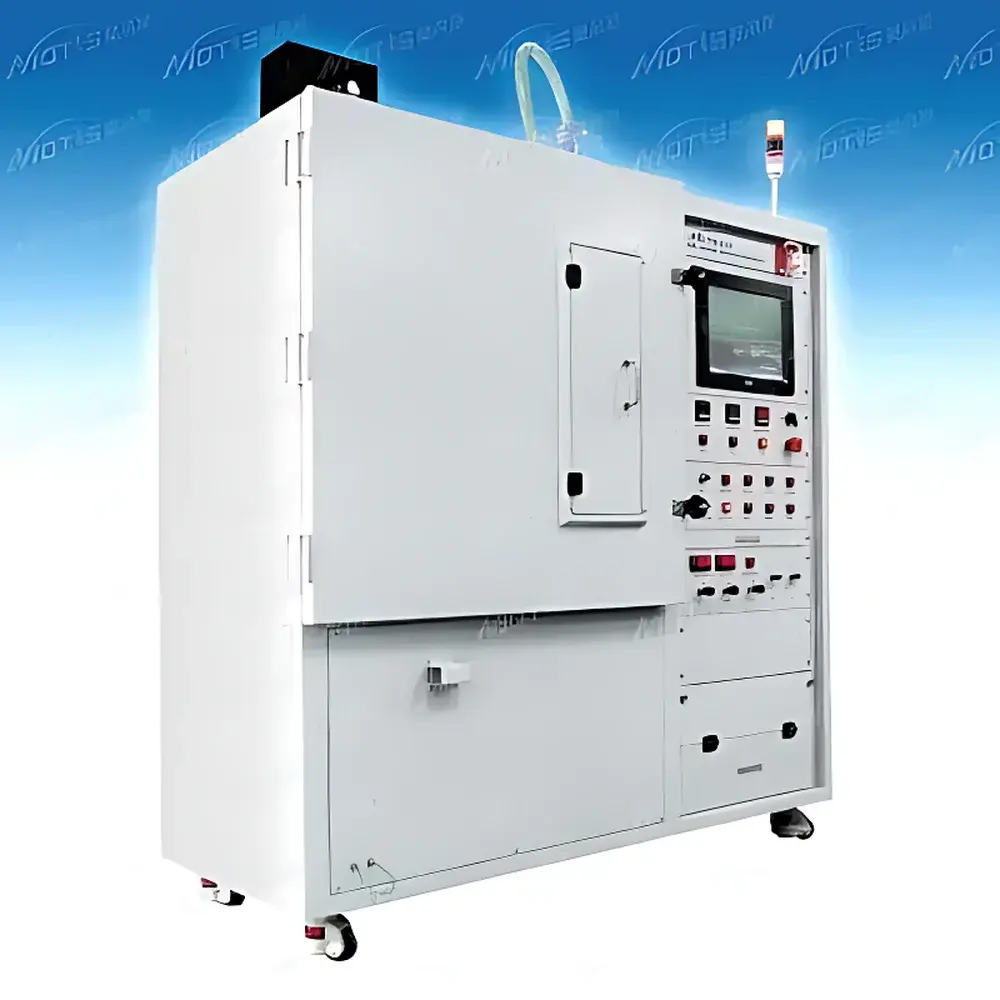
MOTIS SDB Smoke Density Chamber
| Brand | MOTIS |
|---|---|
| Origin | Shanghai, China |
| Model | SDB |
| Chamber Internal Dimensions | 914 × 914 × 610 mm |
| Optical System | Side-window photomultiplier tube (PMT), S-4 spectral response, transmittance resolution 0.0001% |
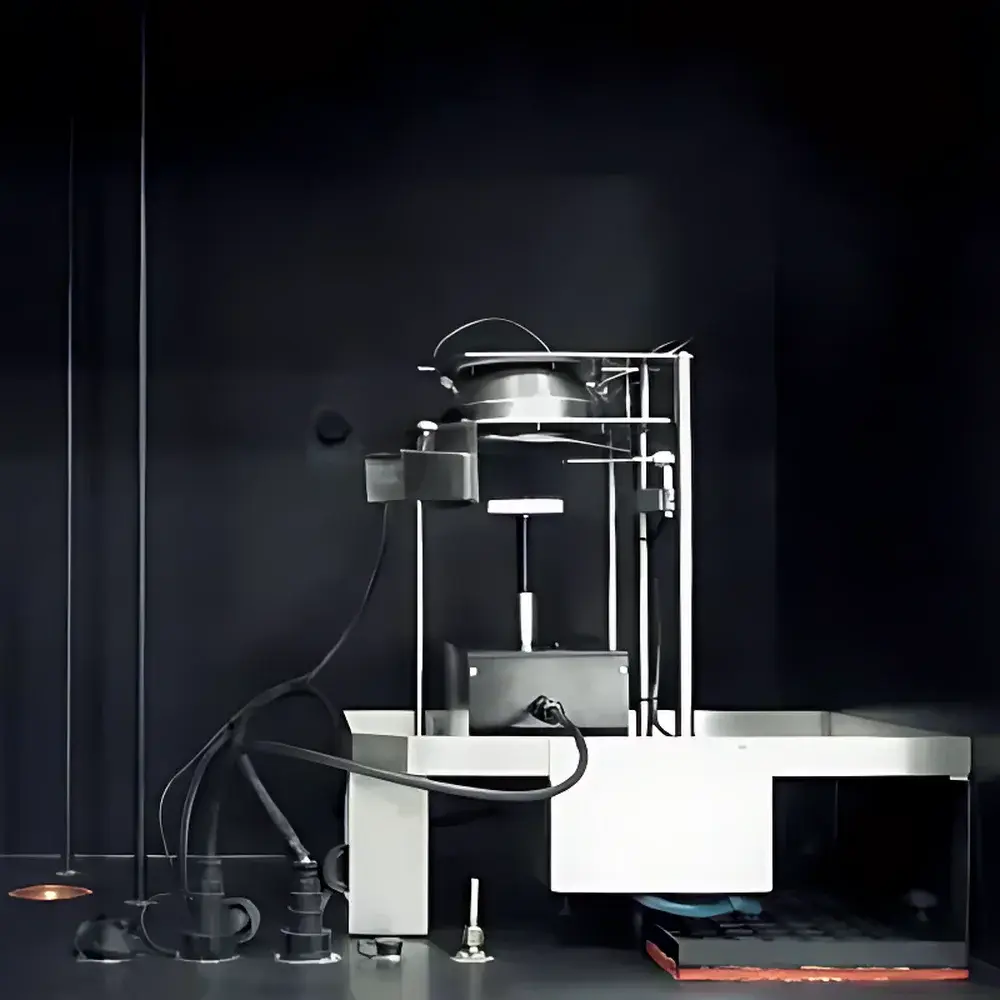
| Radiation Sources | ASTM E662 radiant heater (25 kW/m²) and ISO 5659-2 conical heater (50 kW/m²) |
| Ignition Systems | ASTM E662 flame burner, ISO 5659-2 flame burner, NES 711 flame burner with mixing fan |
| Temperature Control | External auxiliary heating jacket for chamber thermal stabilization |
| Safety Features | Explosion-proof aluminum foil lining, pressure-relief port linked to calibrated volume bottle, dual pneumatic actuators (top/bottom), Teflon-coated interior walls |
| Cooling | Integrated recirculating water chiller (no external supply required), water-cooled MEDTHERM heat flux meter (NIST-traceable calibration) |
| Mass Measurement | Integrated balance, 0–5000 g range, 0.01 g resolution |
| Data Acquisition | Touchscreen PC-based control software with real-time transmittance logging, automated filter wheel (Clear/Filter/Dark/ND2), built-in thermal printer |
| Compliance | ASTM E662, ISO 5659-2, GB/T 8323, NES 711 |
Overview
The MOTIS SDB Smoke Density Chamber is a fully integrated, standards-compliant optical measurement system engineered for quantitative assessment of specific optical density (Ds) generated by non-metallic materials during controlled combustion or radiant exposure. It operates on the fundamental principle of the Beer–Lambert law: incident collimated light (from a stabilized tungsten-halogen source) passes through a defined smoke column within the test chamber, and attenuation of transmitted intensity is measured via a high-sensitivity side-window photomultiplier tube (PMT) with S-4 spectral response. The resulting transmittance data (T%) is mathematically converted into smoke density using the standardized formula Ds = –log₁₀(T/100). This method enables precise, repeatable quantification of smoke obscuration—critical for evaluating fire safety performance in polymers, rail vehicle interior components, marine composites, aerospace wiring insulation, and cable jacketing.
Key Features
- Optically optimized 914 × 914 × 610 mm test chamber with full-opening front door and Teflon-coated interior surfaces for corrosion resistance against acidic combustion byproducts (e.g., HCl, HF, SO₂)
- Dual-standard radiant exposure capability: ASTM E662-compliant radiant heater (25 kW/m²) and ISO 5659-2/GB/T 8323 conical heater (50 kW/m²), both rapidly interchangeable via aviation-grade connectors
- Multi-source ignition support: ASTM E662 flame burner, ISO 5659-2 flame burner, and NES 711 flame burner with integrated mixing fan for uniform smoke dispersion
- Automated optical detection subsystem featuring a motorized filter wheel (Clear / Filter / Dark / ND2 neutral density) and real-time PMT gain adjustment to maintain signal linearity across wide dynamic range (0.0001% transmittance resolution)
- Integrated NIST-traceable MEDTHERM water-cooled heat flux meter for simultaneous radiant heat flux monitoring during cone calorimeter–compatible testing
- Onboard mass loss measurement system (0–5000 g, ±0.01 g) enabling concurrent MOD (Mass Loss Rate × Smoke Production) analysis per ISO 5659-2 Annex D
- Self-contained recirculating chiller eliminates dependency on facility cooling water; auxiliary chamber heating jacket reduces thermal equilibration time prior to test initiation
- Pressure-regulated environment via top-mounted relief port connected to calibrated volumetric bottle; explosion-resistant aluminum foil lining enhances operator safety under overpressure events
Sample Compatibility & Compliance
The SDB accommodates flat, rigid, or semi-rigid specimens up to 100 mm × 100 mm × 25 mm (ASTM E662) or 75 mm × 75 mm × ≤13 mm (ISO 5659-2), including thermoplastics (e.g., PVC, PE, PP), thermosets (epoxies, phenolics), elastomers, foams, laminates, and fiber-reinforced composites. All hardware and software configurations are validated for strict adherence to ASTM E662 (Standard Test Method for Specific Optical Density of Smoke Generated by Solid Materials), ISO 5659-2 (Plastics — Smoke Generation — Part 2: Determination of Optical Density), GB/T 8323.2 (Chinese national equivalent of ISO 5659-2), and NES 711 (Naval Engineering Standard for Smoke Density of Non-Metallic Materials). The system supports GLP-compliant audit trails, user-access level management, and electronic signature functionality aligned with FDA 21 CFR Part 11 requirements when configured with optional secure software modules.
Software & Data Management
Control and data acquisition are managed via an embedded industrial touchscreen PC running proprietary Windows-based firmware. The interface provides real-time visualization of transmittance (%T), calculated smoke density (Ds), mass loss (g), surface temperature (°C), and radiant heat flux (kW/m²). All raw analog signals are digitized at ≥16-bit resolution with 10 Hz sampling rate. Test protocols are preloaded per standard, with parameter lockout to prevent deviation from prescribed ramp rates, exposure durations, and purge cycles. Export options include CSV, PDF, and XML formats compatible with LIMS integration. Automated report generation includes metadata stamping (operator ID, timestamp, instrument serial number), calibration status flags, and pass/fail evaluation against defined Ds thresholds (e.g., Ds₆₀₀ ≤ 100 for low-smoke railway materials per EN 45545-2).
Applications
- Fire safety qualification of polymer formulations for transportation interiors (EN 45545-2 HL3, NF F 16-101, BS 6853)
- Regulatory compliance testing for marine non-metallics under IMO FTP Code Annex 1
- Material screening in aerospace wire & cable development per FAA AC 20-135 and ESA ECSS-Q-ST-70-02C
- Smoke toxicity correlation studies when coupled with Dräger gas detection tubes or FTIR spectrometers (via standardized exhaust port interface)
- R&D of halogen-free flame-retardant additives where smoke suppression is prioritized alongside heat release rate reduction
- Quality assurance of production batches against internal Ds specifications (e.g., maximum Ds₃₀₀ ≤ 75 for subway seat cushions)
FAQ
What standards does the SDB chamber support out-of-the-box?
ASTM E662, ISO 5659-2, GB/T 8323.2, and NES 711 — all hardware and software configurations are factory-validated per respective normative annexes.
Is the optical measurement system NIST-traceable?
Yes: the photomultiplier tube’s spectral responsivity and the MEDTHERM heat flux meter are supplied with NIST-traceable calibration certificates; annual recalibration services are available through MOTIS-certified labs.
Can the chamber be used for smoke toxicity analysis?
The SDB itself measures optical density only; however, its standardized exhaust port (DN50 flange) permits direct coupling to Dräger detector tubes, FTIR gas analyzers, or GC-MS systems for parallel toxic gas quantification.
How is chamber cleaning performed between tests?
The full-front access door and removable upper/lower optical windows allow manual wipe-down with isopropyl alcohol; Teflon coating minimizes residue adhesion and simplifies decontamination after corrosive halogenated smoke exposures.
Does the system meet cybersecurity requirements for regulated laboratories?
When equipped with optional Secure Mode firmware, the SDB enforces password-protected user roles, encrypted data storage, electronic signatures, and immutable audit logs compliant with 21 CFR Part 11 and EU Annex 11 expectations.



