
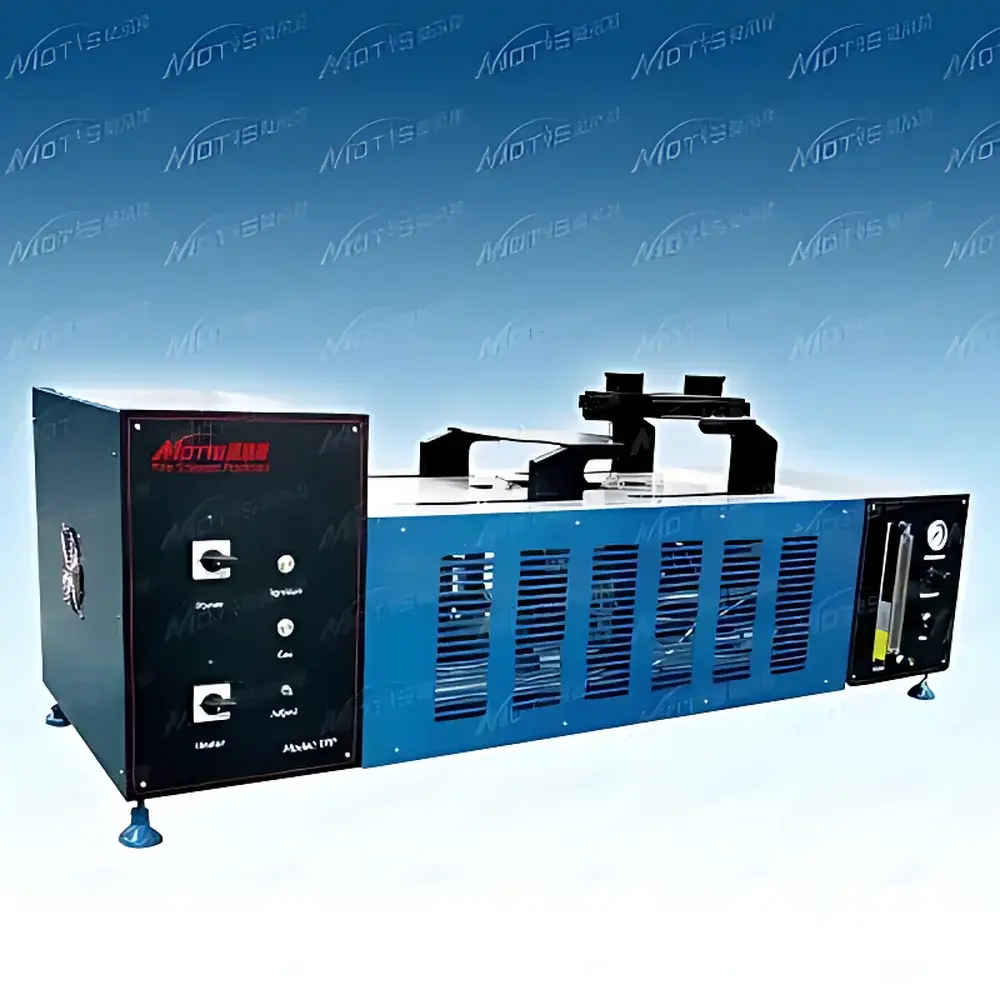
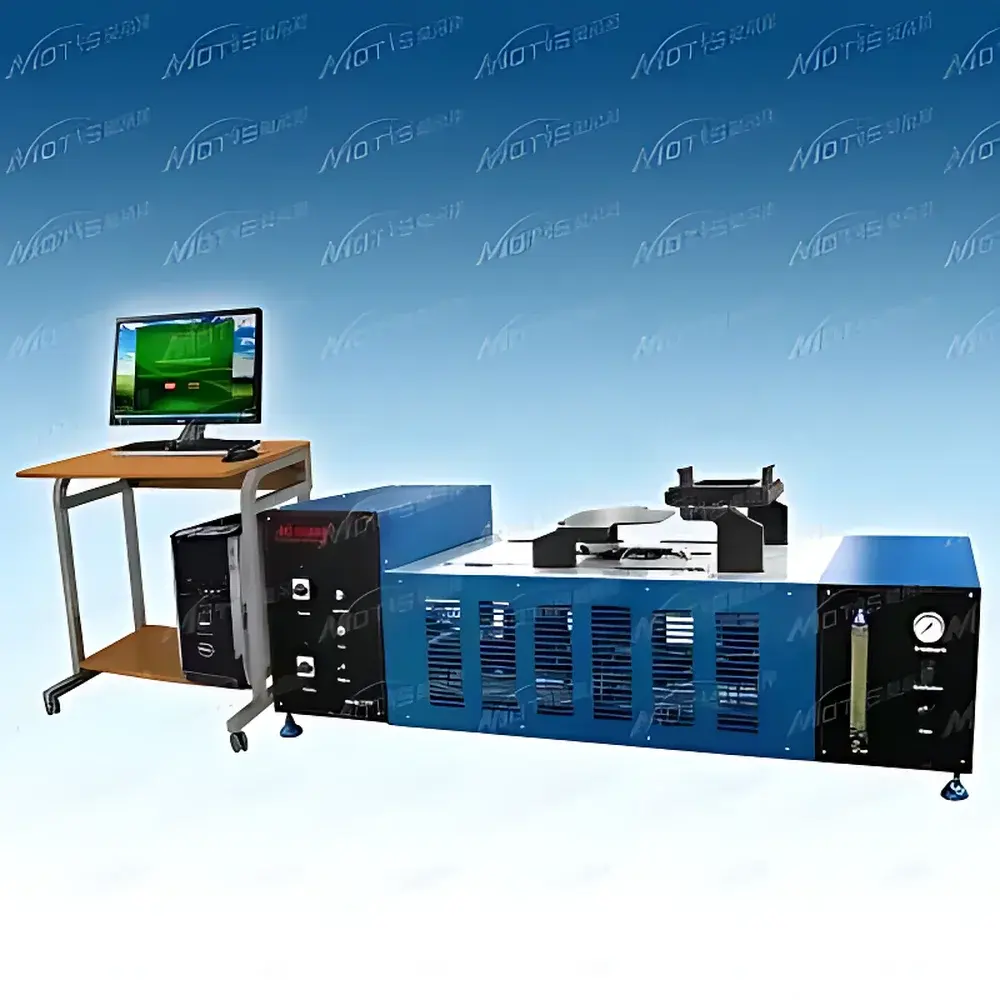
MOTIS TPP Thermal Protective Performance Tester
| Brand | MOTIS |
|---|---|
| Origin | Jiangsu, China |
| Model | TPP |
| Compliance | NFPA 1971, ASTM D4018, GB 8965.1–2009, ISO 12749 |
| Heat Source | Dual Meker burners (38 mm, 5/16″ orifice) + 9× T150 quartz infrared tubes |
| Total Incident Heat Flux | 83 kW/m² ± 2 kW/m² |
| Radiant Flux Range | 13–40 kW/m² ± 4 kW/m² |
| Calibrated Water-Cooled Heat Flux Sensor | 0–100 kW/m², response <200 ms, emissivity >0.95 |
| Thermocouple Resolution | 0.1 °C, accuracy ±0.75 °C |
| Data Acquisition Rate | 20 Hz (50 ms interval) with cold-junction compensation |
| Gas Flow Control | Rotameter ±2% accuracy, range >3 L/min |
| Inlet Pressure Regulation | 0–15 psi via adjustable regulator |
Overview
The MOTIS TPP Thermal Protective Performance Tester is a precision-engineered benchtop instrument designed to quantify the thermal protective capability of personal protective equipment (PPE) materials under controlled, standardized convective and radiant heat exposure. It operates on the principle of measuring time-to-second-degree skin burn (as defined by the Stoll curve) using a copper calorimeter disk mounted beneath the test specimen. The system delivers a reproducible total incident heat flux of 83 kW/m² ± 2 kW/m²—comprising both convective energy from two angled Meker burners and radiant energy from a 9-element T150 quartz tube array—enabling quantitative assessment of thermal barrier performance in accordance with internationally recognized fire safety protocols.
Key Features
- Dual 38 mm Meker burners oriented at 45°, each equipped with a metal mesh flame diffuser and adjustable air/gas mixing valve for stable, repeatable convection output (800–1200 BTU/h per burner)
- 9× T150 quartz infrared tubes arranged in a uniform planar array, delivering calibrated radiant flux between 13–40 kW/m² ± 4 kW/m²
- Water-cooled, NIST-traceable heat flux sensor (0–100 kW/m² range) with 0.95, and analog output ≥5 mV across full scale
- Copper disk calorimeter assembly with integrated Type K thermocouples for real-time measurement of backside temperature rise and calculation of predicted burn time
- Motorized or manually operated stainless-steel shutter for precise initiation/termination of exposure cycles and flame isolation between tests
- Integrated gas control subsystem including ±2% accuracy rotameter, 0–15 psi pressure regulator with analog gauge, and quarter-turn manual shut-off valve for operational safety
- High-resolution data acquisition system sampling at 20 Hz (50 ms intervals), featuring automatic cold-junction compensation and 0.1 °C temperature resolution (±0.75 °C accuracy)
Sample Compatibility & Compliance
The MOTIS TPP tester accommodates flat, rigid, or semi-rigid specimens up to 150 mm × 150 mm—including woven and nonwoven fabrics, laminated composites, leather, coated textiles, and molded polymer components used in firefighter turnout gear, military uniforms, industrial gloves, safety footwear, and helmet shells. All mechanical, thermal, and signal conditioning subsystems are configured to meet the geometric, procedural, and instrumentation requirements specified in NFPA 1971 (2022 edition), ASTM D4018–21, ISO 12749:2015, and GB 8965.1–2009. The system includes documentation supporting audit readiness for GLP-compliant laboratories and provides a NIST-traceable calibration certificate valid for 12 months.
Software & Data Management
The included Windows-based TPP Test Suite supports fully automated test execution, real-time visualization of front-side heat flux and backside temperature profiles, and auto-generation of Stoll-curve-derived time-to-predicted-burn metrics. Raw data is saved in CSV and proprietary binary formats with embedded metadata (operator ID, sample ID, ambient conditions, calibration date). The software enforces user-level access controls, maintains an immutable audit trail of all test modifications and parameter changes, and generates PDF reports compliant with 21 CFR Part 11 requirements—including electronic signatures, timestamping, and revision history. Export options include Excel-compatible datasets and publication-ready vector graphics for technical documentation and regulatory submissions.
Applications
This instrument serves as a primary evaluation tool in R&D labs developing next-generation thermal barriers; quality control environments verifying batch-to-batch consistency of PPE materials; certification bodies conducting third-party conformance testing; and academic fire science programs investigating heat transfer mechanisms through multilayer systems. Typical use cases include comparative analysis of fabric weight vs. TPP rating, impact of moisture content on thermal insulation, aging effects after repeated laundering or exposure to UV/chemical agents, and validation of novel aerogel or phase-change material integrations into structural firefighting ensembles.
FAQ
What standards does the MOTIS TPP Tester fully support?
NFPA 1971 (Standard on Structural Fire Fighting Protective Clothing), ASTM D4018 (Standard Test Method for Thermal Protective Performance of Materials), ISO 12749 (Protective Clothing — Determination of Thermal Protection), and GB 8965.1–2009 (Chinese national standard for flame-resistant clothing).
Is the heat flux sensor calibrated to NIST standards?
Yes—the water-cooled heat flux sensor is supplied with a NIST-traceable calibration certificate covering the full 0–100 kW/m² range, valid for 12 months from date of shipment.
Can the system operate with propane, natural gas, or butane?
The dual Meker burners are configured for propane supply; optional conversion kits for natural gas are available upon request and require recalibration.
What is the minimum specimen thickness the calorimeter can accommodate?
The test fixture accepts specimens ranging from 0.2 mm (e.g., thin films) to 25 mm (e.g., padded composites), with adjustable clamping force to ensure consistent thermal contact without compression artifacts.
Does the software support multi-language interfaces?
The default interface is English; localized versions (Spanish, French, German, Japanese) are available as licensed add-ons with validated terminology per ISO/IEC 17025 translation protocols.



