
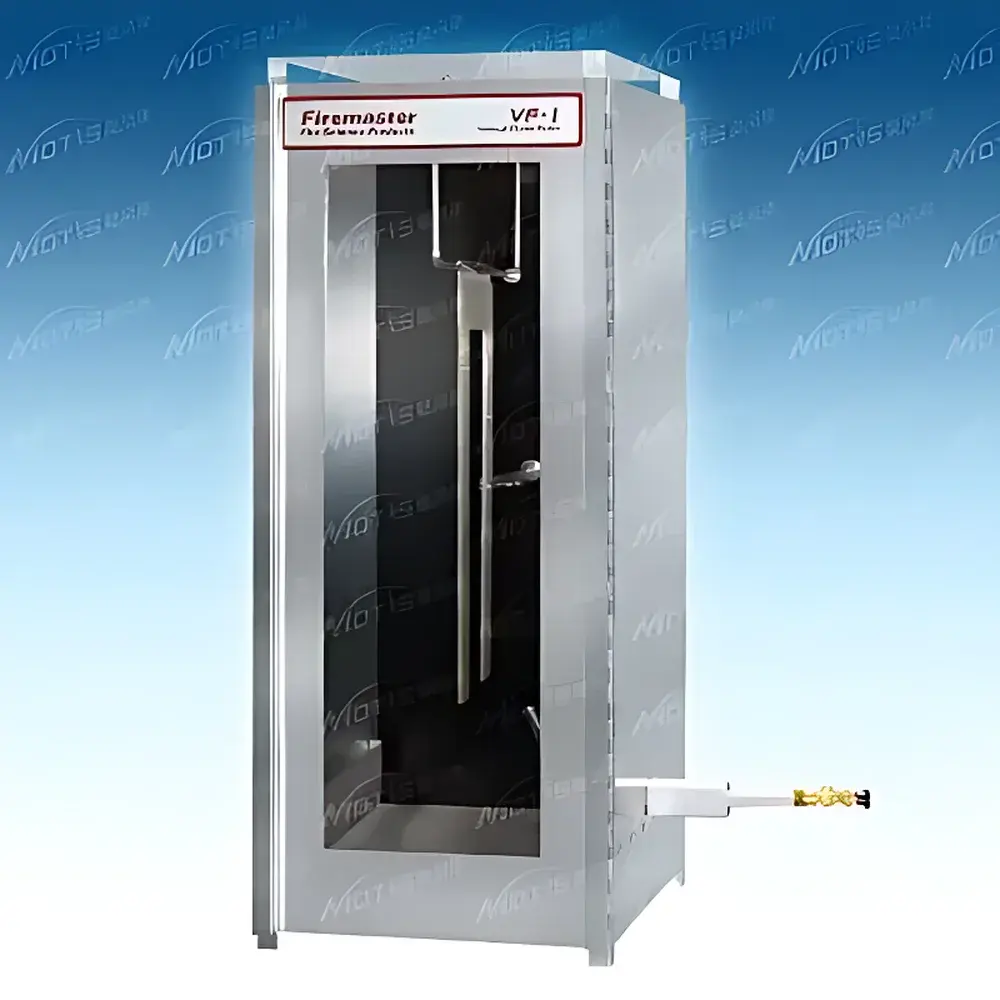
MOTIS VF-1 Vertical Flame Test Chamber
| Brand | MOTIS |
|---|---|
| Origin | Shanghai, China |
| Model | VF-1 |
| Compliance Standards | ASTM D6413, ISO 6941, GB/T 5455, CFR 1615/1616, CA TB117 |
| Chamber Material | Stainless Steel (304) |
| Viewing Window | Tempered Borosilicate Glass |
| Burner Adjustment | Linear Sliding Rail with Precision Needle Valve |
| Sample Holder Options | Multiple Interchangeable Fixtures for Woven, Knitted, and Nonwoven Textiles |
| Flame Height Range | 10–50 mm (adjustable via calibrated needle valve) |
| Ignition Source | Laboratory-grade Bunsen-type Gas Burner (Propane or Butane) |
Overview
The MOTIS VF-1 Vertical Flame Test Chamber is an engineered solution for standardized flammability evaluation of textile materials under controlled vertical orientation. Designed in strict alignment with internationally recognized test methodologies—including ASTM D6413 (Standard Test Method for Flame Resistance of Textiles), ISO 6941 (Textiles — Determination of the Burning Behaviour of Vertical Specimens), and GB/T 5455 (Chinese national standard for vertical flame testing)—the VF-1 provides reproducible, auditable, and operator-safe assessment of afterflame time, afterglow time, char length, and whether flaming drips ignite cotton indicator fabric. Its core measurement principle relies on defined ignition source geometry, precise specimen mounting angle (90° vertical), regulated airflow conditions within the chamber enclosure, and timed exposure to a calibrated open flame. The system does not generate quantitative combustion metrics (e.g., heat release rate or LOI); rather, it delivers pass/fail or classification-based outcomes per regulatory thresholds—making it essential for quality control laboratories supporting apparel, home textiles, and juvenile product compliance.
Key Features
- Robust 304 stainless steel chamber construction ensures long-term corrosion resistance against combustion byproducts and repeated thermal cycling.
- Front-facing tempered borosilicate glass observation window (≥15 mm thickness) provides full visual access while maintaining structural integrity and thermal shielding during test execution.
- Linear sliding rail-mounted burner assembly enables rapid, repeatable positioning relative to the specimen—critical for minimizing inter-operator variability and ensuring consistent flame impingement geometry.
- Integrated precision needle valve allows fine-tuned adjustment of flame height between 10 mm and 50 mm, traceable to calibration protocols specified in ASTM D6413 Annex A1.
- Modular sample holder system accommodates standardized specimen dimensions (e.g., 50 mm × 300 mm strips per ASTM) as well as alternative configurations for knits, pile fabrics, laminates, and multi-layer composites—each fixture designed to eliminate sagging or lateral displacement during exposure.
- No external ventilation ducting required; chamber operates as a self-contained, low-airflow environment compliant with ISO 6941 Annex B specifications for ambient draft suppression.
Sample Compatibility & Compliance
The VF-1 supports testing of diverse textile substrates including but not limited to: woven cotton and polyester blends, flame-retardant-treated workwear fabrics, children’s sleepwear (per CFR 1615/1616 requirements), upholstered furniture coverings (aligned with CA TB117–2013 Section 1), and technical textiles used in transportation interiors. All test procedures executed on the VF-1 are fully traceable to clause-referenced steps in ASTM D6413, ISO 6941, and GB/T 5455. The instrument itself does not carry CE marking or UL certification; however, its mechanical design, dimensional tolerances, and operational parameters conform to the physical apparatus requirements stipulated in each referenced standard. Laboratories deploying the VF-1 for regulatory submissions must validate method performance per ISO/IEC 17025:2017 Clause 7.2.2 and maintain documented evidence of periodic verification (e.g., flame height calibration, timer accuracy, specimen clamp torque consistency).
Software & Data Management
The VF-1 operates as a manually controlled, non-automated test platform—consistent with the procedural intent of ASTM D6413 and related standards, which emphasize human observation and stopwatch-based timing. No embedded software, data logging, or digital output interfaces are integrated. This architecture eliminates electronic failure modes and aligns with GLP-compliant environments where audit trails rely on paper-based or LIMS-integrated manual entry. Users record observed parameters—including ignition time, afterflame duration, afterglow duration, char length measurement, and presence/absence of flaming drips—directly onto standardized test report forms. Optional accessories include calibrated digital timers (NIST-traceable, ±0.1 s accuracy) and stainless steel rulers with engraved millimeter scales for direct char length measurement.
Applications
- Pre-market validation of flame-resistant children’s sleepwear per U.S. CPSC regulations (CFR Title 16 Parts 1615 and 1616).
- Quality assurance testing for contract upholstery fabrics supplied to California-based furniture manufacturers subject to TB117–2013.
- Internal R&D screening of novel flame-retardant finishes applied to natural and synthetic fibers.
- Third-party certification support for textile mills seeking OEKO-TEX® Standard 100 Class II or EN 11612 compliance documentation.
- Educational laboratory instruction in textile engineering programs covering fire safety fundamentals and standard test protocol execution.
FAQ
Does the VF-1 meet ASTM D6413 requirements for burner alignment and flame geometry?
Yes—the sliding rail mechanism and needle valve enable precise burner positioning at 17 mm ± 1 mm from the bottom edge of the specimen, with flame height set to 38 mm ± 2 mm, as mandated in ASTM D6413 Section 6.2.
Can the VF-1 be used for testing non-textile materials such as foams or thin plastics?
No—its fixture design, specimen dimensions, and regulatory scope are exclusively validated for flexible planar textile specimens. Testing of polymeric films or elastomeric foams requires alternate apparatus per ASTM D3801 or ISO 9772.
Is gas supply included with the instrument?
No—users must provide a regulated propane or butane supply meeting ASTM D6413 Section 5.1 specifications (minimum 95% purity, pressure-regulated to 10–15 kPa at burner inlet).
What maintenance is required to ensure long-term compliance?
Monthly inspection of burner tip for carbon buildup, quarterly verification of flame height repeatability using a calibrated gauge, and annual replacement of O-rings in gas line connections per manufacturer guidelines.
Does MOTIS provide installation qualification (IQ) or operational qualification (OQ) documentation?
Upon request, MOTIS supplies a factory-verified IQ/OQ protocol template aligned with ISO/IEC 17025 requirements; final qualification must be performed by the end-user’s qualified personnel or accredited third party.



