
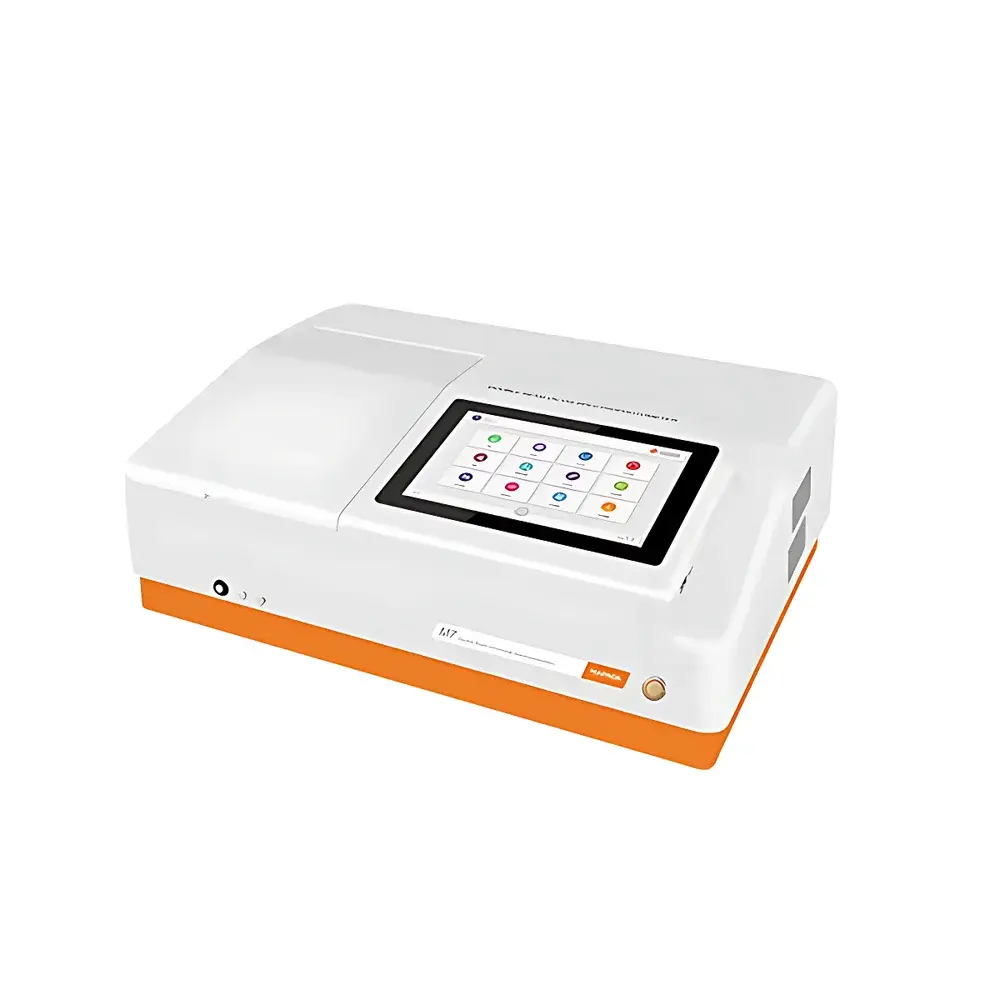
MPB M7 Dual-Beam Pulsed Xenon Lamp UV-Vis Spectrophotometer
| Brand | MPB |
|---|---|
| Origin | Shanghai, China |
| Manufacturer Type | Original Equipment Manufacturer (OEM) |
| Regional Classification | Domestic (China) |
| Model | M7 |
| Price Range | USD 9,800 – 14,000 |
| Optical Design | Dual-beam |
| Detector Type | Silicon Photocell |
| Wavelength Range | 190 – 1100 nm |
| Wavelength Scanning Mode | Motorized Automatic |
| Spectral Bandwidth | 2 nm |
| Wavelength Accuracy | ±0.5 nm |
Overview
The MPB M7 Dual-Beam Pulsed Xenon Lamp UV-Vis Spectrophotometer is engineered for high-fidelity absorbance, transmittance, and reflectance measurements across the ultraviolet, visible, and near-infrared spectral regions (190–1100 nm). Unlike conventional instruments relying on deuterium/tungsten halogen lamp pairs, the M7 employs a single, high-intensity pulsed xenon arc lamp as its broadband light source. This design eliminates lamp-switching artifacts, ensures intrinsic wavelength stability, and delivers uniform photon flux across the full range—critical for reproducible quantitative analysis and kinetic monitoring. The dual-beam optical architecture continuously splits and recombines reference and sample beams via a rotating sector mirror, enabling real-time compensation for source drift, detector sensitivity fluctuations, and environmental perturbations. Its compact footprint and integrated Bluetooth interface support seamless wireless operation with Windows-based tablets—optimized for benchtop flexibility in teaching laboratories, QC environments, and field-deployable research workflows.
Key Features
- Dual-beam optical path with real-time reference correction, minimizing baseline drift and enhancing measurement repeatability over extended acquisition periods.
- Pulsed xenon lamp illumination: cold-light source requiring zero warm-up time; eliminates thermal load on temperature-sensitive biological samples (e.g., enzymes, nucleic acids, live cells) and prevents photodegradation during prolonged scans.
- Motorized automatic wavelength scanning with ±0.5 nm accuracy and 2 nm spectral bandwidth—compliant with ISO 9001 calibration traceability requirements and suitable for method validation under GLP/GMP frameworks.
- Compact, space-efficient chassis designed for modular integration into analytical workstations or mobile lab carts; weighs <12 kg and occupies <0.15 m² footprint.
- Bluetooth 5.0 connectivity certified for stable, low-latency communication with Microsoft Surface Pro tablets preloaded with MPB SpectraSuite v4.x software—no external PC required.
Sample Compatibility & Compliance
The M7 accommodates standard 10 mm square cuvettes (quartz, glass, or plastic), micro-volume adapters (down to 50 µL), and optional fiber-optic probes for non-contact or in-situ measurements. Its xenon-based illumination avoids UV-C emission (<190 nm), eliminating ozone generation and reducing safety hazards associated with deep-UV sources. Instrument firmware and software are structured to support audit-ready data integrity: all user actions—including method creation, parameter modification, and result export—are timestamped and logged with operator ID. Full compliance with FDA 21 CFR Part 11 is enabled via optional electronic signature modules and encrypted database storage—meeting regulatory expectations for pharmaceutical QC, clinical chemistry, and contract research organizations operating under ICH-GCP or ISO/IEC 17025 standards.
Software & Data Management
SpectraSuite v4.x provides an intuitive, role-based interface supporting 12 core measurement modes: photometric (A/T/%T), quantitative (single/multi-point calibration), multi-wavelength analysis, full-spectrum scanning (190–1100 nm), time-based kinetics (up to 10,000 data points per run), enzyme activity assays (Vmax/Km derivation), DNA/RNA/protein quantification (260/280 nm ratio, extinction coefficient application), dual-component analysis, user-defined equation scripting, and GLP-compliant report generation. All datasets are stored in vendor-neutral CSV and XML formats; raw spectra include metadata (wavelength, slit width, integration time, detector gain, calibration date). Audit trails record operator logins, method changes, and data exports—retained for ≥36 months unless purged under documented retention policies.
Applications
The M7 serves as a primary analytical tool in academic teaching labs for Beer-Lambert law verification, equilibrium constant determination, and enzyme kinetics demonstrations. In industrial settings, it supports raw material identity testing (e.g., API verification per USP ), excipient purity assessment, dissolution profile monitoring, and water quality analysis (nitrate, phosphate, COD estimation). Its cold-light capability enables routine quantification of thermolabile biomolecules without cryogenic handling—facilitating high-throughput screening in biotech R&D and diagnostics development. Environmental labs utilize its broad spectral coverage for chlorophyll-a, turbidity, and heavy metal complexation studies compliant with EPA Method 4500-NO3− and ISO 7027.
FAQ
Does the M7 require lamp alignment or periodic recalibration by the user?
No—optical alignment is factory-set and sealed; only annual verification using NIST-traceable holmium oxide and didymium filters is recommended per ISO/IEC 17025 guidelines.
Can the instrument be integrated into a LIMS environment?
Yes—SpectraSuite supports ODBC-compliant database export and HL7 message formatting for direct ingestion into enterprise LIMS platforms.
Is the pulsed xenon lamp replaceable by the end user?
Yes—the lamp module is tool-free and hot-swappable; average lifetime exceeds 10⁹ pulses (≥5 years at 100 scans/day).
What validation documentation is supplied with the instrument?
Each unit ships with a Certificate of Conformance, Factory Calibration Report (including wavelength accuracy, photometric linearity, and stray light performance), and IQ/OQ protocol templates aligned with ASTM E275 and USP .
How is data security maintained during Bluetooth transmission?
All wireless sessions use AES-128 encryption; pairing requires manual confirmation on both devices, and no data is cached on the tablet outside the secured SpectraSuite application sandbox.
Related Products




