
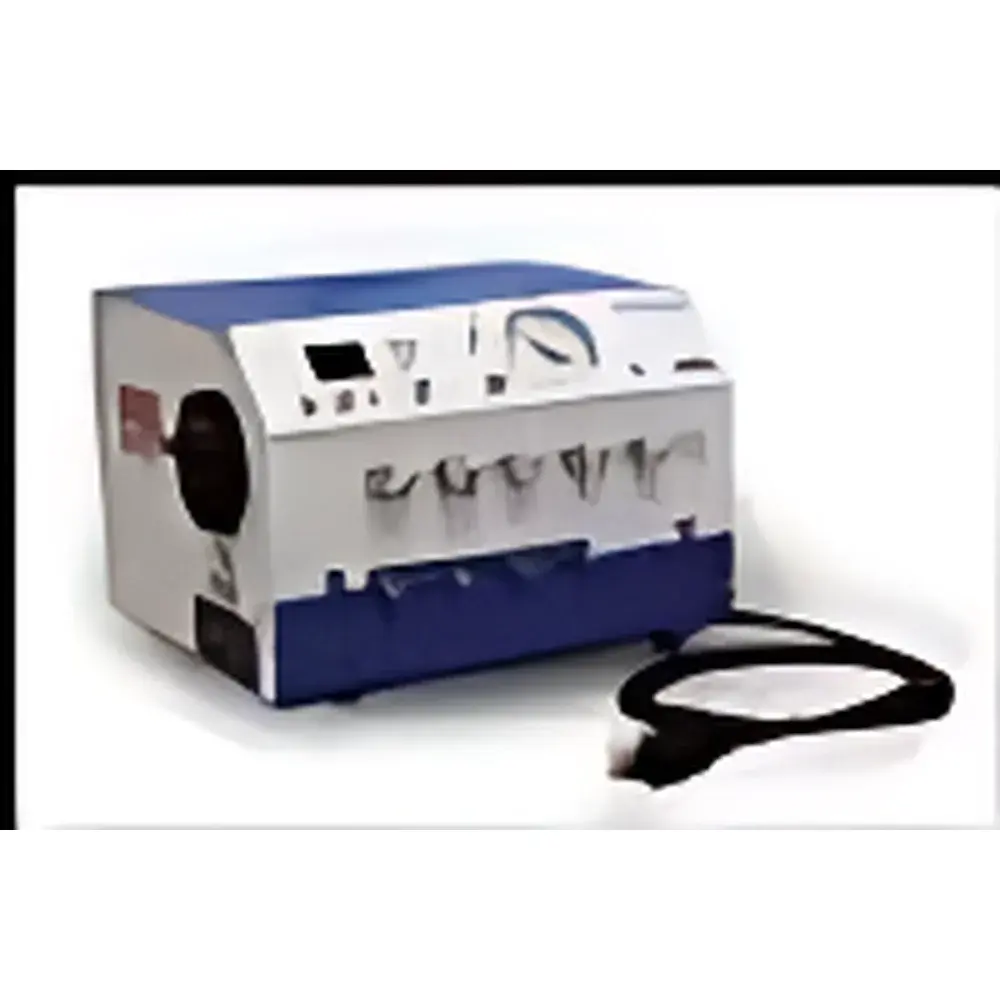
MPB PSX-100 Compact Excimer Laser System
| Brand | MPB |
|---|---|
| Origin | Canada |
| Model | PSX-100 |
| Laser Type | Gas-based Pulsed Excimer Laser |
| Pulse Energy | Millijoule-level (typ. 1–10 mJ, depending on gas mixture and operating conditions) |
| Pulse Width | 2.5 ns (FWHM) |
| Peak Power | >2 MW |
| Cooling | Air-cooled |
| Electrode Architecture | Optimized flowing-gas discharge with low residual reverse current |
| Thyratron Lifetime | >3×10⁸ pulses |
| Halogen Compatibility | Compatible with F₂, ArF, KrF, XeCl, and XeF without passivation requirements |
| Form Factor | Monolithic, portable benchtop design |
| Compliance | Designed for laboratory integration under ISO 11146 (laser beam parameters), IEC 60825-1 (laser safety), and compatible with standard cleanroom and Class 1000 environments |
Overview
The MPB PSX-100 is a monolithic, air-cooled excimer laser system engineered for precision pulsed ultraviolet light generation in demanding scientific and industrial applications. Operating on the principle of transient molecular excitation in rare-gas halide gas mixtures (e.g., ArF at 193 nm, KrF at 248 nm, XeCl at 308 nm), the PSX-100 delivers high peak power UV pulses through a stable, self-contained discharge architecture. Its core innovation lies in the integration of a high-efficiency flowing-gas excitation circuit with minimized reverse current recovery—enabling consistent pulse-to-pulse energy stability (<±2% RMS over 10⁴ pulses) and exceptional long-term operational reliability. Unlike conventional excimer lasers requiring water cooling, external gas recirculation, or complex optical alignment, the PSX-100 achieves millijoule-level output in a single, compact chassis measuring under 450 × 300 × 200 mm—making it uniquely suited for space-constrained laboratories, mobile analytical platforms, and OEM integration into vacuum-compatible instrumentation.
Key Features
- Monolithic benchtop design with fully integrated high-voltage pulsing, gas handling, and thermal management—no external chillers, compressors, or gas cabinets required.
- Air-cooled operation enables continuous duty cycling up to 100 Hz (depending on gas fill and pulse energy), eliminating dependency on facility cooling water infrastructure.
- Sub-3 ns pulse width (2.5 ns FWHM) supports time-resolved photophysical studies, ultrafast ablation thresholds, and high-resolution laser-induced breakdown spectroscopy (LIBS).
- Thyratron-switched discharge architecture with >3×10⁸ shot lifetime ensures multi-year maintenance intervals under typical QC/QA or R&D usage profiles.
- Gas-agnostic electrode geometry accommodates F₂ (157 nm), ArF (193 nm), KrF (248 nm), XeCl (308 nm), and XeF (351 nm) without internal surface passivation—reducing gas changeover downtime and contamination risk.
- Optimized resonator optics with dielectric coatings provide >65% electrical-to-optical conversion efficiency and M² < 30 for near-diffraction-limited beam propagation in fiber-coupled or free-space configurations.
Sample Compatibility & Compliance
The PSX-100 is designed for direct integration into vacuum chambers (down to 10⁻⁶ Torr), gloveboxes, and inert-atmosphere processing stations. Its all-metal, non-outgassing housing and halogen-compatible internal surfaces meet ASTM E595 low outgassing specifications for space-qualified instrumentation. The system complies with IEC 60825-1:2014 Class 4 laser safety requirements, incorporating interlocked shutter control, beam path enclosures, and embedded emission logging per FDA 21 CFR Part 1040.10. It supports GLP/GMP-aligned operation via optional analog/digital trigger interfaces and TTL-synchronized pulse monitoring outputs—enabling full traceability for regulated applications in semiconductor metrology (SEMI S2/S8), pharmaceutical photolysis validation, and USP laser-based dissolution testing.
Software & Data Management
The PSX-100 operates via RS-232/USB-C serial interface with vendor-provided LabVIEW™ and Python SDKs (v3.8+). Real-time monitoring includes pulse energy (via internal calibrated photodiode), repetition rate, thyratron voltage decay profile, and gas pressure trending. All operational logs—including timestamped pulse count, energy history, and fault codes—are stored in CSV-compliant binary files with SHA-256 checksum integrity verification. Audit trail functionality meets FDA 21 CFR Part 11 requirements when deployed with validated third-party LIMS or ELN platforms (e.g., LabWare, Benchling). Remote diagnostics support TLS 1.2-encrypted firmware updates and secure configuration backup/restoration.
Applications
- Laser ablation for LA-ICP-MS sample introduction, enabling sub-µm spatial resolution mapping of geological, biological, and metallurgical specimens.
- UV photolithography mask repair and direct-write microstructuring in MEMS/NEMS fabrication workflows.
- Time-resolved fluorescence upconversion and transient absorption spectroscopy (TAS) using pump-probe delay stages synchronized to <10 ps jitter.
- Photoionization source for orthogonal acceleration TOF mass spectrometers in ambient ionization and single-cell metabolomics.
- Nonlinear frequency conversion (e.g., fourth-harmonic generation in BBO crystals) for deep-UV coherent light sources in synchrotron pre-characterization.
- Surface functionalization of polymers and biomaterials via controlled photochemical grafting under nitrogen or argon atmospheres.
FAQ
What gas mixtures are supported out-of-the-box?
The PSX-100 is factory-configured for KrF (248 nm) and XeCl (308 nm); ArF (193 nm), F₂ (157 nm), and XeF (351 nm) operation require optional gas-handling module calibration and UV-grade quartz window replacement.
Is remote triggering supported for synchronization with other instruments?
Yes—TTL-compatible external trigger input (5 V CMOS, <10 ns jitter) and programmable delay generator output (0–100 ms range, 1 ns resolution) are standard.
What maintenance is required between gas refills?
No scheduled maintenance is required; gas refills occur every 1×10⁷–5×10⁷ shots depending on pulse energy and gas type—typically every 6–18 months under continuous lab use.
Can the PSX-100 be operated inside a vacuum chamber?
Yes—the base model features CF-40 flange mounting and optional differential pumping ports for direct integration into UHV systems down to 10⁻⁸ Torr.
Does the system include beam delivery optics?
No—beam collimation, focusing, and harmonic separation optics must be selected separately based on application-specific M², divergence, and spectral bandwidth requirements.




