
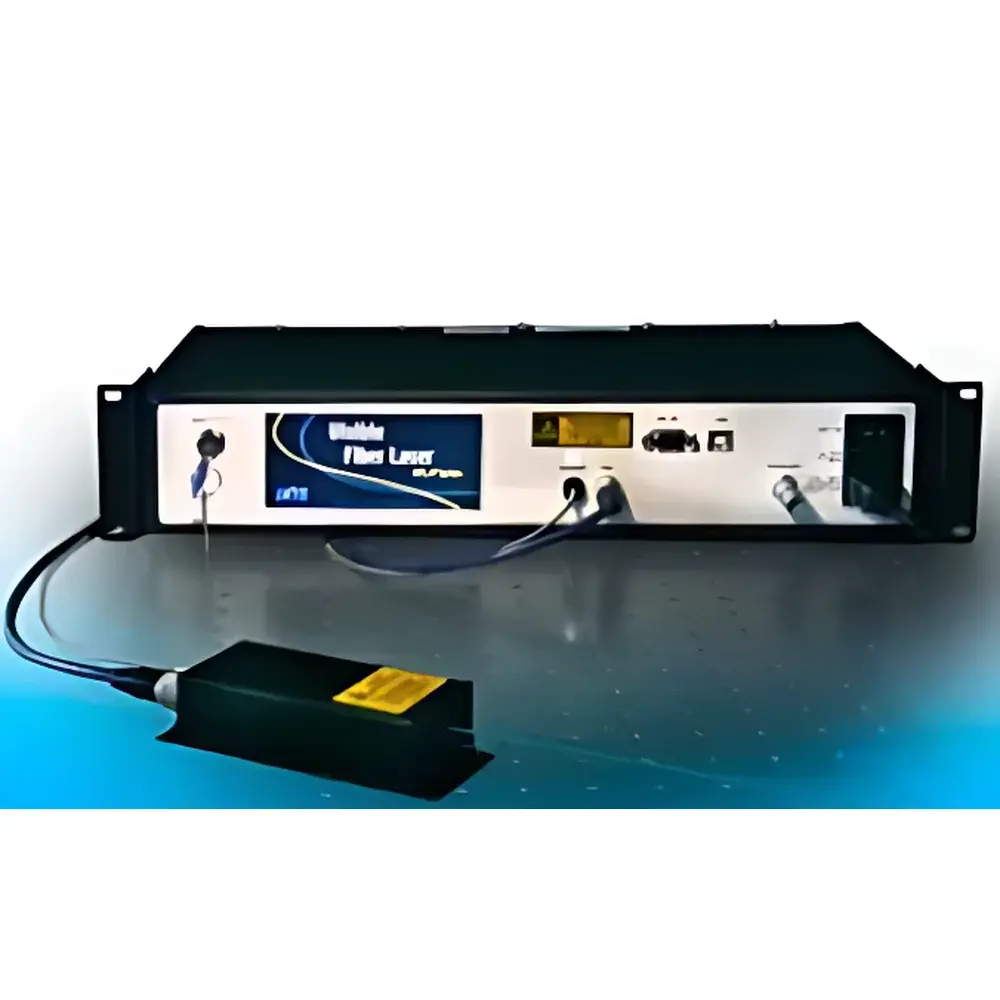
MPB VFL-P Series 532 nm Fiber-Coupled Continuous-Wave Diode-Pumped Solid-State (DPSS) Laser
| Brand | MPB |
|---|---|
| Origin | Canada |
| Model | VFL-P-200-532 |
| Output Power Options | 200–2000 mW (CW) |
| Wavelength | 532 nm |
| Beam Mode | TEM₀₀ |
| Polarization | Linear, vertical to baseplate |
| Beam Divergence (Full Angle) | < 5 mrad |
| Power Stability (RMS, 8 hrs) | ±0.5% |
| Wavelength Stability | ±0.02 nm |
| Cooling | Air-cooled |
| Interfaces | RS232 & USB |
| Safety | Interlock (desktop), Emergency Stop & Integrated Transformer (2RU rack-mount) |
Overview
The MPB VFL-P Series is a family of fiber-coupled, continuous-wave (CW) diode-pumped solid-state (DPSS) lasers emitting at the fundamental wavelength of 532 nm. Engineered for high spectral purity and long-term amplitude stability, these lasers utilize intracavity frequency-doubling of a 1064 nm Nd:YVO₄ or Nd:YAG gain medium to generate visible green light with excellent beam quality (TEM₀₀, M² ≤ 1.1). Unlike direct diode lasers, the DPSS architecture ensures narrow linewidth (< 0.1 nm), low amplitude noise (< 0.3% RMS over 10 Hz–10 MHz), and minimal pointing drift—critical attributes for applications demanding precise photon delivery and interference-limited coherence. The series is available in both benchtop and 2RU 19″/23″/ETSI-rack-compatible configurations, supporting integration into automated optical platforms, clinical instrumentation, and industrial process control systems.
Key Features
- Fiber-coupled output (standard FC/PC or optional SMA905) enabling flexible beam delivery and simplified alignment in OEM systems
- High power stability: ±0.5% RMS over 8 hours under constant ambient conditions (23 ± 2°C, no air drafts)
- Ultra-stable wavelength output: ±0.02 nm deviation from nominal 532.0 nm, verified via calibrated wavemeter traceability to NIST standards
- Dual digital interfaces—RS232 and USB 2.0—with full SCPI command set for remote power modulation, status monitoring, and fault logging
- Integrated graphical user interface (GUI) for real-time parameter visualization, preset recall, and firmware updates
- Air-cooling architecture with intelligent thermal management; no external chiller required for operation up to 2000 mW in 2RU format
- Comprehensive safety compliance: Class 3B laser product per IEC 60825-1:2014; includes hardware interlock loop (benchtop), emergency stop button, and redundant current-limiting circuitry (2RU)
Sample Compatibility & Compliance
The VFL-P Series is designed for compatibility with standard optical components used across life science and industrial metrology workflows. Its linearly polarized, diffraction-limited output couples efficiently into single-mode fibers (SMF-28, 405–600 nm), acousto-optic modulators (AOMs), and scanning galvanometers. All models comply with international regulatory frameworks including CE marking (EMC Directive 2014/30/EU and LVD Directive 2014/35/EU), RoHS 2011/65/EU, and FDA 21 CFR Part 1040.10 (Laser Product Performance Standard). For GxP environments, the laser supports audit-trail-capable software logging (via USB/RS232) and meets baseline requirements for GLP-compliant instrument qualification (IQ/OQ protocols available upon request).
Software & Data Management
MPB provides the VFL Control Suite—a platform-independent application compatible with Windows, macOS, and Linux—that enables full device configuration, real-time telemetry (output power, diode temperature, driver current), and scheduled power ramping. Logged data are exported in CSV format with timestamped metadata (ISO 8601), supporting traceability in regulated labs. The SCPI command library allows seamless integration into LabVIEW, Python (PyVISA), MATLAB, and EPICS-based control systems. Firmware updates preserve calibration coefficients and retain user-defined presets, ensuring continuity during lifecycle maintenance.
Applications
- Fluorescence Microspectroscopy: Stable 532 nm excitation for Raman-enhanced fluorescence imaging and lifetime decay analysis in confocal and widefield systems
- Flow Cytometry: High-brightness, low-noise source for multi-parameter cell sorting and viability assays requiring precise photodetector triggering
- Ophthalmology: Used in adaptive optics retinal imaging and selective retina therapy (SRT) platforms where beam uniformity and pulse-free CW emission are essential
- Thin-Film Characterization: Ellipsometry and photoluminescence excitation in semiconductor and OLED R&D, leveraging narrow spectral bandwidth and polarization fidelity
- Laser Sintering & Additive Manufacturing: Precision heat-source for micro-scale metal and ceramic powder fusion in research-grade selective laser sintering (SLS) testbeds
- Calibration Standards: Reference source for spectrometer wavelength calibration (e.g., against known atomic lines of Neon or Mercury-Argon lamps)
FAQ
Is the 532 nm output inherently TEM₀₀, or is spatial mode filtering applied?
The laser cavity is designed for fundamental transverse mode operation; no external mode cleaners are required to achieve TEM₀₀. M² measurement is performed per ISO 11146-1 using a beam profiler with >12-bit dynamic range.
Can the laser be operated in analog modulation mode?
Yes—via 0–5 V TTL-compatible input (BNC connector), supporting modulation bandwidth up to 10 kHz (small-signal, -3 dB point). Full power modulation depth (20–100%) is supported without mode hopping.
What is the typical warm-up time to reach specified power and wavelength stability?
Less than 15 minutes from cold start to full specification compliance at 23°C ambient, as defined in the factory acceptance test report (FATR) included with each unit.
Are custom fiber connectors or collimation options available?
Yes—MPB offers factory-installed options including FC/APC, SMA905, free-space collimated output (f = 10 mm or f = 25 mm aspheric), and polarization-maintaining (PM980) fiber coupling upon request.
Does the 2RU version support redundant power supply or hot-swap capability?
The 2RU chassis uses a single AC-DC power module compliant with IEC 62368-1. Redundant PSU is not standard but can be implemented via external 24 V DC backup systems interfaced through the auxiliary power input terminal block.





