
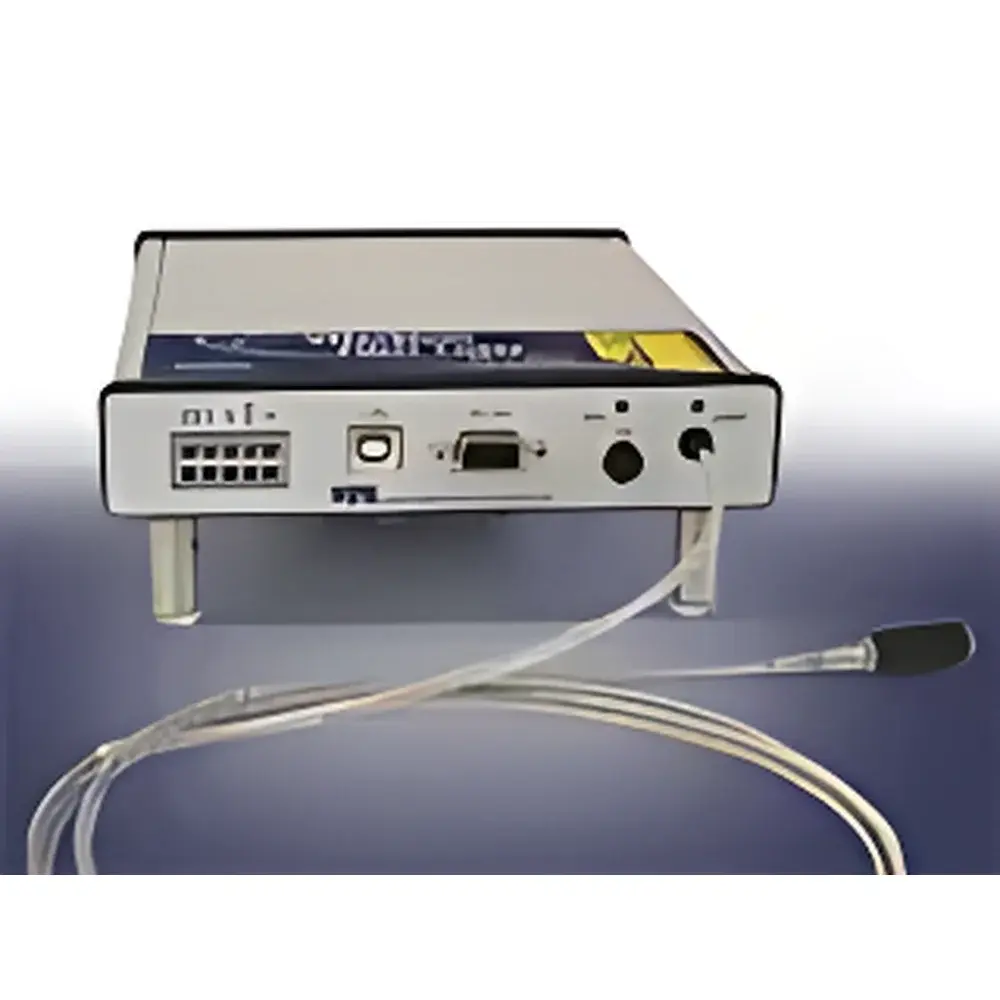
MPB YFL-P-10-1120 Continuous-Wave Ytterbium-Doped Fiber Laser
| Brand | MPB |
|---|---|
| Origin | Canada |
| Model | YFL-P-10-1120 |
| Wavelength | 1120 nm |
| Wavelength Accuracy | ±0.5 nm |
| Output Power | 10 W (CW) |
| Long-Term Wavelength Stability | ±0.02 nm |
| Long-Term Power Stability (8 h) | <3% |
| Spectral Linewidth (FWHM) | <0.05 nm |
| Polarization Extinction Ratio | >99% |
| Mode Field Diameter | 6–6.5 µm |
| ASE Suppression (0.1 nm bandwidth) | >60 dB |
| Relative RMS Intensity Noise | <2% |
| Custom Wavelengths | 1060–1120 nm |
Overview
The MPB YFL-P-10-1120 is a continuous-wave (CW), single-emitter, polarization-maintaining ytterbium-doped fiber laser engineered for high spectral purity, long-term power stability, and robust operation in demanding laboratory and industrial environments. Operating at a fundamental wavelength of 1120 nm, it leverages cladding-pumped double-clad fiber architecture with optimized thermal management to deliver diffraction-limited beam quality (M² < 1.1) and narrow spectral linewidth (<0.05 nm FWHM). Unlike bulk solid-state lasers, this all-fiber design eliminates free-space alignment, minimizes sensitivity to mechanical drift and ambient temperature fluctuations, and ensures intrinsic resistance to optical feedback—critical for applications requiring stable injection seeding or interferometric coherence. Its compact OEM-ready chassis supports integration into larger photonic systems, including frequency-doubling platforms, spectroscopic light sources, and precision metrology setups.
Key Features
- Stable CW output at 1120 nm with 99% polarization extinction ratio
- 10 W nominal output power with <3% power fluctuation over 8-hour continuous operation
- Exceptional wavelength stability: ±0.02 nm over 24 hours under controlled lab conditions
- Integrated digital control interface supporting RS-232 and analog I/O for remote monitoring of output power, diode current, and internal temperature
- OEM-compatible form factor with standardized mounting holes, low-profile heat sink, and fiber-pigtailed output (FC/APC connector, PM1550 fiber)
- Optional external second harmonic generation (SHG) control logic enabling synchronized modulation of pump power and SHG crystal temperature for real-time 560 nm green light stabilization
- ASE suppression exceeding 60 dB within a 0.1 nm bandwidth—ensuring high signal-to-noise ratio in sensitive detection schemes
Sample Compatibility & Compliance
The YFL-P-10-1120 is designed for use with standard silica-based passive and active fibers, including polarization-maintaining (PM) and large-mode-area (LMA) delivery fibers. Its 1120 nm emission falls within the low-dispersion, low-nonlinear regime of standard SMF-28 and HI1060 fibers, facilitating efficient coupling into spectrometers, interferometers, and nonlinear frequency conversion modules. The laser complies with IEC 60825-1:2014 Class 4 laser safety requirements when operated with appropriate interlocks and beam enclosures. It meets CE marking directives for electromagnetic compatibility (EN 61326-1) and low-voltage equipment (EN 61000-6-3/6-4). While not certified for medical device use per ISO 13485, its performance characteristics align with preclinical and analytical instrumentation requirements defined in ISO/IEC 17025-accredited laboratories.
Software & Data Management
MPB provides a Windows-based configuration utility (YFL-Control v3.2) supporting real-time parameter logging, setpoint ramping, and alarm threshold configuration. All operational data—including diode current, thermistor readings, and monitored photodiode output—are timestamped and exportable in CSV format. The embedded microcontroller implements non-volatile memory for calibration constants and user-defined startup profiles. For integration into automated test systems, SCPI-compliant command sets are available over RS-232 or USB-to-serial emulation. Audit trails for critical parameters (e.g., maximum allowed current, thermal shutdown thresholds) are retained across power cycles and support GLP/GMP traceability when deployed in regulated QC/QA workflows.
Applications
- Spectroscopy: As a tunable seed source for OPO pumping or as a fixed-wavelength excitation source in absorption and fluorescence lifetime measurements where water absorption is minimized near 1120 nm
- Biomedical optics: Enabling deep-tissue imaging via optical coherence tomography (OCT) at extended penetration depths; compatible with swept-source OCT architectures when used with external cavity tuning elements
- Laser micromachining: Precision ablation of polymers and thin metal films requiring high peak fluence without thermal damage—enabled by excellent beam quality and MOPA-compatible modulation capability
- Frequency doubling: Efficient SHG in PPLN or BBO crystals to generate visible 560 nm radiation for flow cytometry, confocal microscopy, and photoacoustic imaging
- Optical sensing: Used in fiber Bragg grating interrogation systems and distributed acoustic sensing (DAS) backscatter analysis due to narrow linewidth and low RIN
FAQ
Is the YFL-P-10-1120 suitable for integration into FDA-regulated diagnostic instruments?
It is not supplied with FDA 510(k) clearance or ISO 13485 certification; however, its design documentation, traceable calibration records, and deterministic failure modes support inclusion in Class II medical device subsystems under manufacturer-led risk management (ISO 14971).
Can output power be modulated externally?
Yes—via analog voltage input (0–5 V) with bandwidth up to 100 kHz, enabling direct integration with arbitrary waveform generators for pulsed or amplitude-modulated operation.
What cooling method is required?
Conductive cooling only; no forced air or liquid cooling is necessary. The unit operates continuously at ambient temperatures from 15 °C to 35 °C when mounted on a ≥0.5 m² aluminum heat spreader.
Are custom wavelengths supported outside the standard 1120 nm option?
Yes—MPB offers factory-configured variants between 1060 nm and 1120 nm with identical stability and noise specifications; lead time increases by 4–6 weeks for non-stock wavelengths.
Does the laser include built-in beam collimation?
No—collimated free-space output is optional and provided as an add-on module with adjustable focus and kinematic mount; standard configuration delivers fiber-coupled output only.




