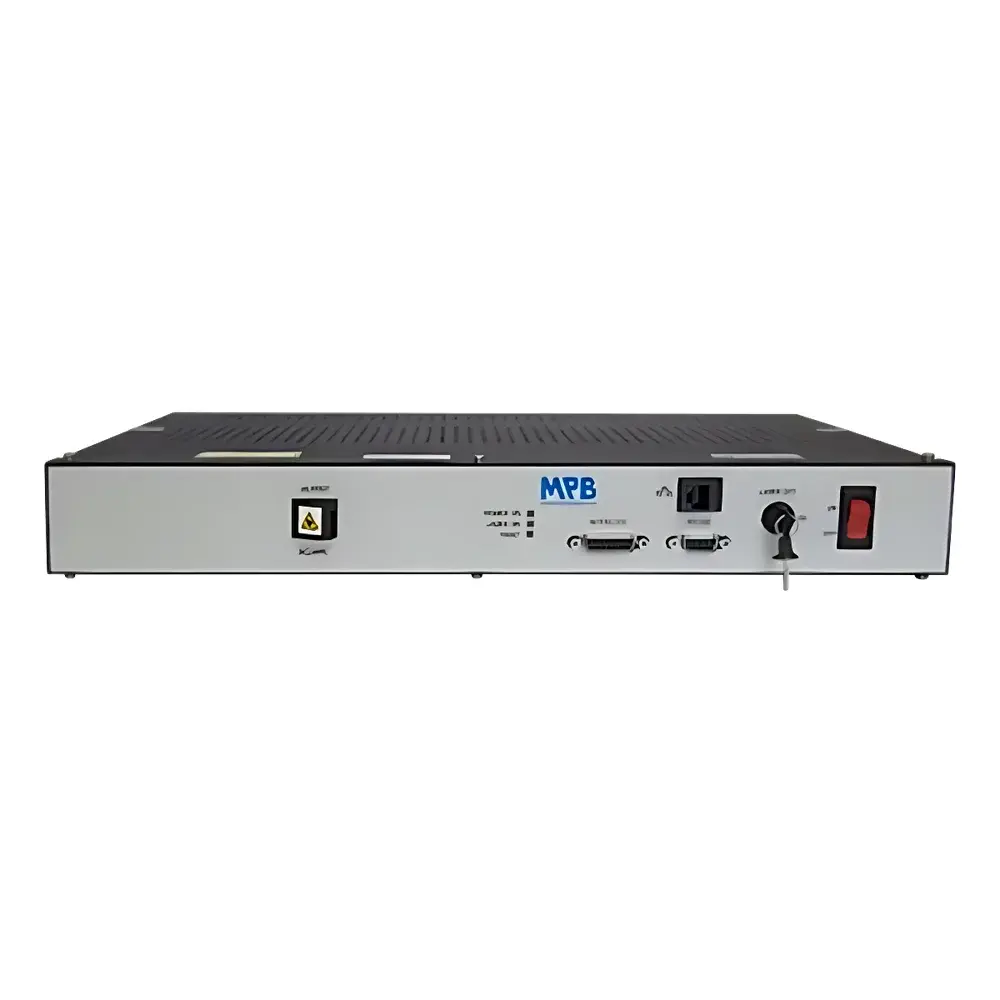
MPBC Erbium-Doped Broadband Light Source
| Brand | MPBC |
|---|---|
| Origin | Canada |
| Model | Erbium-Doped Broadband Light Source (EBS) |
| Spectral Range | 1524–1625 nm (1RU-AC Series), 1525–1605 nm (EBS-xs Series), 1525–1575 nm (EBS-u Series) |
| Spectral Width | Up to 42 nm |
| Output Power | Up to 26 dBm |
| Ripple | <1.5 dB |
| Polarization State | Unpolarized |
| Communication Interface | RS232, RS485, Ethernet (optional) |
| Compliance | Telcordia GR-1312-CORE |
Overview
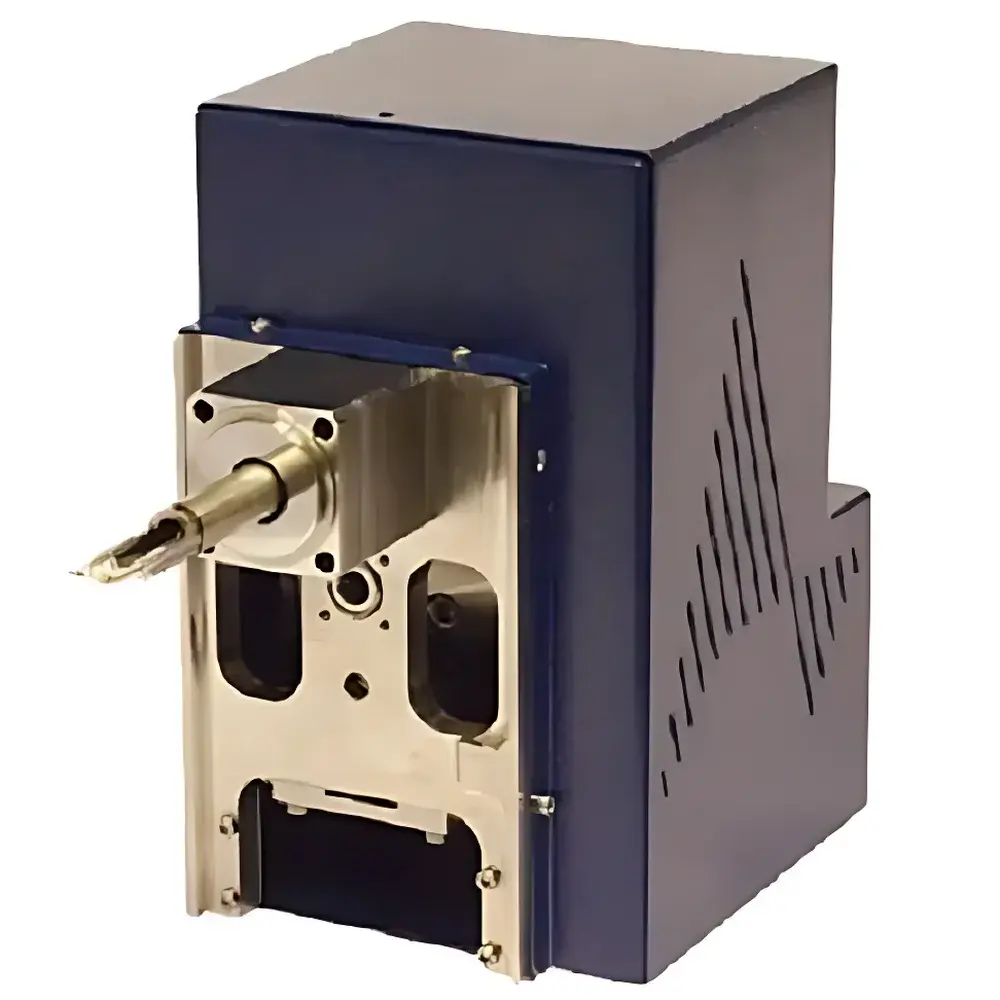
The MPBC Erbium-Doped Broadband Light Source (EBS) is a high-stability, polarization-insensitive optical source engineered for precision spectral characterization and calibration in fiber-optic systems. Based on amplified spontaneous emission (ASE) from erbium-doped fiber pumped by high-reliability laser diodes, the EBS delivers continuous, smooth, and spectrally flat output across the C-band (1524–1565 nm), L-band (1565–1625 nm), or extended C+L band (1524–1625 nm). Its fundamental operating principle relies on broadband ASE generation under controlled pump conditions—ensuring minimal spectral ripple (<1.5 dB), excellent power density uniformity, and long-term intensity stability (<±0.05 dB over 8 hours). Designed for integration into both benchtop test environments and embedded platforms, the EBS series supports two primary form factors: the 1RU AC-powered rack-mount unit for laboratory and production-line deployment, and compact gain-module variants (EBS-xs, EBS-u) optimized for PCB-level integration in inline instrumentation, optical transceivers, and OEM subsystems.
Key Features
- Three configurable spectral bands: C-band (1525–1575 nm), L-band (1575–1605 nm), and full C+L coverage (1524–1625 nm)
- Unpolarized ASE output with low polarization-dependent loss (PDL < 0.1 dB), eliminating alignment sensitivity in interferometric or polarization-diverse setups
- High spectral flatness: ripple <1.5 dB across full bandwidth—critical for accurate insertion loss and return loss measurements of passive components
- Dual communication architecture: standard RS232 control interface with optional Ethernet (TCP/IP) support for remote monitoring and script-driven automation
- Integrated safety features including remote interlock circuitry and mechanical key switch—compliant with IEC 60825-1 Class 1M requirements
- Wide operational temperature range (−5 °C to +65 °C) and robust thermal management—validated per Telcordia GR-1312-CORE for carrier-grade reliability
- Customizable spectral shaping: optional factory-applied spectral tilt compensation or user-defined flatness profiles via firmware configuration
Sample Compatibility & Compliance
The MPBC EBS is compatible with industry-standard single-mode fiber (SMF-28, G.652.D) and polarization-maintaining fiber (PM1550) pigtails. Its non-polarized, spatially coherent ASE output ensures consistent coupling efficiency into optical spectrum analyzers (OSAs), optical time-domain reflectometers (OTDRs), and wavelength-selective switches (WSS). All units undergo full environmental stress screening (ESS) and burn-in testing per MIL-STD-883H Method 1015. The 1RU-AC series meets UL 61010-1 and CE/EMC Directive 2014/30/EU. For regulated environments, the EBS supports audit-ready logging of operational parameters (output power, temperature, pump current) with timestamped records—enabling traceability in GLP/GMP-compliant optical component qualification workflows.
Software & Data Management
MPBC provides a vendor-agnostic SCPI-compatible command set accessible via ASCII serial commands over RS232 or TCP sockets. The embedded GUI—accessible through a web browser over Ethernet—offers real-time spectral preview (when connected to an OSA via GPIB/LAN), power stabilization history graphs, and firmware update capability. Configuration files (.ebc) store user-defined operating modes (e.g., constant-power vs. constant-current), enabling rapid re-deployment across multiple test stations. Data export supports CSV and MATLAB .mat formats; all logs include ISO 8601 timestamps and device serial-number tagging—facilitating integration with LabVIEW, Python-based test automation frameworks, and enterprise MES systems requiring 21 CFR Part 11–compliant electronic signatures.
Applications
- Fiber-optic sensor calibration: Used to characterize FBG-based strain, temperature, and pressure sensors—leveraging its wide spectral coverage and flatness to resolve narrow Bragg peaks with sub-picometer resolution
- Passive component testing: Enables high-accuracy measurement of insertion loss, polarization mode dispersion (PMD), and wavelength-dependent loss (WDL) in WDM multiplexers, thin-film filters, and arrayed waveguide gratings (AWGs)
- Optical amplifier characterization: Serves as a broadband input stimulus for gain flatness, noise figure, and spectral hole-burning analysis of EDFA and Raman amplifiers
- Manufacturing process control: Integrated into automated test equipment (ATE) for in-line verification of filter passband shape, isolator isolation ratio, and circulator directivity during photonic integrated circuit (PIC) packaging
- Reference source for optical coherence tomography (OCT): Provides stable ASE seed spectra for swept-source OCT systems requiring broad instantaneous bandwidth and low temporal coherence
FAQ
What spectral bands are supported by the MPBC EBS series?
The 1RU-AC series covers the full C+L band (1524–1625 nm); the EBS-xs module targets 1525–1605 nm; the EBS-u variant is optimized for 1525–1575 nm.
Is spectral ripple measured with a specific resolution bandwidth?
Yes—ripple specifications are validated using an optical spectrum analyzer with 0.1 nm resolution bandwidth, per IEC 61280-2-9.
Can the EBS be operated in constant-power mode with feedback control?
Yes—integrated photodiode monitoring enables closed-loop power stabilization with ±0.02 dB long-term drift over 24 hours.
Does MPBC offer spectral calibration certificates traceable to NIST standards?
Yes—each unit ships with a factory calibration report referencing NIST-traceable OSA measurements, valid for 12 months.
Are custom fiber pigtails or connector types available?
Yes—FC/APC, SC/APC, LC/APC, and bare fiber options are available; polarization-maintaining and angled physical contact (APC) variants supported upon request.
Related Products