
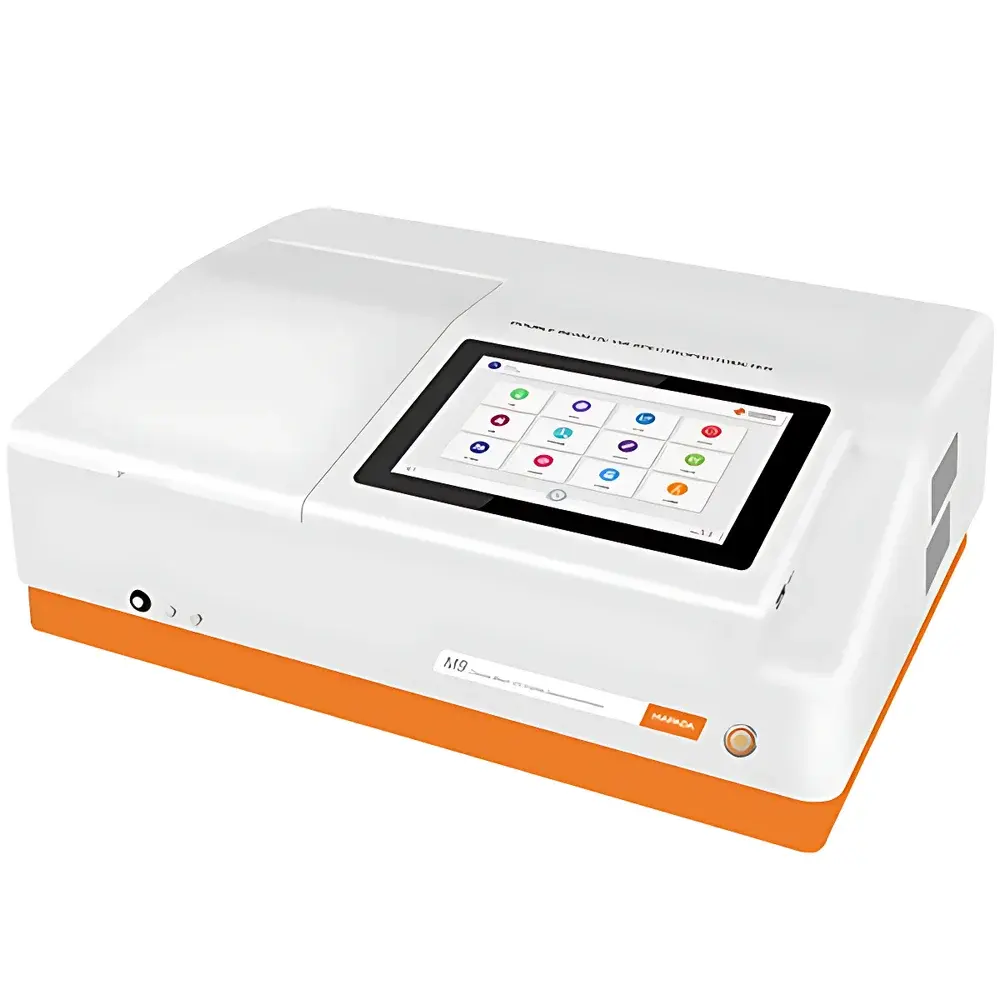
MPD M9 Dual-Beam Pulsed Xenon Lamp UV-Vis Spectrophotometer
| Brand | MPD |
|---|---|
| Origin | Shanghai, China |
| Manufacturer Type | Direct Manufacturer |
| Origin Category | Domestic (China) |
| Model | M9 |
| Price Range | USD 9,800 – 14,000 |
| Optical Design | Dual-Beam |
| Detector Type | Silicon Photocell |
| Wavelength Range | 190 – 1100 nm |
| Wavelength Scanning | Motorized & Auto-Calibrated |
| Spectral Bandwidth | 2 nm |
| Wavelength Accuracy | ±0.5 nm |
Overview
The MPD M9 Dual-Beam Pulsed Xenon Lamp UV-Vis Spectrophotometer is engineered for high-stability absorbance and transmittance measurements across the ultraviolet, visible, and near-infrared spectral regions (190–1100 nm). Unlike conventional continuous-source instruments employing deuterium and tungsten-halogen lamps, the M9 utilizes a solid-state pulsed xenon lamp as its sole broadband light source. This design eliminates thermal drift, removes warm-up delays, and ensures immediate measurement readiness—critical for time-sensitive assays, kinetic studies, and routine QC workflows in regulated environments. The dual-beam optical architecture continuously compares sample and reference beam intensities in real time, compensating for source intensity fluctuations and detector sensitivity drifts. This configuration delivers superior photometric stability (<0.001 A/h at 500 nm), essential for long-duration scans and low-concentration quantitation.
Key Features
- Dual-beam optical path with real-time reference compensation for enhanced baseline stability and reduced noise
- Pulsed xenon lamp (no deuterium or tungsten lamps required): zero warm-up time, minimal heat generation, negligible ozone production, and >70% power reduction versus conventional UV-Vis systems
- Extended lamp lifetime: rated for ≥10⁹ pulses — equivalent to >10 years of typical lab use (e.g., 1,000 samples/day × 50 pulses/sample × 250 operating days/year)
- Motorized, auto-calibrating wavelength drive with ±0.5 nm accuracy and 2 nm spectral bandwidth compliant with ISO 9001 and ASTM E275 verification protocols
- Compact benchtop footprint optimized for space-constrained laboratories and teaching facilities
- Bluetooth-enabled wireless control via pre-installed software on Microsoft Surface Pro tablet (included), supporting full instrument operation without dedicated PC hardware
Sample Compatibility & Compliance
The M9 accommodates standard 10 mm rectangular cuvettes (glass, quartz, or plastic), microvolume adapters (down to 50 µL), and optional flow cells for continuous monitoring applications. Its low-heat illumination minimizes photodegradation of light-sensitive biological samples—including proteins, nucleic acids, and enzyme substrates—ensuring integrity during repeated scanning or kinetic assays. The system supports GLP/GMP-compliant workflows through built-in audit trail functionality, user access levels, electronic signature support, and full data traceability per FDA 21 CFR Part 11 requirements. All calibration records, method parameters, and raw absorbance/time-series data are timestamped and cryptographically logged within the secure software environment.
Software & Data Management
The embedded M9 Control Suite (v3.2+) provides an intuitive, icon-driven interface for all core spectroscopic functions: photometric mode, quantitative analysis (single/multi-point calibration), multi-wavelength measurement, full-spectrum scanning (190–1100 nm), time-based kinetics, enzyme activity assays (including Michaelis-Menten fitting), dual-component analysis, and customizable method templates. Data export options include CSV, TXT, and PDF formats compatible with LIMS integration. Raw spectra and processed results are stored with metadata (operator ID, date/time, instrument serial number, calibration status), enabling seamless traceability during internal audits or regulatory inspections. Software updates are delivered over-the-air via encrypted HTTPS channel.
Applications
The M9 serves diverse analytical needs across pharmaceutical QA/QC (e.g., assay validation per USP , dissolution testing), environmental monitoring (nitrate, phosphate, COD determination), food & beverage quality control (colorimetric assays, preservative quantitation), academic research (nanoparticle characterization, ligand-binding studies), and clinical diagnostics (enzyme-linked immunoassays, hemoglobin quantification). Its pulse-based excitation enables reliable measurement of unstable intermediates and transient species where thermal artifacts from conventional lamps would compromise reproducibility.
FAQ
Does the M9 require lamp warm-up before operation?
No. The pulsed xenon lamp activates only during measurement events, eliminating warm-up delay. Users achieve stable photometric readings immediately upon startup.
What is the expected lifetime of the xenon lamp?
Rated for ≥10⁹ pulses—projected service life exceeds 10 years under typical usage conditions (1,000 samples/day, 50 pulses/sample, 250 operating days/year).
Is the M9 compliant with FDA 21 CFR Part 11?
Yes. The system includes role-based user authentication, electronic signatures, immutable audit trails, and secure data archiving—fully aligned with Part 11 requirements for electronic records and signatures.
Can the M9 be integrated into a laboratory information management system (LIMS)?
Yes. Exported data files (CSV, TXT) contain structured metadata and are compatible with common LIMS ingestion protocols; API-level integration is supported via optional SDK licensing.
What cuvette materials are supported?
Standard 10 mm pathlength cuvettes made of UV-grade fused silica (190–1100 nm), borosilicate glass (320–1100 nm), or disposable polystyrene (340–1100 nm) are fully compatible.



