
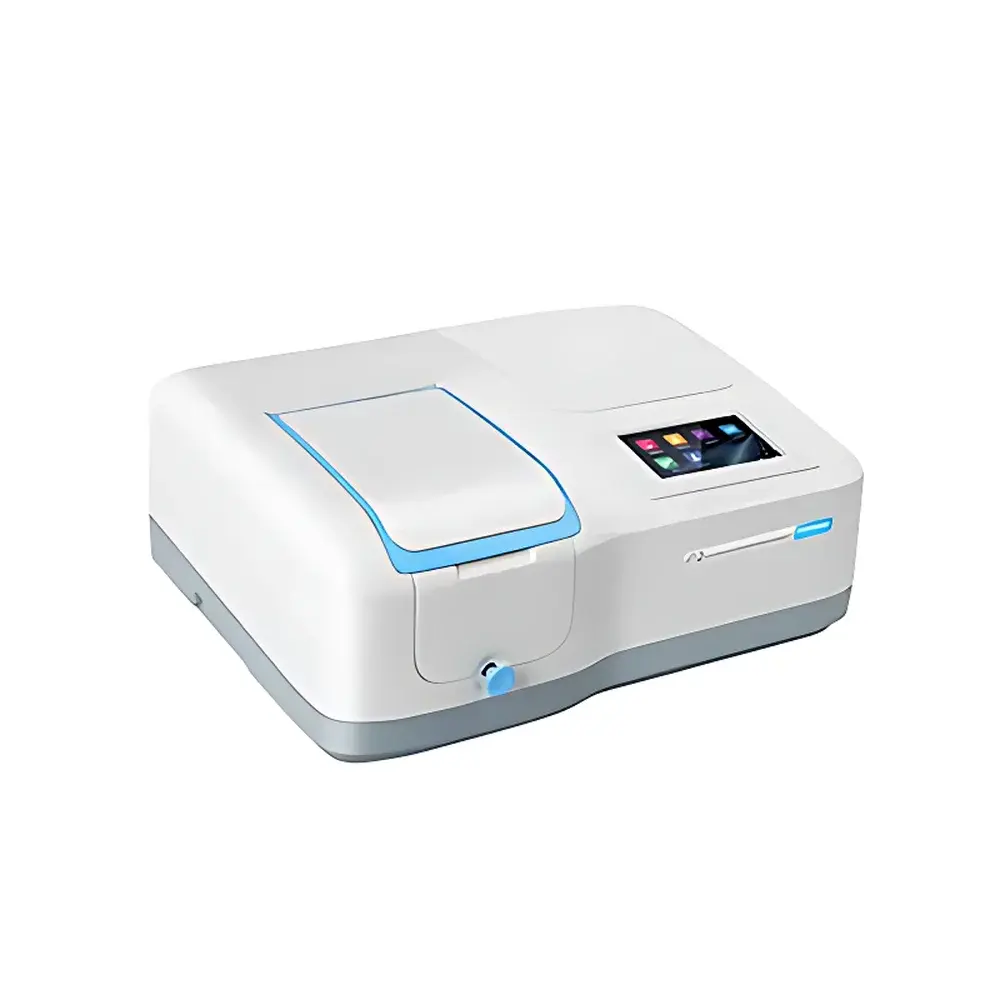
MPD P2 Single-Beam Ultraviolet-Visible Spectrophotometer
| Brand | MPD |
|---|---|
| Origin | Shanghai, China |
| Manufacturer Type | Original Equipment Manufacturer (OEM) |
| Product Origin | Domestic (China) |
| Model | P2 |
| Price Range | USD 1,400 – 2,800 |
| Optical Configuration | Single-Beam |
| Detector Type | Silicon Photocell |
| Wavelength Range | 195 – 1050 nm |
| Wavelength Scanning Mode | Motorized Auto-Scanning |
| Spectral Bandwidth | 2 nm |
| Wavelength Accuracy | ±0.8 nm |
Overview
The MPD P2 Single-Beam Ultraviolet-Visible Spectrophotometer is a precision optical instrument engineered for quantitative and qualitative analysis of absorbance, transmittance, and reflectance across the ultraviolet, visible, and near-infrared spectral regions. Operating on the fundamental principle of Beer–Lambert law-based absorption spectroscopy, the P2 employs a single-beam optical path with a stable tungsten-halogen lamp (for visible/NIR) and a deuterium lamp (for UV), enabling continuous spectral coverage from 195 nm to 1050 nm. Its fixed 2 nm spectral bandwidth ensures adequate resolution for routine laboratory applications—including concentration determination, kinetic studies, and purity assessment—while maintaining high photometric stability and signal-to-noise ratio. Designed for reliability in academic teaching labs, QC environments, and small-scale R&D facilities, the P2 delivers reproducible measurements without the complexity or cost overhead of double-beam architectures.
Key Features
- Motorized wavelength drive with auto-scanning capability, supporting user-defined wavelength programs and fixed-wavelength absorbance monitoring
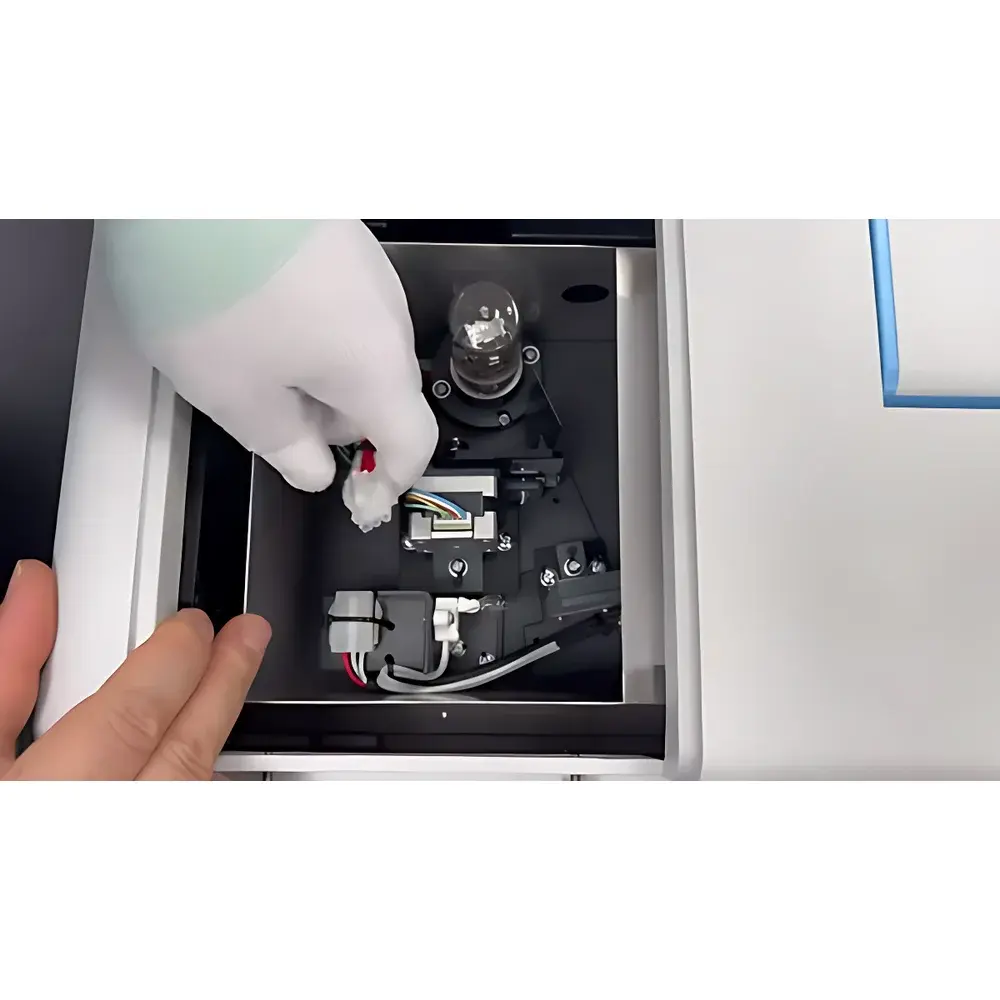
- High-stability dual-lamp system (deuterium + tungsten-halogen) with automatic lamp switching at ~350 nm for seamless UV–Vis–NIR coverage
- Silicon photocell detector offering linear response over OD 0–3.0 and low dark current drift (<0.001 A/h)
- Optical alignment optimized for minimal stray light (<0.1% at 220 nm), critical for accurate low-transmittance measurements
- Integrated cuvette holder accommodating standard 10 mm pathlength cells; optional holders for 5 mm, 20 mm, or micro-volume cells available upon request
- Front-panel keypad interface with LCD display; supports direct operation without external PC connection
Sample Compatibility & Compliance
The MPD P2 accommodates liquid samples in quartz, glass, or plastic cuvettes (10 mm standard), as well as solid thin films and reflective surfaces using optional accessories (e.g., integrating sphere, reflectance probe). It complies with core international performance benchmarks for UV-Vis instrumentation, including ISO 9001:2015 manufacturing controls and ASTM E275–22 (Standard Practices for Describing and Measuring Performance of UV–Vis Spectrophotometers). While not pre-certified for regulated GxP environments, its design supports traceable calibration via NIST-traceable reference standards (e.g., Holmium oxide, Potassium dichromate), and measurement data can be exported for inclusion in GLP-compliant documentation workflows. The instrument meets CE electromagnetic compatibility (EMC) Directive 2014/30/EU and RoHS 2011/65/EU requirements.
Software & Data Management
The P2 operates autonomously via its embedded firmware but also interfaces with MPD’s proprietary Windows-based SpectraView software (v3.2+) via USB 2.0. SpectraView enables full spectral acquisition, baseline correction, peak identification, multi-curve overlay, and export to CSV, TXT, or PDF formats. All data files include embedded metadata: date/time stamp, operator ID (user-definable), instrument serial number, lamp status, and calibration verification timestamp. Audit trail functionality is not built-in; however, users may implement external logging protocols aligned with FDA 21 CFR Part 11 requirements through third-party LIMS integration or manual record-keeping. Firmware updates are distributed directly by MPD and require no hardware modification.
Applications
- Quantitative analysis of pharmaceutical actives (e.g., paracetamol, aspirin) per USP and EP 2.2.25 guidelines
- Enzyme kinetics (e.g., NADH oxidation at 340 nm) and protein concentration estimation (Bradford, BCA assays)
- Water quality testing: nitrate (220 nm), phosphate (880 nm), and COD-related chromogenic assays
- Educational use in undergraduate chemistry and biochemistry laboratories for spectral interpretation and Beer’s law validation
- Thin-film thickness estimation via interference fringe analysis in the 600–1000 nm range
FAQ
What is the minimum detectable absorbance change for the P2?
The instrument achieves a photometric noise level of ≤±0.002 Abs (RMS) at 500 nm under standard conditions (1 s integration time, 10 mm quartz cell), corresponding to ~0.4% transmittance resolution.
Can the P2 perform kinetic measurements?
Yes—via time-scan mode in SpectraView software, with adjustable interval timing from 0.1 s to 600 s per point, up to 10,000 data points per run.
Is quartz cuvette required for UV measurements below 240 nm?
Yes. Standard glass or plastic cuvettes absorb strongly below ~350 nm; fused silica (quartz) cuvettes are mandatory for measurements between 195–240 nm.
Does the P2 support wavelength calibration verification?
Yes—users may perform manual wavelength accuracy checks using Holmium oxide solution (peaks at 241.5, 279.4, 287.5, 333.7, 360.9, 418.5, 460.0, 485.8, 536.2 nm) per ISO 6223.
What maintenance is recommended for long-term stability?
Lamp replacement every 1,000–2,000 hours of use; annual cleaning of optical windows and collimating mirrors with spectroscopic-grade methanol; biannual verification of wavelength and photometric accuracy using certified reference materials.





