
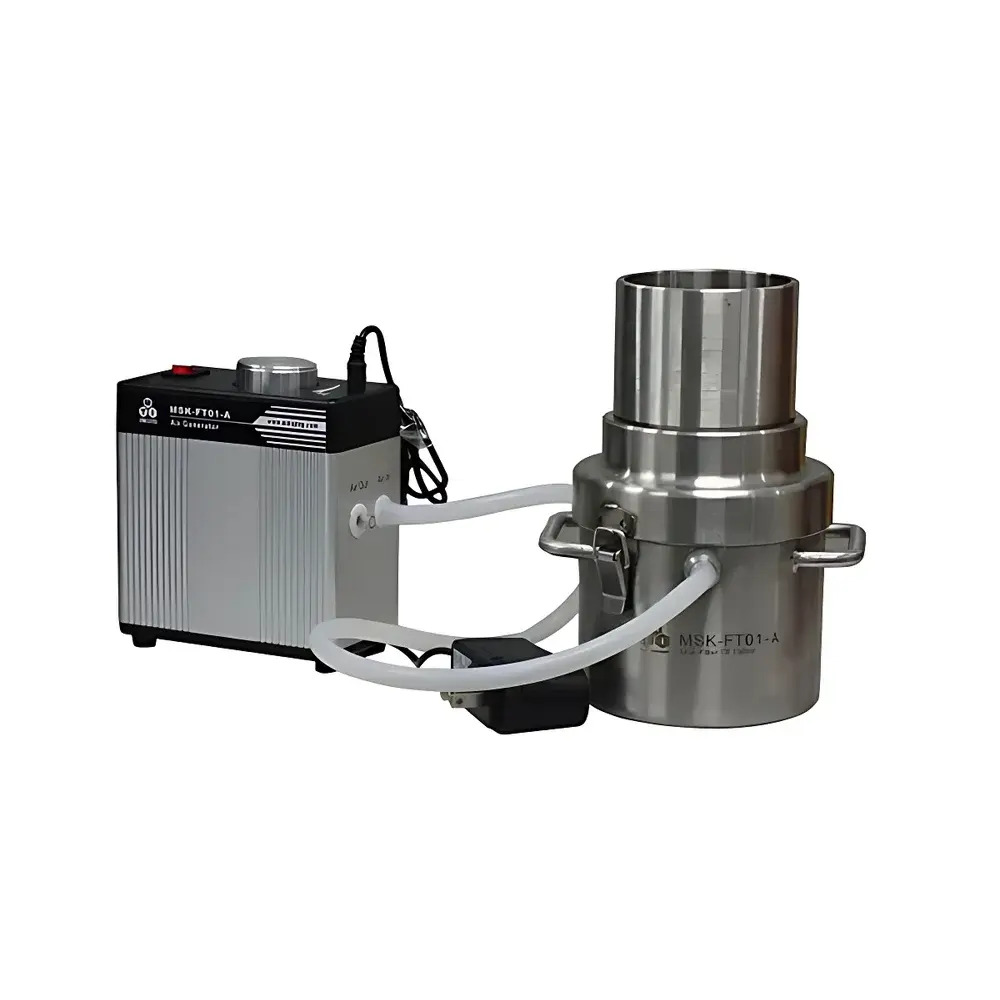
MSK-FT01 Slurry Filtration Unit
| Brand | KJ GROUP (Shenyang Kejing) |
|---|---|
| Origin | Liaoning, China |
| Manufacturer Type | Authorized Distributor |
| Country of Origin | China |
| Model | MSK-FT01 |
| Power Supply | DC 12 V, 0.4 A |
| Air Pump Flow Rate | 3 L/min |
| Absolute Vacuum Level | 65 kPa |
| Filtration Cut-off | ≥124 µm |
| Collection Vessel Capacity | 750 mL |
| Filter Assembly Dimensions | 150 mm × 150 mm × 200 mm |
| Air Generator Dimensions | 140 mm × 70 mm × 150 mm |
| Net Weight | 4 kg |
Overview
The MSK-FT01 Slurry Filtration Unit is a compact, benchtop vacuum-assisted filtration system engineered for precise particulate removal from electrode slurries and functional suspensions in battery R&D, advanced materials laboratories, and quality control environments. It operates on the principle of controlled vacuum-driven cross-flow filtration through standardized mesh screens, enabling selective retention of particles ≥124 µm while preserving slurry homogeneity and rheological integrity downstream. Unlike centrifugal or pressure-based systems, the MSK-FT01 employs low-differential vacuum (65 kPa absolute) to minimize shear-induced agglomeration or phase separation—critical when handling shear-thinning cathode/anode slurries containing NMC, LFP, graphite, or silicon-based active materials. Its modular architecture supports rapid screen exchange between positive- and negative-electrode-specific mesh configurations, ensuring compatibility with industry-standard slurry formulations used in lithium-ion, solid-state, and next-generation battery development.
Key Features
- Vacuum-driven filtration with stable 65 kPa absolute vacuum level, delivered by an integrated oil-free diaphragm air pump (3 L/min flow rate) — eliminating risk of hydrocarbon contamination.
- Dual-mesh compatibility: Interchangeable stainless-steel mesh inserts optimized for cathode (e.g., NMC/LCO slurries) and anode (e.g., graphite/silicon composite slurries), each rated at ≥124 µm nominal cut-off per ISO 3310-1.
- Corrosion-resistant collection vessel fabricated from electropolished SUS304 stainless steel (750 mL capacity), compliant with ASTM A967 for passivation and suitable for aqueous and NMP-based slurries.
- Large effective filtration area (150 mm × 150 mm) minimizes pressure drop across the membrane, maintaining consistent filtrate flux and reducing clogging frequency during extended operation.
- CE-marked design adhering to EU Machinery Directive 2006/42/EC and Low Voltage Directive 2014/35/EU; includes overcurrent protection and thermal cutoff for DC 12 V / 0.4 A power input.
- Modular mechanical construction with ceramic-reinforced contact surfaces: Alumina (Al₂O₃) liners on fixed and movable jaws, plus side-wall alumina ceramic plates, ensure zero metallic leaching and enhanced abrasion resistance during manual slurry loading and cleaning cycles.
Sample Compatibility & Compliance
The MSK-FT01 accommodates aqueous, NMP, DMF, and other common solvent-based slurries used in electrode manufacturing. Its SUS304 wetted path and alumina-lined components meet material compatibility requirements outlined in IEC 62660-1 for lithium battery component testing equipment. The unit supports GLP-aligned documentation workflows: batch records may be linked to filtration logs via external lab notebooks, and its mechanical repeatability (validated via inter-operator trials per ISO 5725-2) ensures consistent particle rejection performance across shifts. While not intrinsically rated for hazardous location use, it complies with general laboratory safety standards including ANSI Z9.5 for ventilation-integrated benchtop equipment.
Software & Data Management
The MSK-FT01 is a standalone electromechanical instrument with no embedded firmware or digital interface. All operational parameters—including vacuum duration, slurry volume processed, and mesh type used—are manually recorded. This analog architecture eliminates cybersecurity concerns and aligns with facilities operating under strict IT governance (e.g., FDA-regulated battery material labs). Users integrate filtration events into electronic lab notebooks (ELNs) such as LabArchives or Benchling using standardized templates referencing ASTM E2878 for slurry particulate screening protocols. Audit trails are maintained externally via timestamped operator entries and photographic documentation of filter residue.
Applications
- Pre-filtration of cathode/anode slurries prior to coating or rheological characterization (e.g., Brookfield or Anton Paar rheometry).
- Removal of oversized agglomerates or milling media fragments (e.g., zirconia beads ≥124 µm) following ball milling or attrition dispersion.
- Quality gate check in pilot-line slurry preparation, verifying compliance with internal specifications for “free-of-coarse-particle” criteria before slot-die or doctor blade coating.
- Supporting ISO 1628-1 viscosity standardization workflows where undissolved particulates must be excluded prior to solution polymer analysis.
- Research into slurry stability mechanisms, where comparative filtration mass retention data informs dispersion optimization studies.
FAQ
Does the MSK-FT01 support automated data logging or USB connectivity?
No. It is a manually operated, non-networked device designed for simplicity, reliability, and regulatory compatibility in controlled environments.
Can the filtration mesh be cleaned and reused?
Yes. The stainless-steel mesh inserts are ultrasonically cleanable and compatible with IPA, acetone, and mild alkaline solutions; reuse is validated for up to 50 cycles under documented SOPs.
Is the unit suitable for filtering slurries containing conductive carbon additives?
Yes. The ≥124 µm cut-off targets only oversized contaminants; nanoscale carbon black or CNTs remain fully suspended and unimpeded.
What maintenance is required for the air pump?
The diaphragm pump requires no lubrication; periodic inspection of inlet filters and replacement every 12 months (or after 2,000 operating hours) is recommended per manufacturer guidelines.
Can the collection vessel be sterilized for bio-hybrid slurry work?
SUS304 construction allows autoclaving at 121°C / 15 psi for 20 minutes; however, alumina liners and gasket materials must be removed prior to sterilization.



