
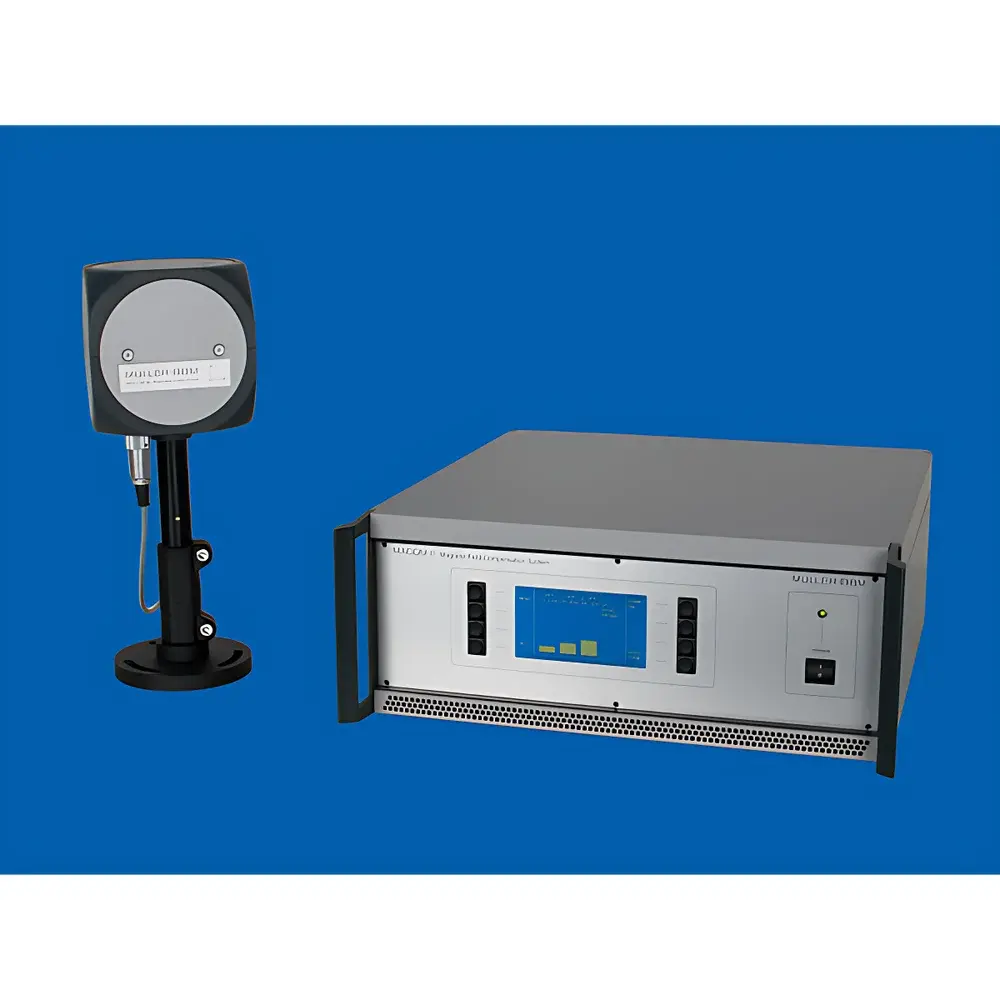
Müller-BBM MACOM II Active Magnetic Field Cancellation System
| Brand | Müller-BBM |
|---|---|
| Origin | Germany |
| Model | MACOM II |
| Operating Frequency Range | 0 Hz to 50 kHz |
| Control Interface | Ethernet / TCP/IP |
| Display | Integrated LCD with real-time monitoring and parameter adjustment |
| Remote Operation | Supported via internal network or internet (optional global remote support) |
| Compliance | Designed for integration with TEM/SEM, e-beam lithography, and MRI systems requiring ultra-low magnetic noise environments |
| Maintenance | Minimal — no consumables or routine calibration required |
Overview
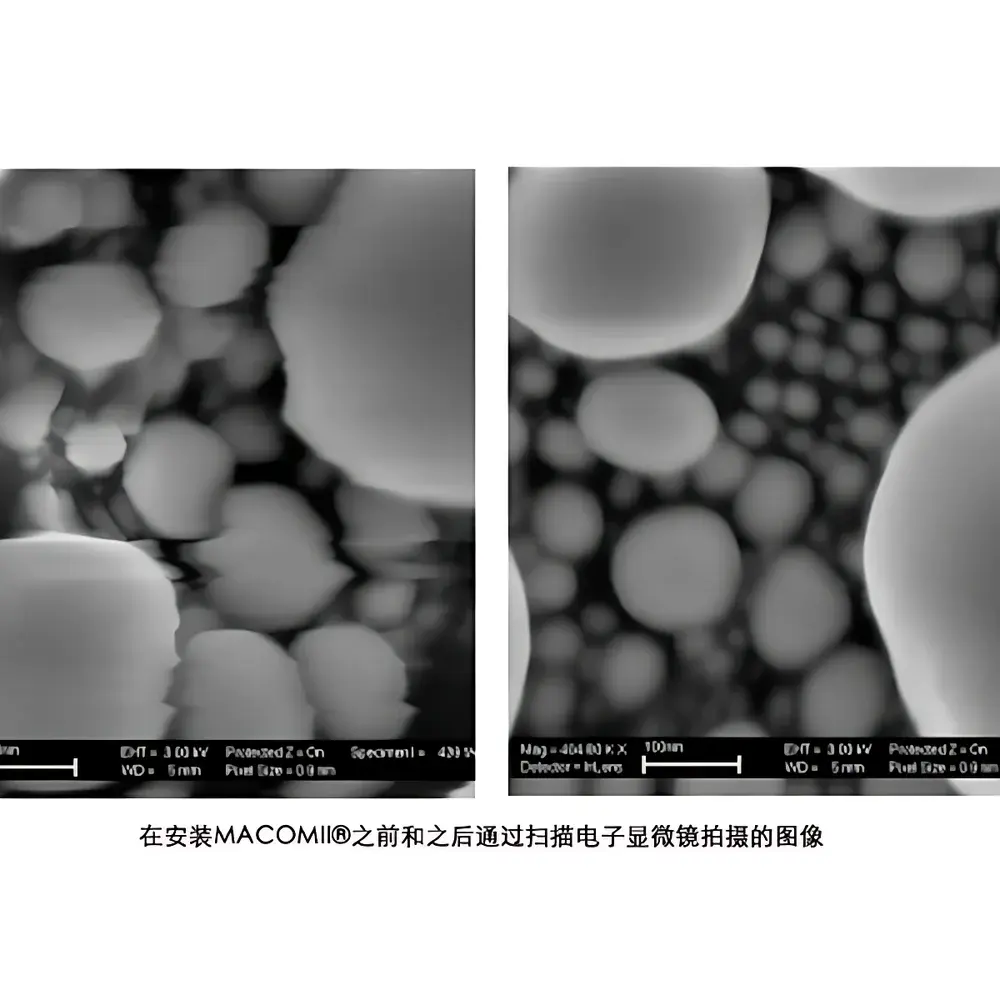
The Müller-BBM MACOM II is an active magnetic field cancellation system engineered to stabilize ambient DC and AC magnetic fields in high-sensitivity electron optical environments. Unlike passive shielding solutions—such as mu-metal enclosures or steel rooms—the MACOM II employs real-time, closed-loop compensation based on vector field measurement and counter-field generation. It operates on the principle of superposition: three orthogonal fluxgate sensors continuously monitor the local magnetic vector (Bx, By, Bz) across a bandwidth spanning from static (0 Hz) up to 50 kHz. A dedicated control unit then drives three independent coil sets—mounted orthogonally within the installation volume—to generate precisely inverted magnetic fields that nullify measured disturbances. This enables sub-nanotesla residual field stability in dynamic electromagnetic environments, critical for maintaining electron beam coherence in transmission electron microscopes (TEM), scanning electron microscopes (SEM), and electron beam lithography (EBL) tools.
Key Features
- Real-time active compensation across 0 Hz–50 kHz, covering both quasi-static (e.g., tramway currents, elevator motion) and transient disturbances (e.g., switching transients in building power networks)
- Integrated 3-axis fluxgate sensor array with temperature-stable gain and offset calibration
- Dedicated low-noise, high-slew-rate current amplifiers for each coil axis, optimized for minimal phase lag and harmonic distortion
- Local operation via built-in backlit LCD display with intuitive menu navigation for status monitoring, parameter tuning, and diagnostic logging
- Remote control and monitoring via standard Ethernet interface using TCP/IP protocol; compatible with LabVIEW, Python (socket API), and SCADA systems
- Modular coil configuration supports custom geometries—including room-sized installations, microscope column integration, or localized chamber-level deployment
- No periodic recalibration required; factory-trimmed sensor and amplifier characteristics ensure long-term repeatability
Sample Compatibility & Compliance
The MACOM II is designed for integration into regulated research and industrial infrastructure where magnetic field integrity directly impacts measurement validity and process yield. It complies with requirements for electromagnetic compatibility (EMC) per IEC 61000-6-4 (emissions) and IEC 61000-6-2 (immunity). While not a medical device itself, its performance supports compliance with ISO 13485 and FDA 21 CFR Part 11 when deployed in GMP-controlled environments housing MRI development platforms or analytical electron microscopy used for materials qualification. The system meets GLP documentation standards for audit trails when operated with optional remote logging servers. Installation adheres to ASTM E1558 (Standard Guide for Magnetic Shielding of Electron Microscopes) and supports alignment verification per JEOL/FEI internal field mapping protocols.
Software & Data Management
The MACOM II includes embedded firmware supporting dual-mode operation: autonomous closed-loop mode (default) and external command mode. A web-based configuration interface provides access to real-time field vector plots, frequency-domain spectral analysis (FFT), and historical trend logs (72-hour buffer, extendable via external NAS). All operational parameters—including sensor gain, PID loop coefficients, coil drive limits, and alarm thresholds—are configurable and stored with timestamped revision history. Audit-ready event logs record all manual adjustments, connection events, and fault conditions. Optional software development kits (SDKs) enable integration into facility-wide environmental monitoring systems, supporting data export in CSV, HDF5, and JSON formats. Remote firmware updates are performed over HTTPS with SHA-256 signature validation.
Applications
- Transmission and scanning electron microscopy (TEM/SEM): Stabilizing beam trajectory and minimizing chromatic aberration induced by stray fields
- Electron beam lithography (EBL): Ensuring nanometer-scale pattern fidelity by suppressing beam deflection in maskless direct-write systems
- Magnetic resonance imaging (MRI) R&D: Creating ultra-low-field test zones for prototype gradient coil characterization and sequence validation
- Quantum sensing laboratories: Enabling atomic magnetometer and SQUID-based measurements requiring <1 nT RMS field noise
- Nanoscale metrology facilities: Supporting interferometric displacement sensors and cryogenic SEMs where thermal drift and magnetic coupling must be decoupled
- Government and defense labs: Meeting MIL-STD-461G RS101 (magnetic field emissions) and CS114 (bulk current injection) mitigation requirements
FAQ
What is the typical residual field after MACOM II activation?
Residual field stability depends on initial ambient conditions and coil geometry, but typical installations achieve ≤0.5 nT RMS in the 0.1–10 Hz band and ≤2 nT RMS across 0–50 kHz.
Can MACOM II be retrofitted into existing shielded rooms?
Yes—its modular coil design allows integration into pre-existing mu-metal or steel enclosures without structural modification; sensor placement and coil routing are customized per site survey.
Does the system require regular recalibration?
No. Factory-trimmed analog front-end components and digital offset compensation algorithms eliminate the need for user-performed calibration under normal operating conditions.
How is electromagnetic interference from the MACOM II’s own coils managed?
Coil drivers incorporate active common-mode suppression and differential current sourcing; radiated emissions are below Class B limits per CISPR 32 when installed per recommended separation distances.
Is FDA or CE marking applicable to MACOM II?
The MACOM II carries CE marking under the EMC Directive 2014/30/EU. As a supporting peripheral—not a diagnostic or therapeutic device—it does not fall under MDR or FDA 510(k) requirements.





