
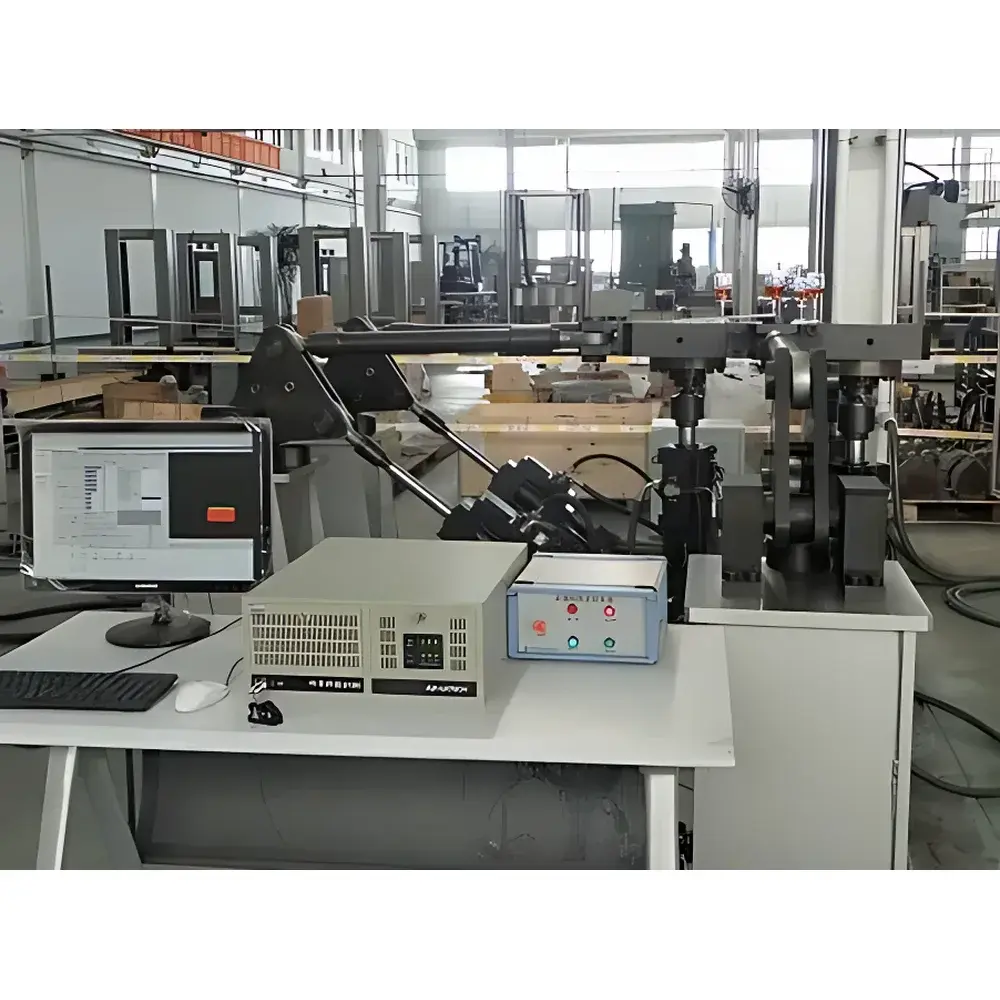
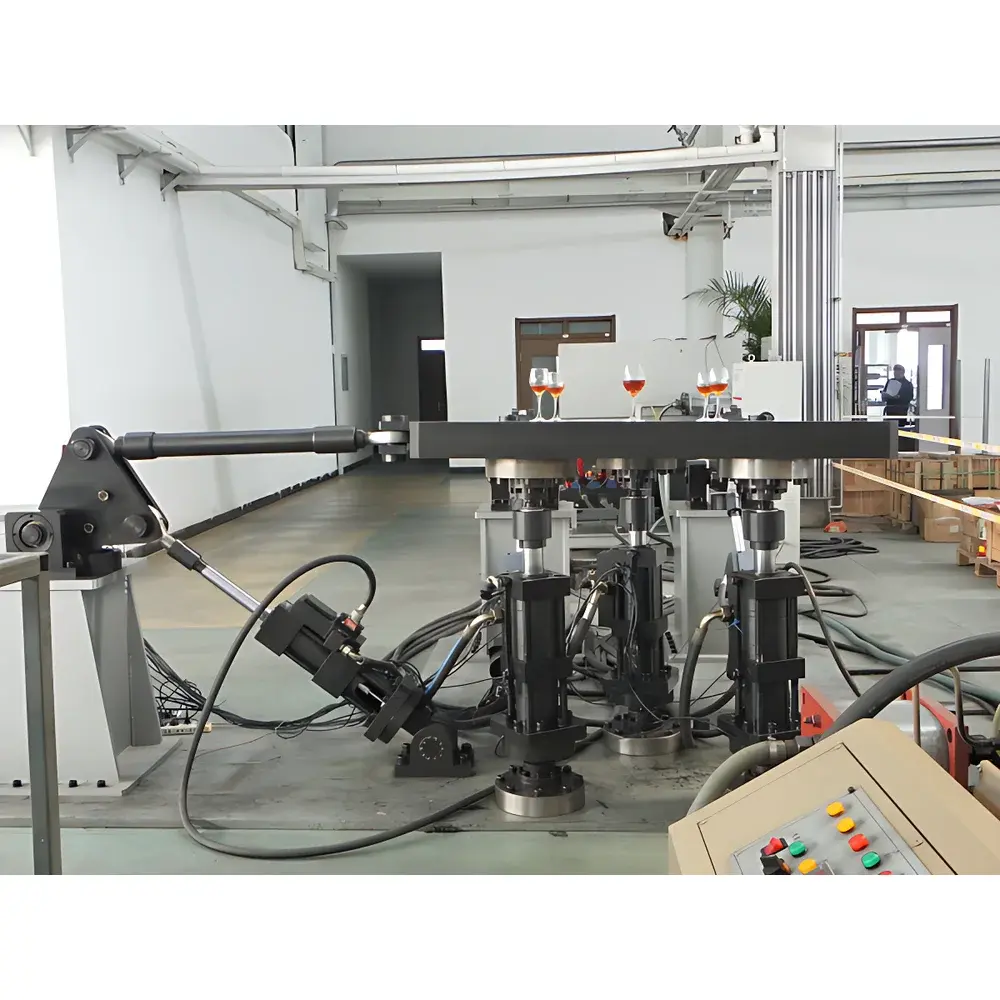
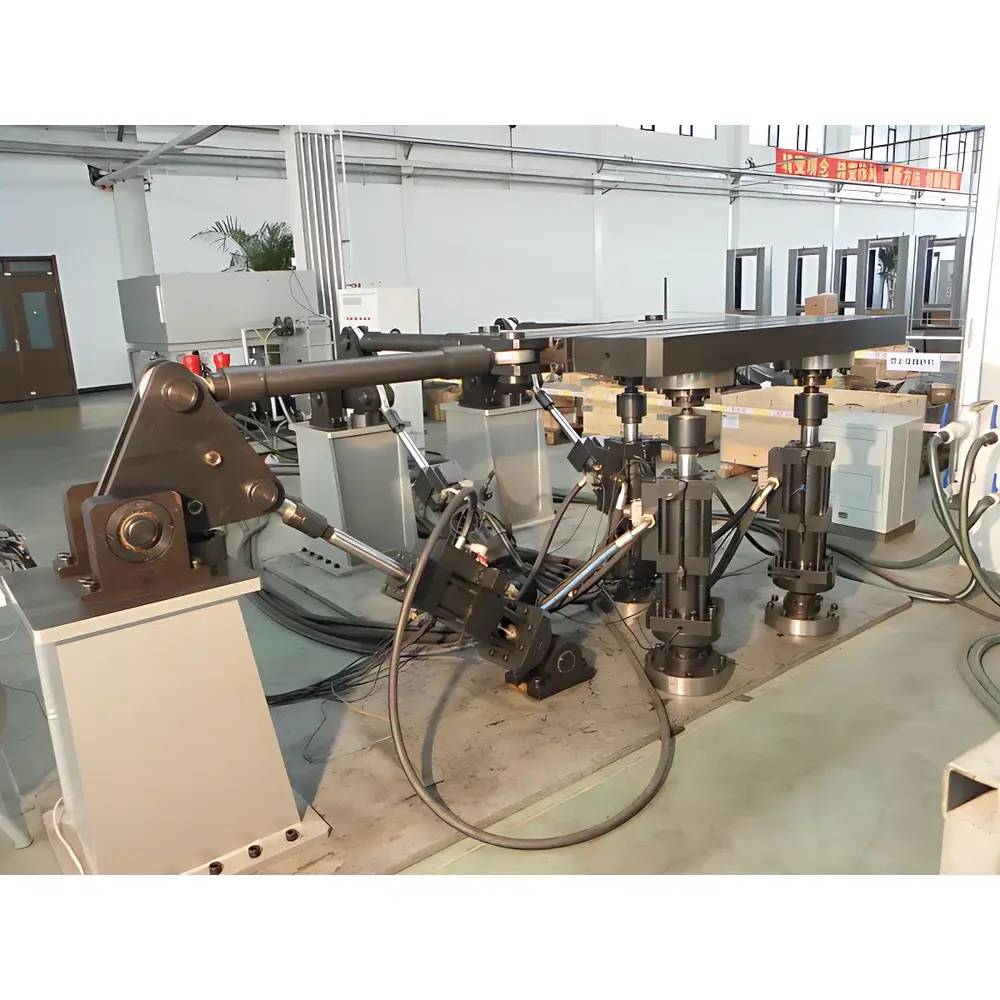
Multi-Channel Coordinated Loading Test System CIMACH ZSDS Electro-Hydraulic Servo Fatigue Testing Machine
| Brand | CIMACH |
|---|---|
| Origin | Jilin, China |
| Manufacturer Type | Authorized Distributor |
| Country of Origin | China |
| Model | ZSDS |
| Price Range | USD 70,000 – 140,000 (FOB) |
| Instrument Type | Electro-Hydraulic Servo Fatigue Testing Machine |
| Maximum Test Load | 50–3000 kN |
| Frequency Range | 5–40 Hz |
| Host Weight | 3000 kg |
Overview
The CIMACH ZSDS Multi-Channel Coordinated Loading Test System is an electro-hydraulic servo-controlled fatigue testing platform engineered for high-fidelity structural simulation under complex, multi-axial loading conditions. It operates on the principle of closed-loop hydraulic force and displacement control, utilizing high-bandwidth servo valves, precision load cells, and real-time digital motion controllers to synchronize up to six independent actuation channels. This architecture enables precise replication of service-level stress states—including combined tension-compression, bending, torsion, and shear—making it suitable for validating full-scale components and subassemblies in aerospace, rail transport, civil infrastructure, and energy sectors. The system complies with fundamental mechanical testing frameworks defined in ASTM E4, ASTM E606, ISO 1099, and EN 6072, supporting both sinusoidal and arbitrary waveform loading profiles with deterministic phase relationships across all channels.
Key Features
- Six-channel coordinated loading capability with independent force/displacement control per channel, enabling true multi-axial fatigue simulation.
- Electro-hydraulic servo architecture featuring high-stiffness hydraulic power units, low-hysteresis servo valves, and integrated pressure-compensated flow control for stable dynamic response.
- Digital real-time controller with ≥1 kHz sampling rate and sub-millisecond latency, supporting user-defined loading algorithms, phase-shifted harmonic excitation, and closed-loop synchronization via Ethernet-based deterministic communication (e.g., EtherCAT or SERCOS III).
- Modular frame design accommodating vertical, horizontal, and angular configurations; optional thermal enclosures and environmental chambers available for coupled thermo-mechanical testing.
- Comprehensive safety architecture including dual-redundant emergency stop circuits, hydraulic pressure relief interlocks, and software-enforced operational limits compliant with ISO 13850 and EN 954-1 Category 4 requirements.
Sample Compatibility & Compliance
The ZSDS system accommodates specimens ranging from small-scale coupons (e.g., ASTM E8/E9 tensile bars) to large structural assemblies such as railway bogie frames, wind turbine blade root sections, or bridge deck joints. Fixture interfaces conform to standard T-slot and flange-mount configurations (ISO 2768-mK, DIN 650). All force transducers are calibrated traceable to NIM (National Institute of Metrology, China) and certified per ISO/IEC 17025. The system supports GLP/GMP-aligned test execution when paired with validated software—audit trails, electronic signatures, and data integrity controls meet FDA 21 CFR Part 11 requirements for regulated environments.
Software & Data Management
Control and analysis are executed via CIMACH’s proprietary TestMaster™ software suite, a Windows-based application built on .NET Framework with modular architecture. It provides synchronized acquisition of load, displacement, strain, temperature, and acoustic emission signals at configurable rates up to 20 kHz per channel. Raw data is stored in HDF5 format with embedded metadata (test parameters, calibration IDs, operator logs), ensuring long-term readability and interoperability with MATLAB, Python (h5py), and third-party FEA post-processors. The software includes preconfigured test templates aligned with ASTM D3479 (tension-tension fatigue), ISO 14662 (multi-axial fatigue), and custom protocol scripting via Lua API. All test reports export to PDF with digital signature support and version-controlled revision history.
Applications
- Fatigue life prediction of welded joints and composite laminates under out-of-phase cyclic loading.
- Dynamic qualification testing of seismic dampers and base isolators per ASCE 7 and ISO 18438.
- Multiaxial spectrum loading simulation for automotive chassis components using road-load data replay.
- Structural health monitoring validation through controlled damage induction and progressive crack growth tracking.
- Calibration and verification of finite element models used in digital twin development for civil and mechanical systems.
FAQ
What is the maximum number of synchronized loading channels supported by the ZSDS system?
The ZSDS system supports up to six independently controlled and phase-synchronized actuation channels.
Does the system support non-sinusoidal waveforms such as random vibration or transient impact profiles?
Yes—via arbitrary waveform generation (AWG) mode, users can import time-history data (e.g., measured road loads or earthquake accelerograms) and replay them synchronously across all active channels.
Is the controller compatible with third-party sensors and DAQ systems?
The system provides analog ±10 V and digital TTL I/O interfaces, along with TCP/IP and Modbus TCP protocols, enabling integration with external strain amplifiers, thermocouple scanners, or vision-based extensometers.
Can the ZSDS be configured for high-temperature or corrosive environment testing?
Yes—optional environmental enclosures, heated platens (up to 300 °C), and corrosion-resistant hydraulic fluid conditioning systems are available upon request.
What documentation is provided for regulatory compliance in international markets?
Each shipment includes CE Declaration of Conformity, Factory Calibration Certificates (traceable to national standards), Electrical Safety Test Reports (EN 61000-6-2/6-4), and Software Validation Summary per IEC 62304 Class B.



