
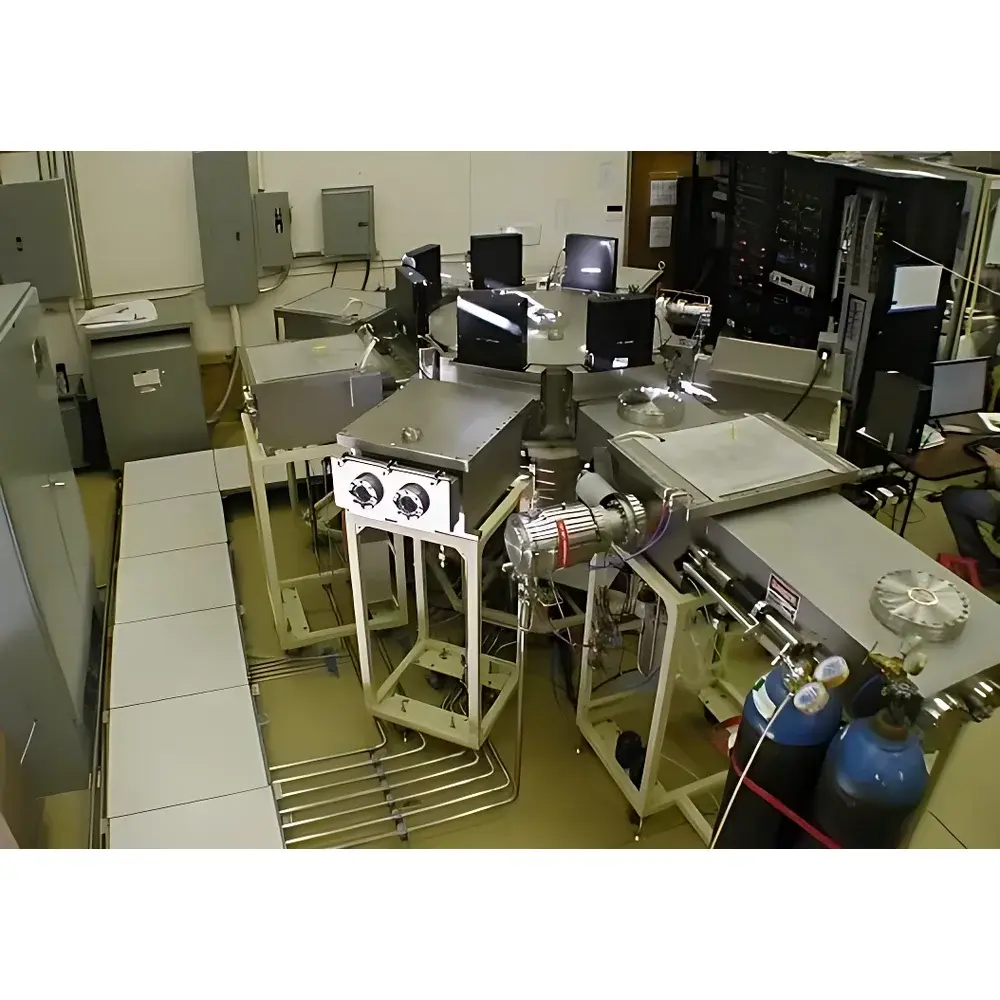
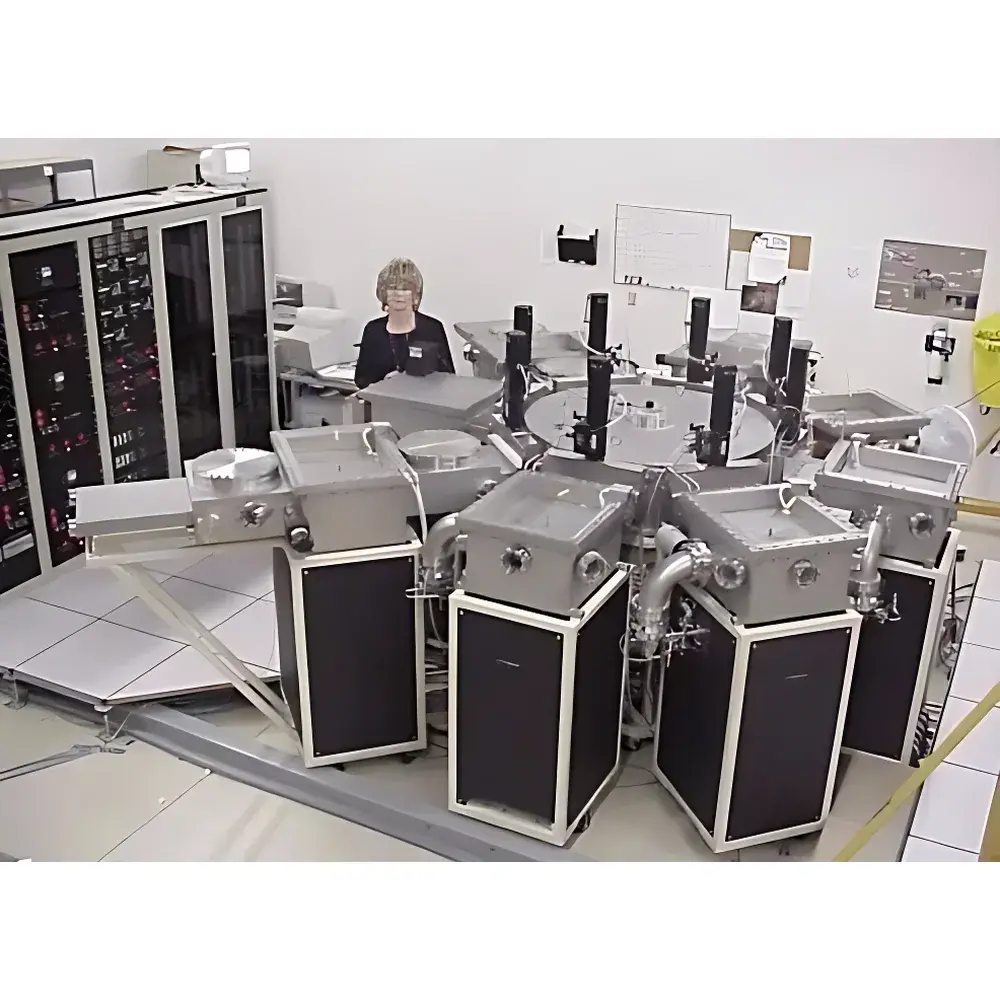
MVSystems Cluster Tool for R&D PECVD, HWCVD & Sputtering
| Brand | MVSystems |
|---|---|
| Origin | USA |
| Model | Cluster |
| Substrate Size | 30 × 40 cm |
| Chamber Configuration | 8-port cluster architecture |
| Deposition Methods | Plasma-Enhanced CVD (PECVD), Hot-Wire CVD (HWCVD), DC/RF Sputtering |
| Control System | Fully computer-integrated with programmable process sequencing |
| Category | Cluster-Type Thin-Film Deposition System |
| Import Status | Imported Equipment |
Overview
The MVSystems Cluster Tool is a modular, ultra-high-vacuum (UHV)-compatible thin-film deposition platform engineered for advanced materials research and process development in photovoltaics, optoelectronics, and functional coatings. Built around a central high-vacuum transfer chamber with eight radial port locations, this cluster tool enables sequential, contamination-free integration of multiple deposition and in-situ characterization modules—including PECVD, HWCVD, and magnetron sputtering stations—within a single, unified vacuum environment. Its design adheres to fundamental principles of surface science and thin-film physics: maintaining base pressures below 1×10⁻⁷ Torr ensures minimal residual gas interference during film nucleation, while the 30 × 40 cm substrate handling capability supports scalable prototyping of large-area devices such as solar cells, flexible sensors, and transparent conductive electrodes. Unlike standalone single-chamber systems, the cluster architecture eliminates air exposure between process steps—critical for preserving interfacial integrity in multilayer stacks (e.g., SiOₓ/SiNₓ passivation layers or ITO/ZnO heterojunctions).
Key Features
- Modular 8-port UHV cluster configuration with load-lock and robotic transfer arm for automated wafer/subsheet handling
- Standardized CF-63 and CF-100 flanges enabling rapid integration of third-party or custom modules (e.g., ALD, thermal evaporation, or in-situ ellipsometry)
- Dual-frequency (13.56 MHz / 2 MHz) RF power supply for independent plasma control in PECVD chambers, supporting low-damage deposition of hydrogenated amorphous silicon (a-Si:H), silicon nitride (SiNₓ), and silicon oxide (SiOₓ)
- Dedicated hot-wire filament assembly with tungsten or rhenium filaments operating up to 2200 °C, optimized for catalytic dissociation of SiH₄ and NH₃ in HWCVD mode
- DC/RF magnetron sputtering station equipped with water-cooled targets (up to 6″ diameter), capable of depositing metals (Al, Mo, Ag), oxides (ITO, ZnO, TiO₂), and nitrides (TiN, TaN)
- Integrated residual gas analyzer (RGA) and quadrupole mass spectrometer for real-time process gas monitoring and endpoint detection
- Full LabVIEW-based control suite with deterministic timing resolution (<10 ms), recipe-driven automation, and hardware interlock logic compliant with IEC 61508 SIL-2 requirements
Sample Compatibility & Compliance
The system accommodates rigid and flexible substrates up to 30 × 40 cm in dimension—including glass, quartz, stainless steel foils, polyimide (PI), and PET films—with optional substrate heating (RT–400 °C) and backside cooling (−20 to +150 °C) across all deposition modules. Substrate holders feature kinematic mounting and electrostatic clamping for uniform thermal contact and minimal warpage. All vacuum components meet ASTM F2782-19 standards for UHV-compatible materials (304L/316L stainless steel, oxygen-free copper gaskets), and the entire system conforms to ISO 14644-1 Class 5 cleanroom integration specifications. Process documentation supports GLP-compliant audit trails, including timestamped parameter logs, operator ID authentication, and electronic signature capture per FDA 21 CFR Part 11.
Software & Data Management
Control and data acquisition are managed via MVSystems’ proprietary ClusterControl™ software—a Windows-based application built on NI LabVIEW Real-Time and SQL Server Express. The interface provides synchronized multi-channel monitoring of pressure profiles, RF forward/reflected power, substrate temperature gradients, and gas flow dynamics (MFC accuracy ±0.8% FS). All process recipes are stored in encrypted XML format with version control and rollback capability. Raw sensor data (10 kHz sampling rate) is archived in HDF5 format, enabling direct import into MATLAB, Python (via h5py), or OriginLab for statistical process control (SPC) analysis. Optional API access allows integration with enterprise MES platforms (e.g., Siemens Opcenter, Rockwell FactoryTalk) via RESTful web services.
Applications
- Development of tandem solar cell architectures requiring precise interlayer engineering (e.g., perovskite/Si bottom cells with graded charge transport layers)
- Deposition of low-stress, stoichiometric dielectric stacks for MEMS encapsulation and OLED thin-film barrier layers
- Rapid screening of sputtered TCO compositions (e.g., Ga-doped ZnO vs. Al-doped ZnO) under identical vacuum history conditions
- In-situ studies of plasma-surface interactions using time-resolved optical emission spectroscopy (OES) coupled with mass spectrometry
- Process transfer from lab-scale R&D to pilot-line manufacturing, supported by MVSystems’ scalable chamber design and documented process qualification reports (PQRs)
FAQ
What vacuum level can the cluster achieve, and how is it maintained?
Base pressure ≤ 1×10⁻⁷ Torr is achieved using a combination of turbomolecular pumps (2000 L/s) and cryogenic panels; pressure stability is actively monitored and compensated via feedback-controlled throttle valves.
Can the system be upgraded with additional deposition modules after installation?
Yes—the modular port architecture and standardized flange interfaces support field upgrades, including atomic layer deposition (ALD), e-beam evaporation, or in-situ XRD modules, subject to vacuum and footprint constraints.
Is remote operation and diagnostics supported?
ClusterControl™ includes secure VNC-based remote desktop access, SNMP-enabled alarm notification, and predictive maintenance alerts derived from pump vibration and MFC drift analytics.
What substrate heating and cooling options are available?
Standard configuration includes resistive heating (RT–400 °C, ±1 °C uniformity) and liquid nitrogen-cooled chuck (−20 to +150 °C); optional RF biasing and laser thermal processing modules are available.
Does MVSystems provide process validation documentation for regulatory submissions?
Upon request, MVSystems delivers IQ/OQ protocols, calibration certificates traceable to NIST standards, and raw data packages formatted for inclusion in IND/NDA filings per ICH M4 guidelines.



