
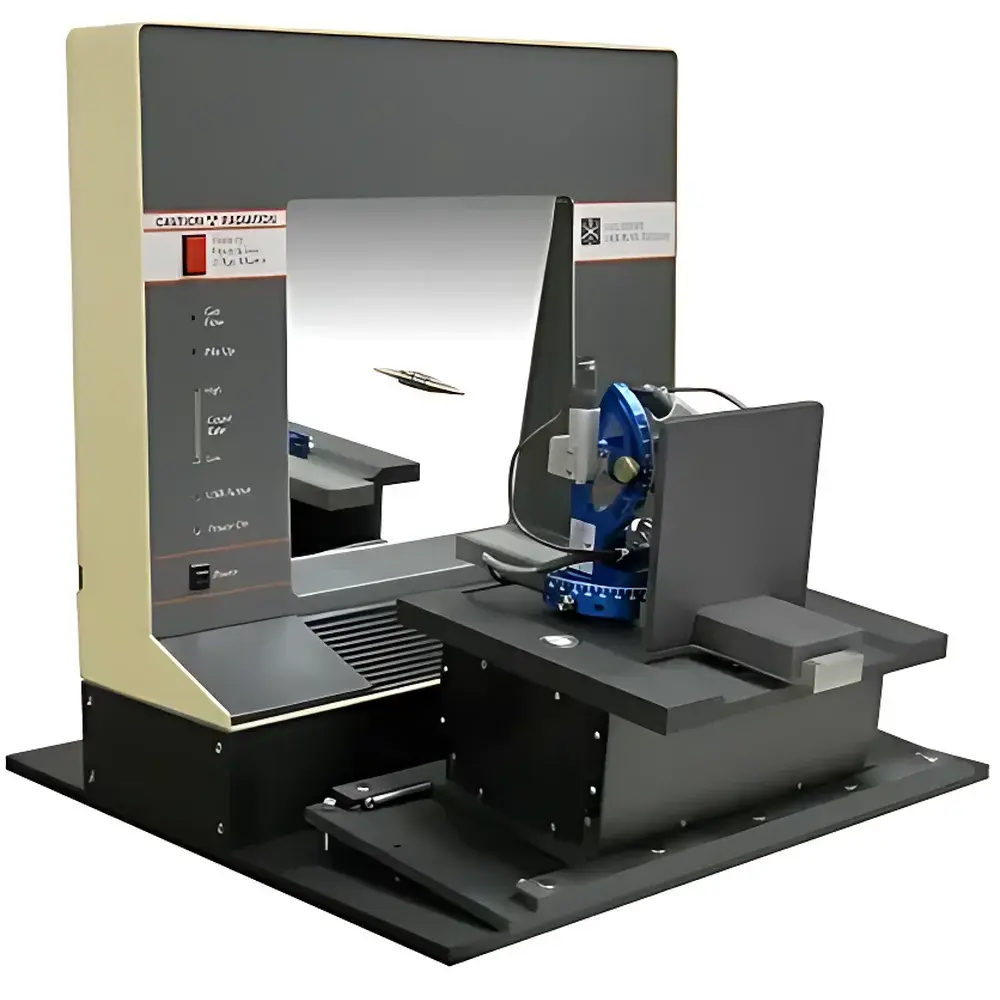
MWL120 Laue Camera System for Single-Crystal Orientation and Crystal Structure Analysis
| Origin | USA |
|---|---|
| Manufacturer Type | Authorized Distributor |
| Origin Category | Imported Instrument |
| Model | MWL120 |
| Pricing | Available Upon Request |
Overview
The MWL120 Laue Camera System is a high-precision, real-time X-ray diffraction instrument engineered for single-crystal orientation determination, lattice parameter refinement, symmetry analysis, and microstructural defect visualization. Operating on the principle of back-reflection and transmission Laue diffraction, the system utilizes polychromatic X-ray radiation generated by a sealed-tube X-ray source. When incident X-rays interact with a stationary or rotationally controlled single crystal, constructive interference occurs according to Bragg’s law (nλ = 2d sinθ), producing a characteristic spot pattern on a position-sensitive detector. Unlike monochromatic techniques requiring goniometric scanning, the Laue method captures full reciprocal lattice information in a single exposure—enabling rapid, non-destructive assessment of crystallographic orientation, domain structure, and local strain fields. The MWL120 is optimized for laboratory-based crystal characterization in materials science, semiconductor R&D, and advanced optics manufacturing environments where deterministic crystal alignment and lattice integrity verification are critical.
Key Features
- Large active detection area: 30 cm × 30 cm imaging field—supports comprehensive coverage of extended crystals, wafers, and bulk specimens without tiling or repositioning.
- High angular sensitivity: ≤0.05° resolution in orientation deviation detection—enables precise identification of misorientation between adjacent crystallites or sub-grains.
- Single-exposure acquisition: Full Laue pattern captured in seconds; integrated real-time image processing delivers immediate orientation matrix output via automated indexing algorithms.
- Motorized sample rotation stage: Synchronized detector–sample motion ensures high-symmetry Laue patterns and facilitates systematic zone-axis mapping and twin-domain analysis.
- Low-maintenance thermal and gas management: Sealed X-ray tube requires only biannual gas replenishment and annual coolant replacement—minimizing operational downtime and consumables cost.
- Modular optical path design: Compatible with both reflection and transmission geometries; configurable beam collimation and filtering options support optimization for diverse crystal systems (e.g., cubic, hexagonal, orthorhombic).
Sample Compatibility & Compliance
The MWL120 accommodates a broad range of crystalline samples—including semiconductor wafers (Si, GaAs, SiC), laser gain media (Nd:YAG, Yb:YAG), piezoelectric substrates (LiNbO₃, quartz), and metallurgical single crystals (Ni-based superalloys, Ti alloys). Sample dimensions up to Ø100 mm and thicknesses from 0.1 mm to 25 mm are supported using adjustable holders with vacuum or mechanical clamping. The system complies with IEC 61000-6-3 (EMC) and IEC 61000-6-4 emission standards. Radiation shielding meets ANSI N43.3 requirements for cabinet X-ray systems. All data acquisition and reporting workflows support audit-ready documentation per GLP and ISO/IEC 17025 quality frameworks.
Software & Data Management
Control and analysis are performed via LaueSoft v4.2—a dedicated Windows-based application supporting live image preview, automatic spot detection, crystallographic indexing (using reference databases such as ICDD PDF-4+ and Bilbao Crystallographic Server symmetry libraries), and orientation matrix export in Euler angle, Rodrigues vector, and quaternion formats. Raw TIFF and HDF5 data files include embedded metadata (exposure time, voltage, current, sample rotation angles, detector calibration parameters). Software supports 21 CFR Part 11-compliant user access control, electronic signatures, and immutable audit trails for regulated environments. Export modules integrate with MATLAB, Python (via NumPy/HDF5 bindings), and CrystalMaker for advanced lattice strain modeling.
Applications
- Determination of crystallographic orientation for epitaxial film growth substrate alignment
- Residual stress mapping in turbine blade single crystals using lattice strain shifts
- Identification of twin boundaries, stacking faults, and dislocation density gradients
- Verification of crystal cut angles in optical and electro-optic components (e.g., Brewster-cut prisms, Q-switch crystals)
- Quality control of boule-grown crystals prior to wafer slicing and polishing
- Teaching and research in solid-state physics, mineralogy, and crystallography laboratories
FAQ
What X-ray source configuration does the MWL120 use?
It employs a high-stability, air-cooled sealed-tube Cu-anode X-ray source operating at 40 kV / 15 mA, delivering broadband radiation (λKα = 0.154 nm, λKβ = 0.139 nm) suitable for Laue diffraction across most common crystal systems.
Can the system perform quantitative strain analysis?
Yes—by comparing measured Laue spot positions against ideal lattice predictions, localized lattice distortions corresponding to elastic strain components (ε₁₁, ε₂₂, ε₁₂) can be derived with sub-10⁻⁴ precision when calibrated with NIST-traceable reference crystals.
Is remote operation supported?
The system supports secure TCP/IP-based remote monitoring and control via VNC or TeamViewer-compatible protocols; however, physical interlocks require on-site presence for initial safety validation and beam alignment.
Does it meet FDA or pharmaceutical industry requirements?
While not classified as a medical device, its software architecture and data integrity features align with FDA 21 CFR Part 11 expectations for analytical instrumentation used in API crystallization process development and solid-form characterization.






