
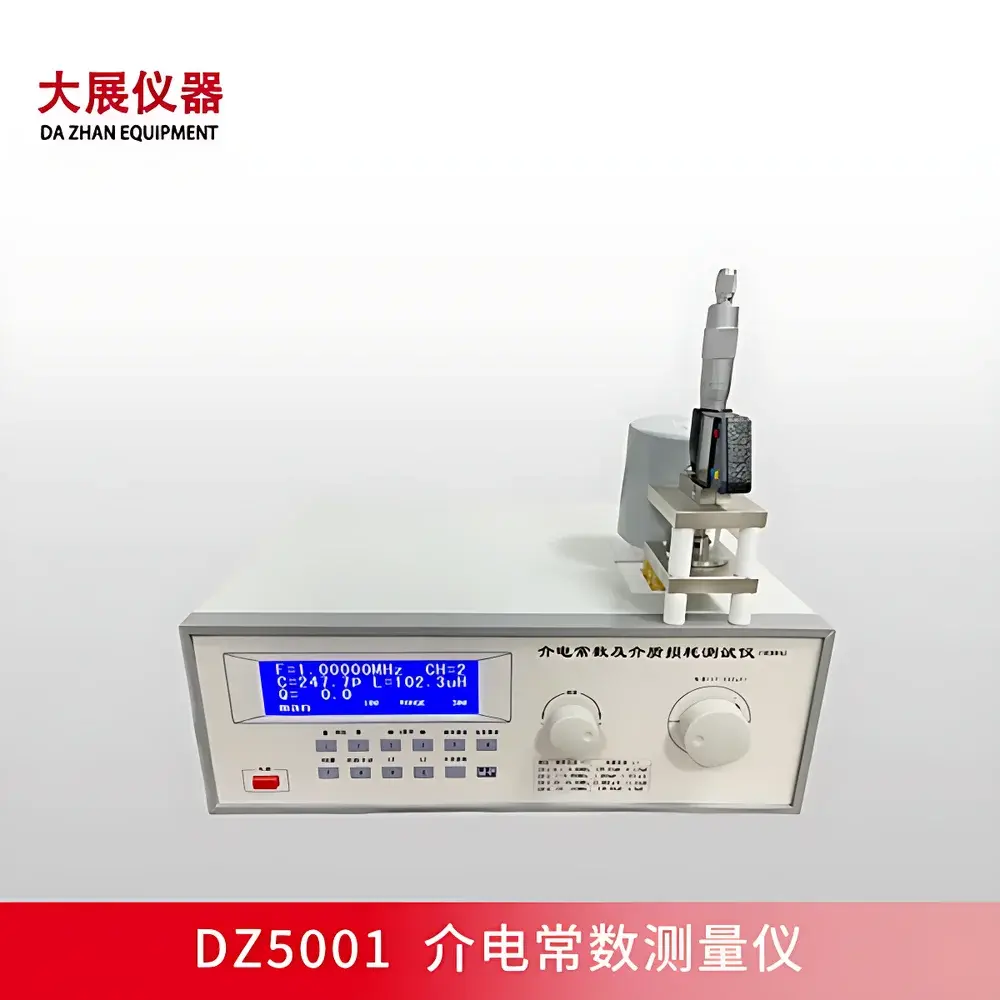
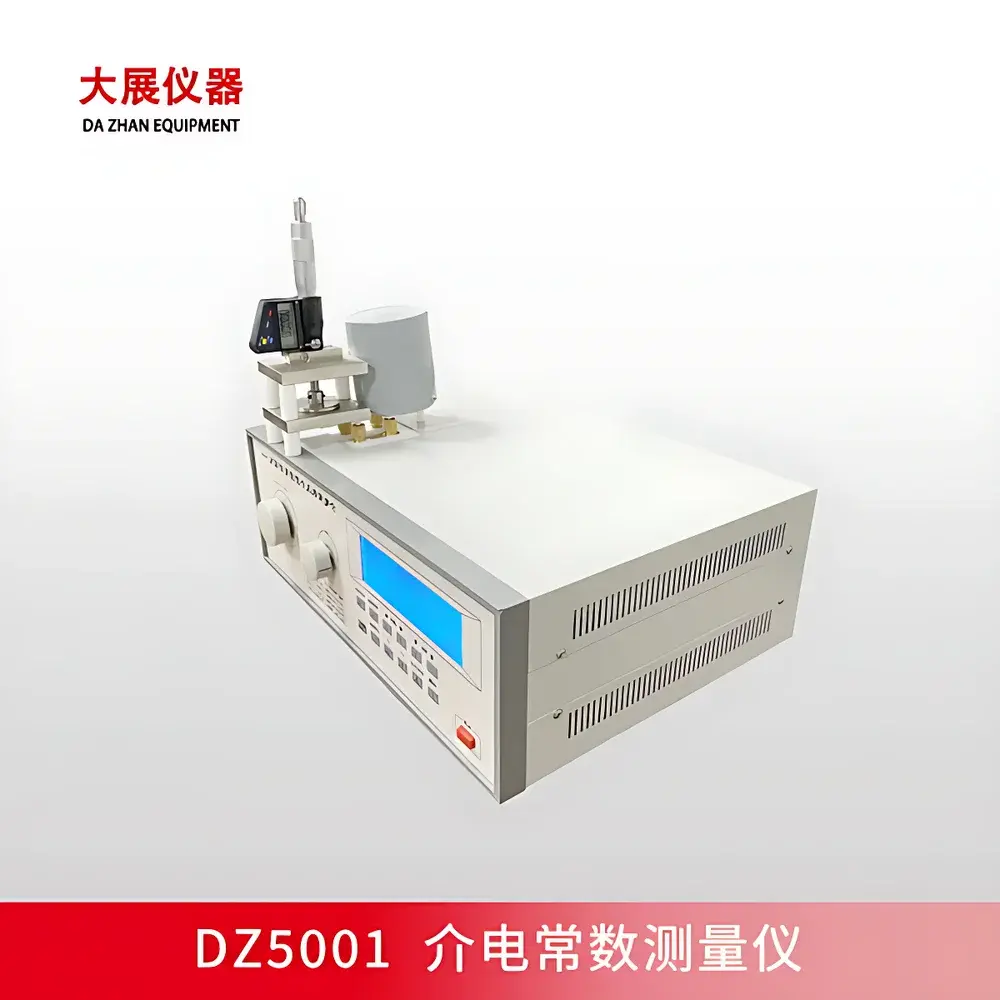
Nanjing Dazhan DZ5001 Dielectric Constant and Loss Tangent Analyzer
| Brand | Nanjing Dazhan |
|---|---|
| Origin | Jiangsu, China |
| Manufacturer Type | Direct Manufacturer |
| Country of Origin | China |
| Model | DZ5001 |
| Price Range | USD 2,800 – 7,000 |
| Frequency Range | 10 kHz – 100 MHz |
| Frequency Accuracy | ±3×10⁻⁵ (6-digit resolution) |
| ADC Resolution | 12-bit |
| Q Factor Range | 1–1000 |
| Q Resolution | 0.1 (4-digit effective) |
| Q Measurement Error | <5% |
| Inductance Range | 1 nH – 140 mH |
| Inductance Resolution | 0.1 nH |
| Inductance Error | <3% |
| Main Tuning Capacitance | 17–240 pF (silver-plated monolithic construction) |
| Capacitance Direct Measurement Range | 1 pF – 25 nF |
| Capacitance Accuracy | ±1 pF or <1% |
| Capacitance Resolution | 0.1 pF |
| Automatic Resonance Search | Yes (stepper motor-driven) |
| Displayed Parameters | F, L, C, Q, Lt, Ct, εᵣ, Tn |
| Residual Inductance Compensation | Yes |
| Lead Inductance Compensation | Yes |
Overview
The Nanjing Dazhan DZ5001 Dielectric Constant and Loss Tangent Analyzer is a precision impedance resonance spectrometer engineered for the quantitative determination of complex permittivity (ε* = ε’ − jε”) in solid and powdered dielectric materials. It operates on the principle of series-resonant cavity perturbation combined with high-stability digital synthesis and real-time Q-factor extraction. By measuring the resonant frequency shift and bandwidth change of a calibrated LC tank circuit upon sample insertion, the instrument calculates relative permittivity (εᵣ) and loss tangent (tan δ = ε”/ε’) across a continuous frequency sweep from 10 kHz to 100 MHz. This method complies with the foundational framework of ASTM D150 and IEC 60250 for dielectric characterization of insulating materials, supporting both R&D labs and quality control environments where traceable, repeatable permittivity data under controlled environmental conditions is required.
Key Features
- DDS-based signal source with 6-digit frequency resolution and stability of ±3×10⁻⁵ — enabling precise identification of resonance peaks even in low-loss ceramics and polymer films
- Monolithic silver-plated tuning capacitor (17–240 pF) with <1% absolute accuracy and 0.1 pF step resolution, minimizing parasitic effects and thermal drift
- Integrated stepper-motor-driven automatic capacitance search algorithm that locates resonance within ±0.5 pF without manual adjustment
- 12-bit high-speed ADC with synchronous sampling architecture, ensuring stable Q-factor measurement down to tan δ ≈ 1×10⁻⁴ for ultra-low-loss materials such as fused quartz and sapphire substrates
- On-board residual inductance and test-lead compensation routines — critical for eliminating systematic errors in high-frequency measurements of small-volume samples
- Real-time display of eight concurrent parameters: resonant frequency (F), measured inductance (L), tuning capacitance (C), Q-factor, loaded inductance (Lt), tuned capacitance (Ct), relative permittivity (εᵣ), and normalized temperature coefficient (Tn)
Sample Compatibility & Compliance
The DZ5001 supports standardized sample geometries per ASTM D2520 and ISO 21331, including disk-shaped specimens (diameter 25–50 mm, thickness 0.5–5 mm) and cylindrical pellets. It accommodates both air-dielectric and coaxial fixture configurations for bulk solids, powders (in compressed pellet form), and thin-film laminates. All measurement protocols are fully compatible with GLP-compliant documentation workflows. While the instrument itself does not embed FDA 21 CFR Part 11 functionality, its raw data export (CSV/ASCII) supports integration into validated LIMS or ELN systems requiring audit-trail-capable data acquisition. Calibration traceability follows NIST-referenced LC standards, and factory verification reports include uncertainty budgets per ISO/IEC 17025 guidelines.
Software & Data Management
The DZ5001 operates autonomously via its embedded firmware but includes USB 2.0 and RS-232 interfaces for external control and data logging. Optional PC software (Windows 10/11 compatible) enables batch parameter scripting, multi-frequency sweep sequencing, εᵣ vs. f curve fitting using Debye or Cole-Cole models, and automated report generation in PDF or Excel format. All exported datasets contain timestamped metadata, instrument ID, operator ID field, and environmental condition tags (ambient T/RH if external sensors are connected). Data files conform to ASTM E1447-22 structured naming conventions to ensure interoperability with enterprise analytics platforms.
Applications
- Development and qualification of high-κ dielectrics for advanced semiconductor gate stacks and embedded capacitors
- Quality assurance of ceramic substrates (Al₂O₃, AlN, ZrO₂) used in RF packaging and microwave components
- Characterization of polymer matrix composites (e.g., epoxy-glass, polyimide-copper) for aerospace PCBs
- Research on ferroelectric phase transitions in perovskite oxides (BaTiO₃, PZT) via temperature-dependent εᵣ profiling
- Evaluation of moisture absorption effects on insulation performance in transformer bushings and cable terminations
- Validation of additive manufacturing feedstocks (e.g., PEKK, PEEK) for RF-transparent structural parts
FAQ
What sample preparation is required for accurate εᵣ measurement?
Standard practice requires parallel-polished, flat-surfaced disks with diameter ≥3× thickness to minimize fringing field error. Surface roughness must be <0.8 µm Ra; electrodes (if applied) should be vacuum-deposited Au or sputtered Cr/Au with edge definition ≤50 µm.
Can the DZ5001 measure liquids or conductive materials?
No — it is optimized for low-conductivity (<10⁻⁶ S/m) solid dielectrics. Conductive or highly polar liquids require guarded electrode cells and alternative techniques such as broadband dielectric spectroscopy (BDS) or impedance analyzers with liquid test fixtures.
Is calibration traceable to national standards?
Yes — each unit ships with a factory calibration certificate referencing NIST-traceable LC standards at 1 MHz, 10 MHz, and 50 MHz. Users may perform periodic verification using supplied reference capacitors (10 pF, 100 pF, 1 nF) certified to ±0.25% tolerance.
How is temperature dependence assessed?
The instrument does not include integrated thermal control, but its Tn parameter provides a normalized coefficient for post-acquisition correction when used with external environmental chambers. Recommended practice is to acquire full εᵣ(f) sweeps at discrete setpoints (e.g., 25°C, 50°C, 75°C) using a calibrated PID-controlled stage.
Does the system support GMP-compliant data integrity requirements?
While the embedded firmware lacks electronic signature or role-based access control, all measurement records include immutable timestamps, checksums, and configurable operator ID fields — satisfying baseline ALCOA+ principles when paired with validated third-party data management software.



