
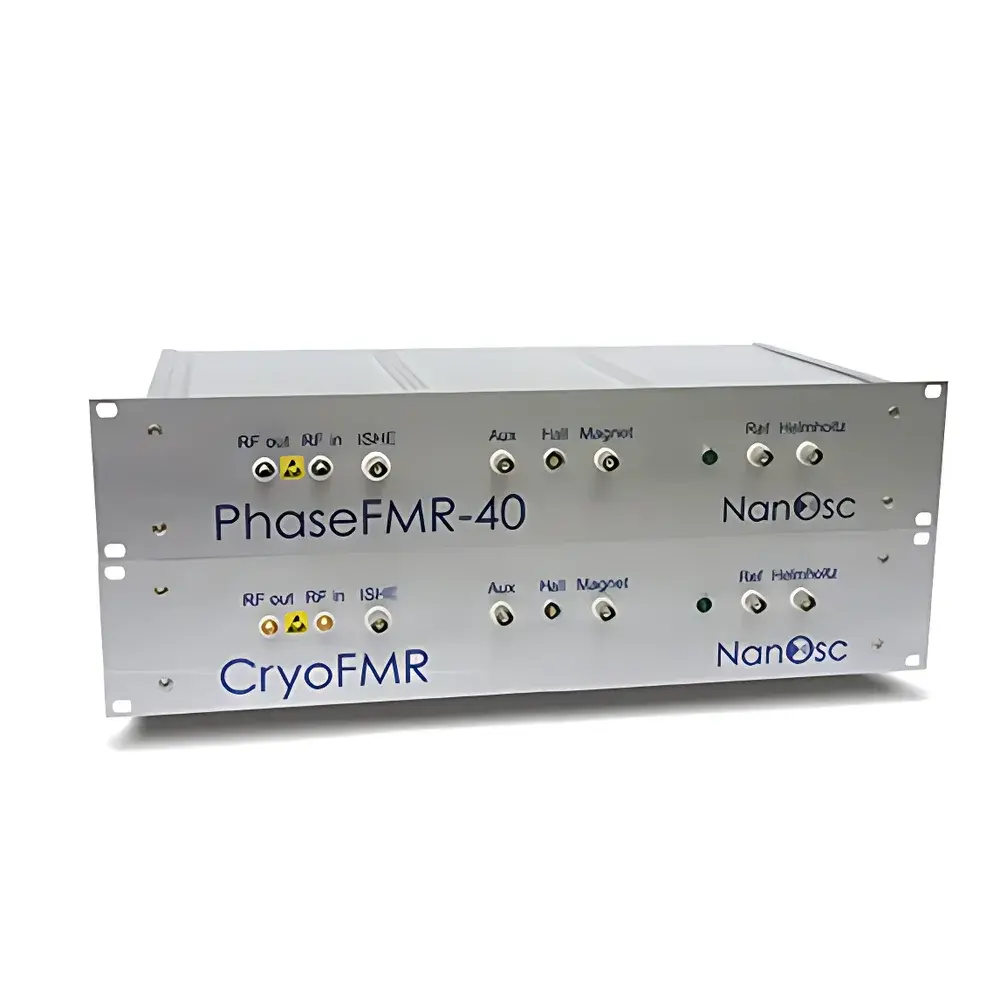
NanOsc PhaseFMR & CryoFMR High-Precision Ferromagnetic Resonance Spectrometer
| Brand | NanOsc AB |
|---|---|
| Origin | Sweden |
| Model | PhaseFMR / CryoFMR Series |
| Frequency Range | 2–40 GHz |
| Temperature Range | Room Temperature to 4 K |
| Magnetic Field Range | ±0.7 T to ±16 T (platform-dependent) |
| Frequency Accuracy | ±0.05 GHz |
| SNR | >10 for 10 nm Ni₈₀Fe₂₀ at 40 GHz |
Overview
The NanOsc PhaseFMR and CryoFMR series are high-precision, broadband ferromagnetic resonance (FMR) spectrometers engineered for quantitative magnetodynamic characterization of thin-film magnetic materials. Based on the fundamental principle of microwave absorption spectroscopy in a static magnetic field, these instruments detect resonant precession of magnetization vectors in ferromagnetic layers under applied RF excitation—governed by the Landau–Lifshitz–Gilbert (LLG) equation. Unlike static magnetometry, FMR provides direct access to dynamic parameters including effective magnetization (Meff), uniaxial and cubic anisotropy fields (HK, K), gyromagnetic ratio (γ), Gilbert damping parameter (α), and inhomogeneous linewidth (ΔH). The 2–40 GHz operational bandwidth enables multi-frequency dispersion analysis critical for decoupling contributions from exchange stiffness, surface anisotropy, and spin-pumping effects—making it indispensable for spintronics, magnonics, and next-generation MRAM and STNO development.
Key Features
- Modular platform integration: PhaseFMR for room-temperature electromagnet-based operation; CryoFMR variants compatible with Quantum Design PPMS®, DynaCool™, VersaLab™, MPMS®3, and Montana Cryostation® S50 systems
- Broadband coplanar waveguide (CPW) excitation architecture supporting both field-sweep and frequency-sweep modes
- High-sensitivity detection with lock-in amplification and dual modulation schemes (field modulation via Helmholtz coils or pulse modulation for ISHE measurements)
- Quantitative extraction of Meff, K, γ, α, and ΔH via automated spectral fitting using physics-based LLG models
- Capable of resolving FMR signals from ultrathin films down to 1.4 nm CoFeB, validated by SNR >10 for 10 nm Ni80Fe20 at 40 GHz
- Optional inverse spin Hall effect (ISHE) measurement module with dedicated CPW geometry and transverse voltage readout
- Support for higher-order spin-wave modes—including perpendicular standing spin waves (PSSW)—enabling exchange stiffness (A) and spin-wave stiffness (D) quantification in films >50 nm thick
Sample Compatibility & Compliance
The system accommodates standard planar thin-film samples (typically 3–10 mm × 3–10 mm) deposited on non-magnetic substrates such as Si/SiO2, MgO, or sapphire. Both in-plane and out-of-plane sample orientations are supported via motorized rotation stages integrated into CryoFMR probe designs. All hardware and software comply with ISO/IEC 17025 traceability principles for measurement uncertainty reporting. Data acquisition protocols support GLP/GMP-aligned audit trails when interfaced with PPMS or DynaCool platforms via LabVIEW-based instrument drivers. While not FDA-certified, the architecture meets foundational requirements for 21 CFR Part 11 compliance when deployed with validated electronic lab notebook (ELN) integration and user-access controls.
Software & Data Management
NanOsc’s proprietary FMR Control Suite provides a three-panel graphical interface: (1) Scan parameter configuration (field/frequency step size, sweep rate, power level, modulation amplitude); (2) Real-time spectrum acquisition with overlay capability and live derivative display; and (3) Post-processing environment featuring nonlinear least-squares fitting against analytical FMR line shapes, PSSW dispersion models, and temperature-dependent parameter mapping. Export formats include ASCII, HDF5, and MATLAB-compatible .mat files. Batch processing scripts enable automated parameter extraction across multi-temperature or multi-field datasets. The software supports direct synchronization with PPMS/DynaCool temperature and field controllers, enabling fully autonomous variable-temperature FMR sweeps from 4 K to 400 K with sub-Kelvin stability and milli-Oe field resolution.
Applications
- Quantification of Gilbert damping enhancement in heavy-metal-capped magnetic bilayers (e.g., Py/Pt, Py/Pd) via spin-pumping and ISHE
- Thermal evolution studies of Ms(T), α(T), and ΔH(T) in multilayer stacks relevant to thermal-assisted switching in MRAM
- Exchange stiffness mapping in compositionally graded permalloy alloys (e.g., Py100−xMx, M = Pt/Au/Ag) for magnonic waveguide design
- Resonance field and linewidth analysis of pseudo-spin-valve structures before and after annealing—revealing interfacial diffusion kinetics and microstructural relaxation
- Propagation-mode spin-wave spectroscopy in nanoscale MTJ-based STNOs, including higher-order mode identification (2nd/3rd order) and wavelength estimation below 100 nm
- Calibration-grade validation of micromagnetic simulation inputs (e.g., A, K, α) for OOMMF and MuMax3 modeling workflows
FAQ
What is the minimum detectable film thickness for FMR signal acquisition?
The system has demonstrated reliable FMR detection from 1.4 nm CoFeB films using optimized CPW coupling and low-noise amplification. Sensitivity is strongly dependent on material’s gyromagnetic ratio and magnetic moment density.
Can the CryoFMR probe be used on non-Quantum Design cryostats?
Yes—the CryoFMR probe is mechanically and electrically designed for drop-in integration with any cryogenic platform offering standard 12-pin electrical feedthroughs, vacuum compatibility, and field control via ±10 V analog input. Custom mounting adapters are available upon request.
Is ISHE measurement capability included by default?
No—ISHE functionality requires the optional ISHE-CPW probe head and dedicated voltage readout channel. It is sold separately and must be specified at time of order.
How is frequency accuracy maintained across the 2–40 GHz range?
Each instrument is factory-calibrated using NIST-traceable microwave standards. Frequency synthesis is performed via phase-locked YIG-tuned oscillators with inherent stability of ±0.05 GHz across full bandwidth, verified per ASTM E2892-22 guidelines for RF metrology.
Does the software support automated temperature-dependent parameter extraction?
Yes—batch analysis modules allow users to define temperature ramps, extract resonance fields and linewidths at each point, and generate Arrhenius or Bloch-law fits for α(T) and Ms(T) without manual intervention.



