
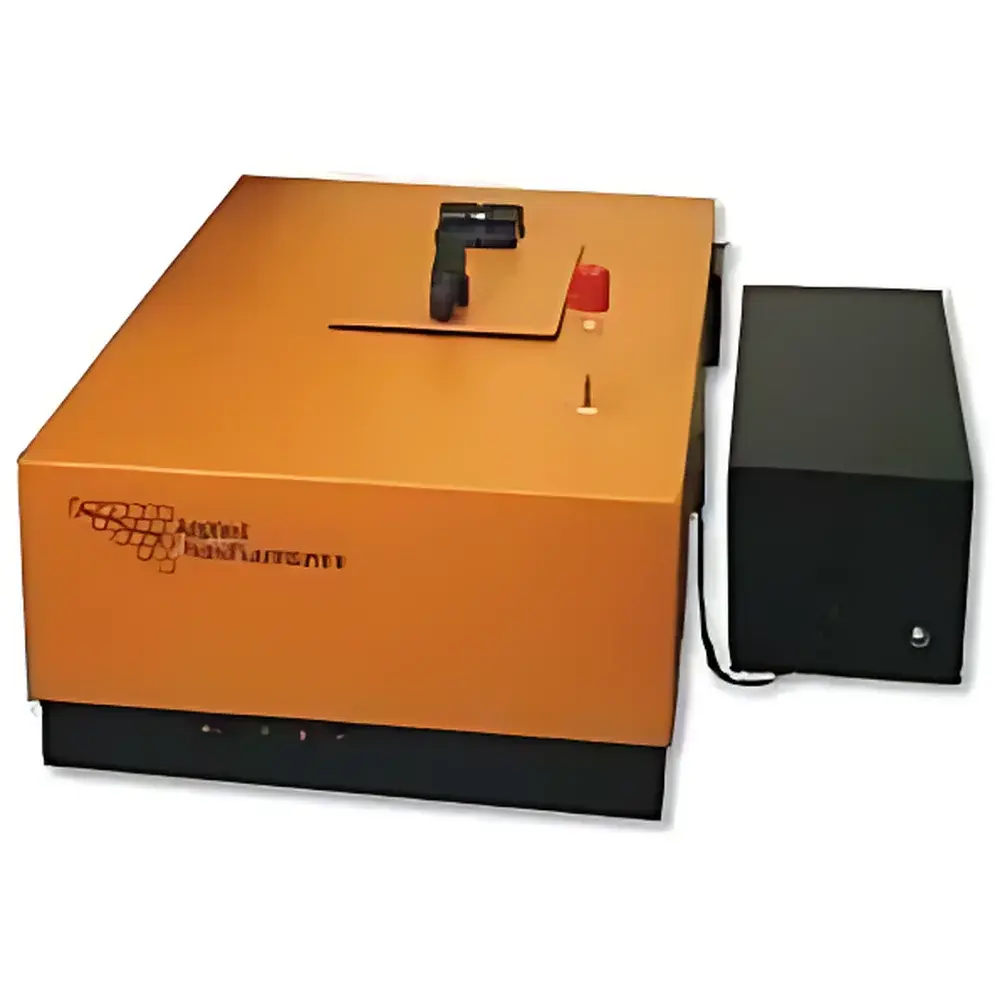
NanoSpectralyzer NS1 Molecular Fluorescence and Absorption Spectrometer for Single-Walled Carbon Nanotubes
| Origin | USA |
|---|---|
| Manufacturer Type | Authorized Distributor |
| Origin Category | Imported |
| Model | NS1 |
| Pricing | Available Upon Request |
Overview
The NanoSpectralyzer NS1 is a purpose-built, benchtop molecular fluorescence and absorption spectrometer engineered exclusively for the quantitative spectral characterization of single-walled carbon nanotubes (SWNTs) in aqueous dispersions. Unlike general-purpose near-infrared (NIR) spectrometers, the NS1 implements a dual-mode optical architecture optimized for simultaneous or sequential acquisition of excitation-resolved fluorescence emission spectra and absorption spectra across the technologically critical 880–1580 nm SWNT electronic transition window. Its measurement principle relies on photoluminescence excitation spectroscopy (PLE) combined with broadband absorption detection—enabling direct correlation between chiral index (n,m), diameter distribution, semiconducting/metallic ratio, and bundle dispersion state. The system operates on the fundamental photophysics of SWNTs: upon laser excitation, semiconducting tubes emit characteristic NIR fluorescence whose peak wavelength and intensity are uniquely determined by their atomic structure and local dielectric environment. This enables non-destructive, label-free compositional analysis without centrifugation or chromatographic separation.
Key Features
- Triple temperature-stabilized diode laser excitation sources (e.g., 635 nm, 730 nm, 785 nm) ensuring wavelength reproducibility ≤ ±0.1 nm and power stability < 1% RMS over 8 hours—critical for quantitative PLE mapping.
- Dual-spectral capability: integrated fluorescence emission detection (880–1580 nm) and absorption spectroscopy (base unit: 880–1580 nm; optional visible-NIR extension: 380–1580 nm) using calibrated InGaAs and Si CCD detectors.
- High-throughput analysis: full spectral acquisition completed in ≤5 seconds per sample; maximum sequential acquisition rate of 10 spectra/second for real-time monitoring of dispersion kinetics or surfactant exchange processes.
- Minimal sample requirement: compatible with standard 1-cm pathlength quartz cuvettes; minimum volume 200 µL—enabling analysis of precious or low-yield synthetic batches.
- Compact main optical module (318 × 470 × 165 mm; 18 kg) with fixed optical axis height (8.5 mm) for precise cuvette positioning and repeatable beam alignment—reducing operator-induced variability.
- One-click automated workflow: software-controlled laser selection, grating positioning, detector integration time, and background subtraction eliminate manual parameter tuning.
Sample Compatibility & Compliance
The NS1 is validated for use with SWNT suspensions stabilized in common aqueous media including sodium deoxycholate (DOC), sodium dodecyl sulfate (SDS), and polyacrylic acid (PAA). It accommodates both as-produced and post-purified dispersions, provided optical density at 980 nm remains within 0.1–1.5 AU to avoid inner-filter effects. All hardware and firmware comply with IEC 61010-1:2010 safety standards for laboratory electrical equipment. Data handling supports ALCOA+ principles (Attributable, Legible, Contemporaneous, Original, Accurate, Complete, Consistent, Enduring, Available) and is compatible with 21 CFR Part 11-compliant audit trail configurations when deployed with validated LIMS or ELN environments. Routine operation meets ASTM E2919-21 guidelines for spectral characterization of nanomaterials.
Software & Data Management
The proprietary NanoSpectralyzer Control Suite (v4.x) provides instrument control, spectral processing, and chiral assignment via reference-matched peak fitting against a validated SWNT spectral library containing >120 (n,m) species. Raw data are stored in HDF5 format with embedded metadata (laser ID, integration time, temperature, user ID, timestamp). Quantitative outputs include diameter distribution histograms, relative abundance of (6,5), (7,5), (7,6), (8,3), (8,4), (8,6), (9,1), (9,2), (9,4), (10,2), (10,3), (10,5), (11,1), (12,1), and (12,2) species, and semiconducting-to-metallic tube ratios. Batch processing supports CSV export for statistical analysis in MATLAB, Python (NumPy/Pandas), or JMP. Software updates follow ISO/IEC 17025:2017 clause 5.9.2 requirements for method validation documentation.
Applications
- Quality control of SWNT synthesis batches (e.g., CoMoCAT, HiPco, arc-discharge) for diameter uniformity and chirality yield.
- Optimization of dispersion protocols—including surfactant screening, sonication energy calibration, and centrifugal fractionation verification.
- In-process monitoring of functionalization reactions (e.g., PEGylation, DNA wrapping) via fluorescence quenching or peak shift analysis.
- Stability assessment under thermal, pH, or ionic strength stress conditions using time-series spectral tracking.
- Reference material certification for NIST-traceable SWNT standards (e.g., SRM 2483).
- Academic research in nanoelectronics, biosensing, and photothermal therapy where chiral purity directly impacts device performance.
FAQ
Does the NS1 require cryogenic cooling for detector operation?
No—the InGaAs detector is thermoelectrically cooled to –10°C, eliminating liquid nitrogen dependency while maintaining dark current < 50 e⁻/pixel/s.
Can the system distinguish metallic from semiconducting SWNTs?
Yes—metallic tubes exhibit no characteristic NIR fluorescence but contribute to broad-band absorption; their presence is inferred quantitatively via absorption/fluorescence intensity ratio modeling.
Is spectral calibration traceable to NIST standards?
Yes—wavelength calibration uses certified rare-earth oxide emission lines (e.g., Holmium Oxide, NIST SRM 2034); intensity calibration employs NIST-traceable tungsten halogen and deuterium lamps.
What sample preparation steps are required prior to analysis?
Samples must be centrifuged (12,000 rpm, 30 min) to remove large aggregates, then filtered (0.2 µm PVDF) to prevent scattering artifacts; no dilution or matrix matching is needed beyond standard cuvette filling.
Is remote operation supported?
Yes—the software includes secure TCP/IP interface and RESTful API endpoints for integration into automated lab workflows and central data repositories.




