
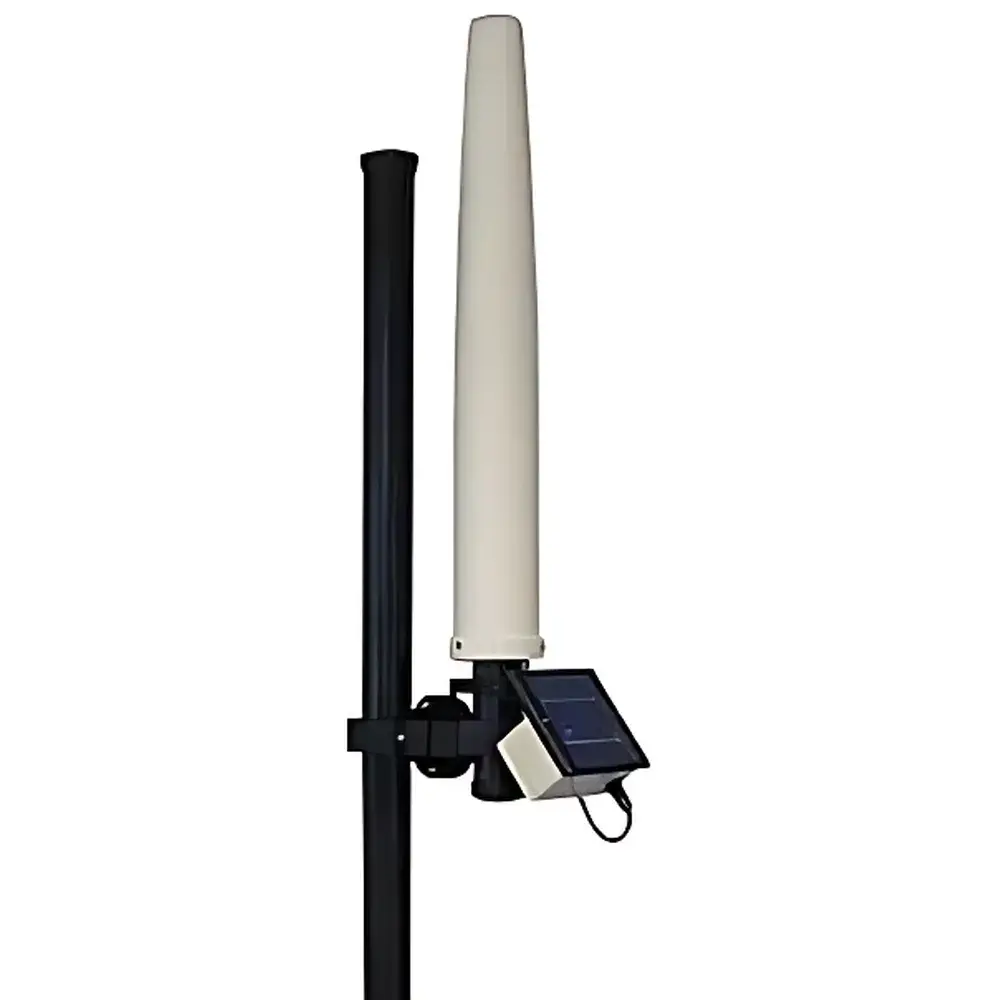
Narda AMB 8057 Electromagnetic Field Long-Term Continuous Monitoring System
| Brand | Narda |
|---|---|
| Origin | Germany |
| Model | AMB 8057 |
| Frequency Range (E-field) | 100 kHz – 3 GHz |
| Frequency Range (H-field) | 10 Hz – 5 kHz |
| Data Storage Capacity | Up to 338 days @ 15-min intervals (3-band mode) |
| Sampling Interval | 3 seconds (simultaneous multi-band acquisition) |
| Communication | Dual-mode GSM/GPRS + RS-232C |
| Power Supply | Integrated Li-ion battery (3.6 V, 13 Ah) with solar panel (4 V, 2.5 Ah lead-acid backup) |
| Operating Temperature | −10 °C to +50 °C |
| Ingress Protection | IP54 |
| Data Capture Rate | ≥99% |
| Alarm Triggers | Field strength exceedance, memory full, temperature out-of-range, low battery, probe disconnection, enclosure open |
| SMS Alert Support | Up to two mobile numbers |
| Software | AMB-8057-SW-02 (data download, threshold-based alerts, RMS/AVG/MAX computation, linear/logarithmic plotting, calibration traceability) |
Overview
The Narda AMB 8057 Electromagnetic Field Long-Term Continuous Monitoring System is an industrial-grade, autonomous environmental monitoring platform engineered for regulatory-compliant, unattended electromagnetic field (EMF) surveillance across wide spectral bands. It operates on the principle of broadband isotropic field sensing—using calibrated, triaxial E-field and H-field probes—to capture time-synchronized vector magnitude data in accordance with international measurement standards including ICNIRP, IEEE C95.1, and EU Council Recommendation 1999/519/EC. Designed for permanent outdoor deployment or fixed indoor installations near RF infrastructure (e.g., base stations, broadcast transmitters, smart grid substations), the system delivers high-reliability, metrologically traceable measurements without manual intervention. Its architecture integrates real-time spectral separation algorithms to quantify contributions from specific telecommunication services—including GSM (900/1800 MHz), UMTS (2100 MHz), LTE (700–2600 MHz), and 5G NR (sub-6 GHz)—enabling source attribution within composite exposure environments.
Key Features
- Simultaneous dual-domain monitoring: Independent, synchronized acquisition of electric field (100 kHz – 3 GHz) and magnetic field (10 Hz – 5 kHz) components using interchangeable, factory-calibrated probes (EP-1B-01, EP-3B-01, EP-4B-01, HP-1B-01)
- Robust autonomous operation: Solar-powered architecture with integrated Li-ion battery (3.6 V / 13 Ah) and 4 V / 2.5 Ah lead-acid backup ensures ≥6 months continuous runtime at 30-minute sampling intervals—even during extended overcast conditions
- High-integrity data capture: ≥99% measurement availability under nominal environmental stress; internal clock synchronization with GPS optional via external module
- Dual communication redundancy: Embedded dual-band GSM/GPRS modem (SIM card slot, user-supplied) plus RS-232C serial interface for failover connectivity and local diagnostics
- Configurable alarm hierarchy: Programmable dual-threshold logic (warning/alert) for field strength, temperature, battery voltage, memory occupancy, probe integrity, and physical tampering (open-case detection)
- Compliance-ready data logging: Timestamped RMS, AVG, and MAX values stored with metadata including probe ID, calibration date, firmware version, ambient temperature, and supply voltage
Sample Compatibility & Compliance
The AMB 8057 supports a modular probe ecosystem enabling application-specific configuration: single-band (EP-1B-01), three-band (EP-3B-01), four-band (EP-4B-01), and low-frequency magnetic (HP-1B-01) variants—all traceably calibrated per ISO/IEC 17025 requirements. Probe interchangeability allows rapid re-deployment across heterogeneous EMF environments—from urban macrocell sites to rural power line corridors. The system complies with EN 50492:2008 (measurement methodology for EMF exposure assessment), EN 50413:2020 (basic restrictions and reference levels), and supports audit trails required under GLP and national regulatory frameworks (e.g., China MEP Order No. 11, German BImSchV Annex 1). All stored datasets include embedded digital signatures for data integrity verification during regulatory submission.
Software & Data Management
AMB-8057-SW-02 is a Windows-based desktop application providing full lifecycle management of monitoring campaigns. It enables scheduled or on-demand data retrieval via GSM/GPRS or direct RS-232 connection, auto-generates timestamped ASCII (.txt) reports per download session, and supports batch export to CSV or XML for integration with GIS or enterprise LIMS platforms. Visualization tools include scalable time-series plots (linear/logarithmic Y-axis), spectral contribution overlays, and comparative analysis across multiple monitoring nodes. The software enforces role-based access control (administrator/operator) aligned with ISO/IEC 27001 principles and maintains immutable audit logs of all configuration changes, alarm events, and data exports—facilitating compliance with FDA 21 CFR Part 11 electronic record requirements when deployed in health physics or occupational safety contexts.
Applications
- Regulatory compliance monitoring for telecom operators and national radiation protection authorities
- Long-term baseline characterization prior to 5G infrastructure rollout
- Public exposure assessment near schools, hospitals, and residential zones
- Occupational EMF monitoring in power generation, rail traction, and industrial induction heating facilities
- Environmental impact assessment (EIA) studies supporting permitting of new transmission lines or broadcasting towers
- Scientific research on diurnal/seasonal EMF variability and correlation with meteorological parameters
FAQ
Does the AMB 8057 meet international EMF exposure limit standards?
Yes—it is configured and calibrated to measure against ICNIRP 2020, IEEE C95.1-2019, and EU 1999/519/EC reference levels, with probe-specific uncertainty budgets documented in calibration certificates.
Can the system operate without cellular coverage?
Yes—local data storage persists autonomously; GSM/GPRS serves as primary telemetry, but RS-232 enables periodic manual retrieval where wireless connectivity is unavailable.
Is remote firmware update supported?
Firmware updates require physical access or secure GPRS-initiated download via authenticated administrator credentials; no over-the-air (OTA) self-upgrade capability is implemented to preserve measurement integrity.
How is measurement traceability ensured?
Each probe carries a unique serial number linked to its accredited calibration certificate (valid for 12 months); software displays calibration expiry dates and flags expired probes during data acquisition.
What is the minimum recommended sampling interval for regulatory reporting?
For most national reporting regimes (e.g., Germany BNetzA, UK OFCOM), 6-minute averaging is standard; the AMB 8057 supports configurable intervals from 30 seconds to 15 minutes, with RMS averaging conforming to IEC 62232 ed.2 Annex D.
Related Products







