
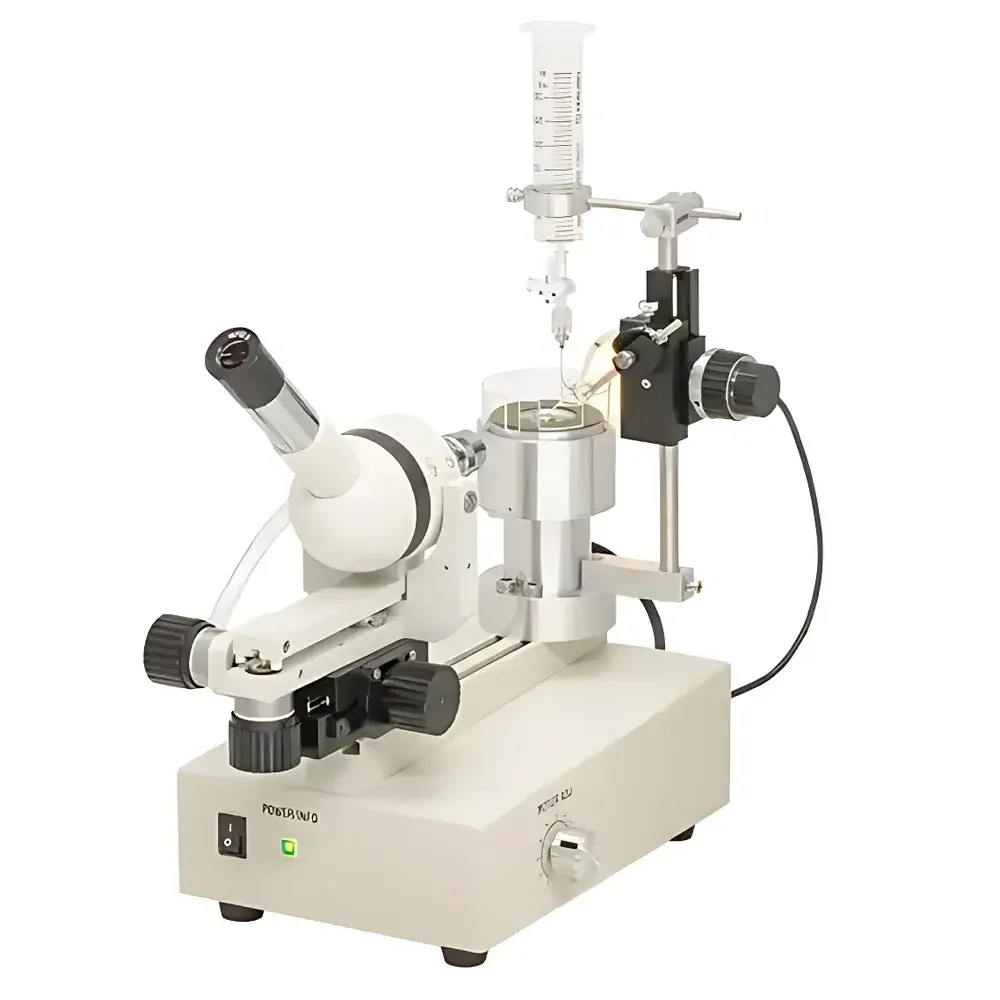
Narishige EG-402 Microelectrode Grinder
| Origin | Japan |
|---|---|
| Manufacturer Type | Authorized Distributor |
| Origin Category | Imported Instrument |
| Model | EG-402 |
| Price | Upon Request |
| Motor Speed Range | 150–2100 rpm |
| Electrode Manipulator Travel | 47 mm (vertical) |
| Microscope Magnification | 30× (10× eyepiece × 3× objective) |
| Microscope Adjustment | X-axis (rotary fine adjustment): ±5°, Y-axis (coarse focus): 30 mm, Z-axis (tilt fine control): ±3° |
| Compatible Capillary OD | 1.0–1.5 mm |
| Power Supply | AC 100–240 V, 50/60 Hz |
| Power Consumption | ~10 W |
| Dimensions (W×D×H) | 250 × 450 × 430 mm |
| Weight | 6.4 kg |
Overview
The Narishige EG-402 Microelectrode Grinder is a precision-engineered benchtop instrument designed for the reproducible fabrication of sharp, low-resistance glass micropipettes used in electrophysiology, microinjection, patch-clamp recording, and single-cell manipulation. It operates on the principle of controlled abrasive grinding: a rotating optical-grade flat grinding disk—driven by a high-stability brushless DC motor—interacts with a glass capillary under precise angular and vertical positioning. The system enables deterministic tip geometry generation—including beveled, angled, or symmetrically sharpened profiles—by combining real-time optical monitoring, calibrated angular orientation, and regulated slurry-assisted abrasion. Unlike manual or non-motorized grinders, the EG-402 eliminates mechanical drift and rotational irregularities through its torque-consistent motor architecture, ensuring consistent material removal rates across speed ranges. Its design conforms to fundamental requirements for GLP-compliant electrode preparation workflows where inter-experiment repeatability and intra-lab standardization are critical.
Key Features
- Brushless DC motor delivering stable rotational output from 150 to 2100 rpm with minimal speed deviation (< ±2% full-scale), enabling both gentle polishing and aggressive sharpening without vibration-induced surface artifacts.
- Integrated stereoscopic microscope (30× total magnification: 10× wide-field eyepiece + 3× objective) mounted directly on the base for parallax-free observation of capillary-to-disk contact dynamics during grinding.
- Coaxial coarse/fine manipulator with 47 mm vertical travel and dual-stage control—macro-positioning via knurled knob and sub-micron fine adjustment via micrometer screw—ensuring repeatable electrode immersion depth and contact pressure.
- Dual-axis angular calibration system: a fixed protractor base (±5° X-axis rotation) and tilt-adjustable Z-axis mount (±3° fine tilt) allow precise bevel angle definition (e.g., 15°, 30°, 45°) prior to grinding; optional vertical-grinding adapter supports 90° orthogonal tip formation.
- Integrated water management module comprising adjustable drip-feed nozzle and sump-style drainage channel, preventing abrasive slurry accumulation and maintaining thermal stability at the grinding interface over extended operation cycles.
- Variable-intensity LED illumination system with diffused coaxial lighting path, optimized for high-contrast visualization of meniscus formation, crack propagation, and edge definition during real-time tip shaping.
Sample Compatibility & Compliance
The EG-402 accommodates borosilicate and quartz glass capillaries with outer diameters of 1.0–1.5 mm, including filamented and non-filamented variants commonly used in intracellular recording and nanoliter-scale injection. Its grinding protocol is compatible with standard alumina (Al2O3) and silicon carbide (SiC) slurries (particle sizes 0.3–3 µm), supporting ISO 8549-2:2017 guidelines for microelectrode tip characterization. While the instrument itself does not carry CE or FDA 510(k) certification as a medical device, its operational parameters align with ASTM F2149-21 Annex A2 recommendations for electrophysiological probe conditioning and support audit-ready documentation when integrated into SOP-driven labs operating under ISO/IEC 17025 or GLP frameworks.
Software & Data Management
The EG-402 is a fully manual, hardware-controlled system with no embedded firmware or digital interface. All operational parameters—including rotational speed, angular orientation, vertical position, and slurry flow rate—are set mechanically and recorded manually in lab notebooks or LIMS-integrated electronic logs. This analog architecture ensures electromagnetic compatibility in shielded electrophysiology suites and eliminates software validation burdens under FDA 21 CFR Part 11. Users maintain full traceability via standardized electrode preparation logs that document batch number, capillary lot, grinding duration, final resistance measurement (via impedance analyzer), and visual tip assessment per USP particulate evaluation criteria.
Applications
- Preparation of low-impedance intracellular microelectrodes for sharp-electrode recordings in neurons, oocytes, and plant cells.
- Fabrication of beveled injection needles for pronuclear or cytoplasmic microinjection in transgenic mouse, zebrafish, and C. elegans embryo studies.
- Production of ultra-fine cutting electrodes for laser-assisted microdissection and subcellular ablation protocols.
- Calibration-grade pipette sharpening for scanning ion conductance microscopy (SICM) and nanopore sensing applications requiring sub-100 nm aperture consistency.
- Reconditioning of dulled patch-clamp pipettes to restore tip symmetry and reduce seal formation time in whole-cell configuration.
FAQ
What capillary types and dimensions are supported by the EG-402?
The EG-402 accepts standard borosilicate and quartz capillaries with outer diameters between 1.0 mm and 1.5 mm, including those with internal filaments. Inner diameter is not mechanically constrained but must permit stable clamping in the provided electrode holder.
Is the grinding disk replaceable, and what materials are compatible?
Yes—the optical-grade flat grinding disk is user-replaceable and compatible with standard 100 mm diameter abrasive disks (e.g., alumina, silicon carbide, diamond-impregnated). Narishige recommends ISO 6344-2 certified disks with surface roughness Ra ≤ 0.05 µm for optimal tip uniformity.
Can the EG-402 produce asymmetric or double-beveled tips?
Yes—by combining controlled lateral offset positioning (via microscope stage translation) with sequential angular reorientation, users can fabricate custom asymmetric geometries, including stepped or dual-angle bevels, as documented in Journal of Neuroscience Methods Vol. 342 (2020).
Does the system require external vacuum or compressed air?
No—the EG-402 operates exclusively on line power and gravity-fed water delivery. No auxiliary pneumatic or vacuum connections are needed.
How is calibration verified for long-term use?
Users perform quarterly mechanical verification using certified gauge blocks (ISO 3650) to confirm manipulator travel linearity and protractor angular accuracy; microscope magnification is validated using NIST-traceable stage micrometers.




