
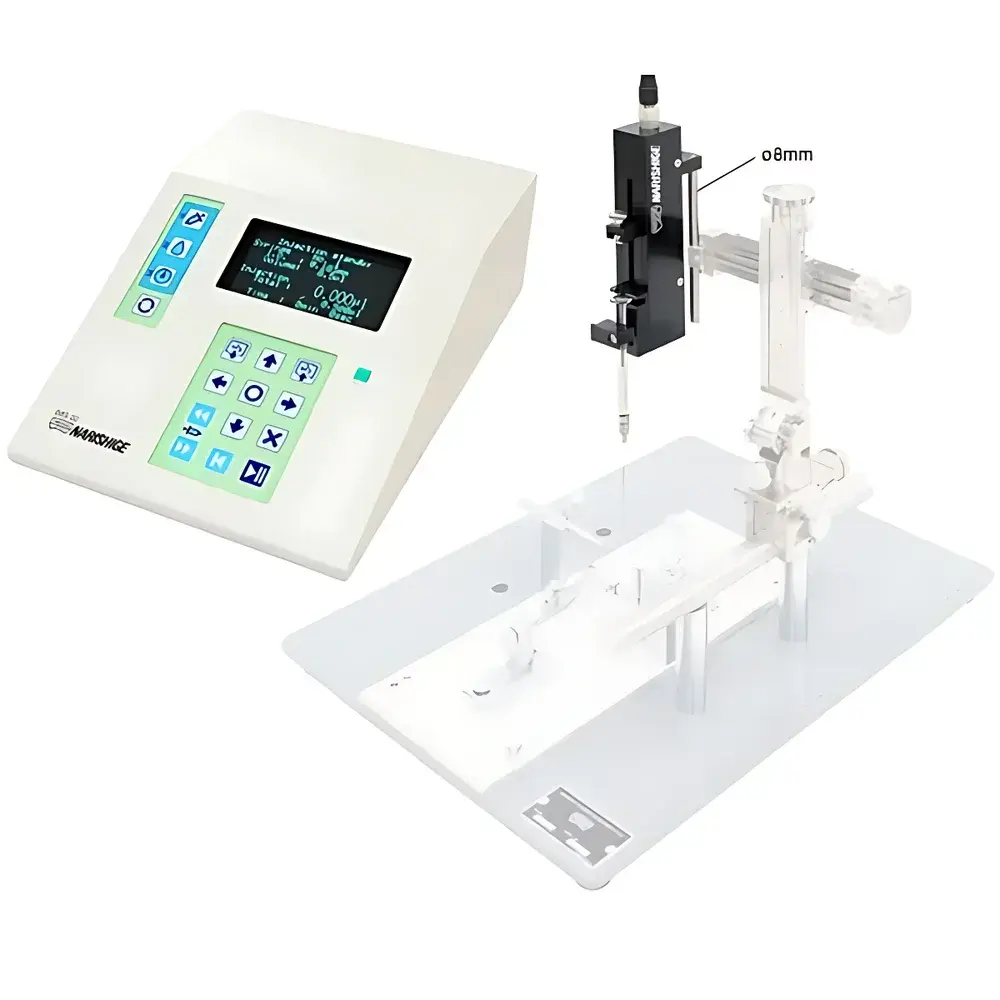
NARISHIGE IMS-20 Microsyringe Pump for Stereotaxic Brain Injection
| Origin | Japan |
|---|---|
| Manufacturer Type | Authorized Distributor |
| Origin Category | Imported |
| Model | IMS-20 |
| Price Range | USD 1,400 – 7,000 |
| Syringe Compatibility | Hamilton series (75, 701–725, 1701–1725, 7000.5–7105) and equivalent glass/metal syringes with outer diameter 6.5–9.0 mm |
| Motor Type | Precision Stepper Motor |
| Total Travel | 60 mm |
| Power Supply | AC 100–240 V, 50/60 Hz |
| Power Consumption | 10 W |
| Pump Dimensions/Weight | 30 × 167 × 84 mm / 426 g |
| Controller Dimensions/Weight | 180 × 95 × 260 mm / 2.45 kg |
| Included Cables | Power cord (1.5 m), Data cable (2 m) |
Overview
The NARISHIGE IMS-20 Microsyringe Pump is a precision-engineered electromechanical injection system designed explicitly for stereotaxic neuroscientific applications in rodent and small-animal models. Operating on a high-resolution stepper motor-driven linear actuation principle, the IMS-20 delivers controlled, repeatable fluid displacement by advancing the syringe plunger at programmable rates—enabling volumetric accuracy essential for intracerebral, intraventricular, or intraparenchymal delivery of neuroactive compounds, viral vectors, tracers, or cell suspensions. Its architecture integrates seamlessly with standard stereotaxic frames (e.g., NARISHIGE SR series, Stoelting 51600, or Kopf 1900) and micromanipulators, supporting both manual and automated workflows in electrophysiology, optogenetics, chemogenetics, and behavioral neuroscience laboratories. The pump does not rely on pressure-based or peristaltic mechanisms; instead, it employs direct plunger displacement to eliminate pulsatility, backflow, and compressibility artifacts—critical for sub-microliter dosing fidelity.
Key Features
- Programmable volumetric delivery: Users define target volume (nL to µL range), injection duration (ms to hours), and flow profile (linear ramp, step, or hold) via intuitive controller interface.
- Dual-mode operation: Real-time control via front-panel buttons or hands-free activation using optional footswitch (FS-1 compatible), minimizing operator-induced vibration during delicate craniotomy or cannula insertion.
- Real-time display: LCD panel continuously shows elapsed time, delivered volume, remaining volume, current flow rate, and syringe model-specific calibration status.
- Modular mechanical design: Compact pump head (426 g) mounts directly onto stereotaxic arms or custom 3D-printed adapters; controller unit houses non-volatile parameter storage and firmware-upgradable logic board.
- Hamilton syringe optimization: Preloaded calibration curves for 14+ Hamilton models (701–725, 1701–1725, etc.) and generic syringes (OD 6.5–9.0 mm) ensure accurate conversion from motor steps to nanoliter-scale volume displacement.
- Low-power, low-noise operation: 10 W nominal draw and brushless stepper motor minimize electromagnetic interference near electrophysiology rigs or MRI-compatible setups.
Sample Compatibility & Compliance
The IMS-20 accommodates borosilicate glass, stainless steel, and polypropylene syringes conforming to ISO 7886-1 and ASTM D3720 standards for dimensional consistency. It supports sterile, filter-equipped, and luer-lock configurations commonly used in GLP-compliant preclinical studies. While the device itself is not FDA-cleared or CE-marked as an IVD or medical device, its operational parameters align with NIH Guide for the Care and Use of Laboratory Animals (2011) and AAALAC International accreditation requirements for instrument validation in animal protocols. Calibration traceability is maintained through user-recorded syringe ID mapping and time-stamped injection logs—supporting audit readiness for institutional animal care and use committees (IACUC).
Software & Data Management
The IMS-20 operates without proprietary PC software; all configuration and execution occur locally on the embedded controller. However, ASCII-formatted log files (timestamp, volume, rate, syringe ID, operator code) can be exported via RS-232 serial output (DB9 connector) for integration into LabArchives, Electronic Lab Notebooks (ELN), or custom Python/Matlab acquisition scripts. Audit trails meet basic ALCOA+ principles (Attributable, Legible, Contemporaneous, Original, Accurate) when paired with timestamped operator entries. For regulated environments requiring 21 CFR Part 11 compliance, external validation packages—including electronic signature capture and role-based access control—must be implemented at the laboratory information management system (LIMS) layer.
Applications
- Stereotaxic delivery of AAV, lentivirus, or CRISPR-Cas9 constructs into defined brain nuclei (e.g., hippocampus, striatum, VTA, mPFC).
- Controlled infusion of pharmacological agents (e.g., muscimol, bicuculline, DREADD ligands) for reversible neural silencing or activation.
- Co-injection of fluorescent dyes (e.g., Alexa Fluor–conjugated dextrans) with tracers for anterograde/retrograde mapping.
- Microdialysis probe priming and zero-flow calibration prior to in vivo sampling.
- Embryonic or neonatal intracerebroventricular (ICV) injections in P0–P7 mice/rats under cryo-anesthesia.
FAQ
Is the IMS-20 compatible with non-Hamilton syringes?
Yes—provided the syringe barrel outer diameter falls within 6.5–9.0 mm and the plunger mechanism engages reliably with the pump’s drive screw. Users must manually input syringe geometry (barrel ID, plunger pitch) for accurate volume calculation.
Can injection parameters be saved between sessions?
Yes—the controller retains up to 10 user-defined protocols in non-volatile memory, including volume, time, syringe type, and pause intervals.
Does the IMS-20 support multi-step or gradient infusion protocols?
No—it executes single-phase linear infusions only. Complex temporal profiles require external triggering via TTL pulse input (available on RS-232 port) synchronized with third-party timing hardware.
What maintenance is required for long-term reliability?
Annual inspection of lead screw lubrication and drive belt tension is recommended. No consumables are required beyond standard syringes and replacement O-rings for syringe holders.
Is technical support available outside Japan?
Yes—NARISHIGE maintains authorized service centers in the US (NARISHIGE America, NJ), Germany (NARISHIGE Europe GmbH), and China (Beijing NARISHIGE Instrument Co., Ltd.), offering firmware updates, calibration verification, and repair services under international warranty terms.



