
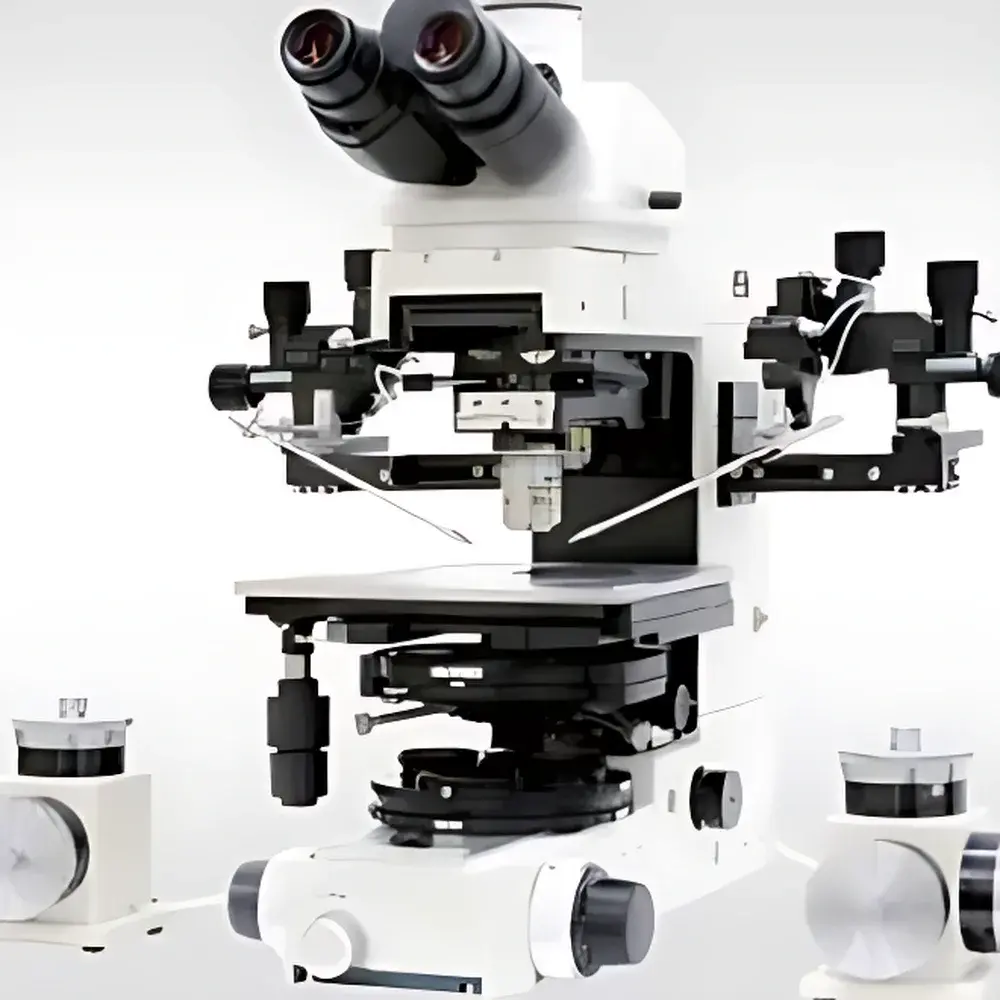
NARISHIGE MMO-203 / MMO-4 / UMM-3FC Micromanipulation System for Micro-Object Handling
| Brand | NARISHIGE |
|---|---|
| Origin | Japan |
| Model | MMO-203 / MMO-4 / UMM-3FC |
| Component Type | Precision Optical Manipulation Assembly |
| Positioning Resolution | 1 µm (MMO-203), Continuous Fine/Coarse Dual-Stage Control (UMM-3FC) |
| Actuation Method | Manual Mechanical Drive with Ergonomic Knob or Joystick Interface |
| Sample Interaction Modes | Electrostatic Pickup, Pneumatic Aspiration/Dispensing, Mechanical Dissection & Retrieval |
Overview
The NARISHIGE MMO-203, MMO-4, and UMM-3FC are high-precision manual micromanipulation systems engineered for delicate micro-object handling in optical laboratory environments. Designed for integration with upright or inverted optical microscopes—including transmitted-light, phase contrast, DIC, and fluorescence configurations—these systems enable precise three-dimensional positioning of microtools relative to biological specimens, microfabricated devices, or micron-scale materials. The core operational principle relies on mechanically amplified translational motion translated through calibrated gear trains and low-backlash lead screws, ensuring deterministic displacement without hysteresis or thermal drift. Unlike motorized or piezoelectric alternatives, these instruments prioritize tactile feedback, mechanical stability, and long-term repeatability under ambient lab conditions—making them particularly suitable for applications requiring iterative manual intervention, such as single-cell isolation, microinjection probe alignment, microelectrode placement, and microtissue dissection.
Key Features
- MMO-203: Large-diameter ergonomic control knobs provide intuitive 3D positioning with a minimum incremental step of 1 µm; backlash-free movement ensures consistent approach/retraction trajectories without unintended contact.
- MMO-4: Compact joystick-style manipulator delivers smooth, multi-directional motion—including diagonal and point-to-point translation—optimized for surface scraping, lateral probing, and repetitive positional tasks.
- UMM-3FC: Dual-stage XYZ control architecture integrates coarse adjustment (for rapid gross positioning) and fine adjustment (with sub-micron resolution), enabling efficient workflow transitions between macro-alignment and micro-scale manipulation.
- All models support interchangeable tool holders compatible with glass capillaries, tungsten needles, metal electrodes, and electrostatic pickup probes.
- Pneumatic interface compatibility allows connection to standard syringe pumps or air-driven aspiration units for controlled fluid-phase sample retrieval from suspension media.
- Modular mounting options include vertical post clamps, microscope stage adapters, and vibration-isolated optical table brackets.
Sample Compatibility & Compliance
These manipulators are routinely deployed in GLP-compliant cell biology labs, microengineering cleanrooms, and academic microscopy cores. They accommodate samples ranging from suspended algae or zebrafish embryos (5–500 µm) to embedded tissue sections, polymer microstructures, and semiconductor microdevices. Tool tips can be functionalized for electrostatic adhesion (e.g., silicon nitride-coated glass), conductive probing (Pt/Ir electrodes), or mechanical ablation (sharp tungsten or diamond-tipped blades). While the systems themselves are not certified medical devices, their mechanical design adheres to ISO 13485-aligned manufacturing practices typical of Japanese precision instrumentation. No electrical safety certification (e.g., IEC 61010) is required, as all variants operate exclusively via manual mechanical input.
Software & Data Management
The MMO-203, MMO-4, and UMM-3FC are fully analog, standalone instruments with no embedded electronics, firmware, or digital interfaces. Consequently, they generate no native data streams, require no driver installation, and introduce zero electromagnetic interference into sensitive optical or electrophysiological setups. Positional repeatability is documented manually via stage micrometer calibration and operator logbooks—a practice aligned with traditional microscopy QA protocols. For labs implementing digital workflows, third-party camera-based tracking software (e.g., ImageJ with MTrackJ plugin or commercial solutions like MetaMorph) may be used to annotate and archive manipulation coordinates relative to live image feeds.
Applications
- Single-cell picking and transfer in developmental biology and stem cell research
- Microinjection needle alignment for CRISPR/Cas9 delivery or mRNA transfection
- Mechanical dissection of neural organoids or embryoid bodies
- Probe placement for localized mechanical stimulation or nanoindentation assays
- Retrieval of microbeads, microparticles, or microfluidic droplets from aqueous suspensions
- Assembly and positioning of micro-optical components during prototype fabrication
- Correlative light-electron microscopy (CLEM) sample preparation workflows
FAQ
Are these manipulators compatible with inverted microscopes?
Yes—each model offers flexible mounting configurations, including dovetail-compatible base plates and adjustable height posts, enabling secure attachment to standard inverted microscope stages.
Can the electrostatic pickup function be used with non-conductive samples?
Electrostatic adhesion is most effective with semi-conductive or hydrated biological specimens; for highly insulating materials (e.g., polystyrene beads), pneumatic aspiration or mechanical gripping is recommended.
Is calibration traceable to national standards?
While the manipulators do not include built-in encoders, their mechanical travel is empirically verifiable using NIST-traceable stage micrometers or laser interferometry—common practice in metrology-focused microscopy labs.
Do NARISHIGE manipulators meet FDA or CE requirements?
As Class I general-purpose laboratory equipment (not intended for diagnostic or therapeutic use), they fall outside FDA 21 CFR Part 820 or EU MDR scope; CE marking applies only to power-supplied accessories, which are not part of this product line.
What maintenance is required?
Periodic cleaning of lead screws and gear trains with isopropyl alcohol and light instrument-grade lubricant (e.g., Braycote 601 EF) is recommended every 6–12 months depending on usage frequency and environmental dust levels.






