
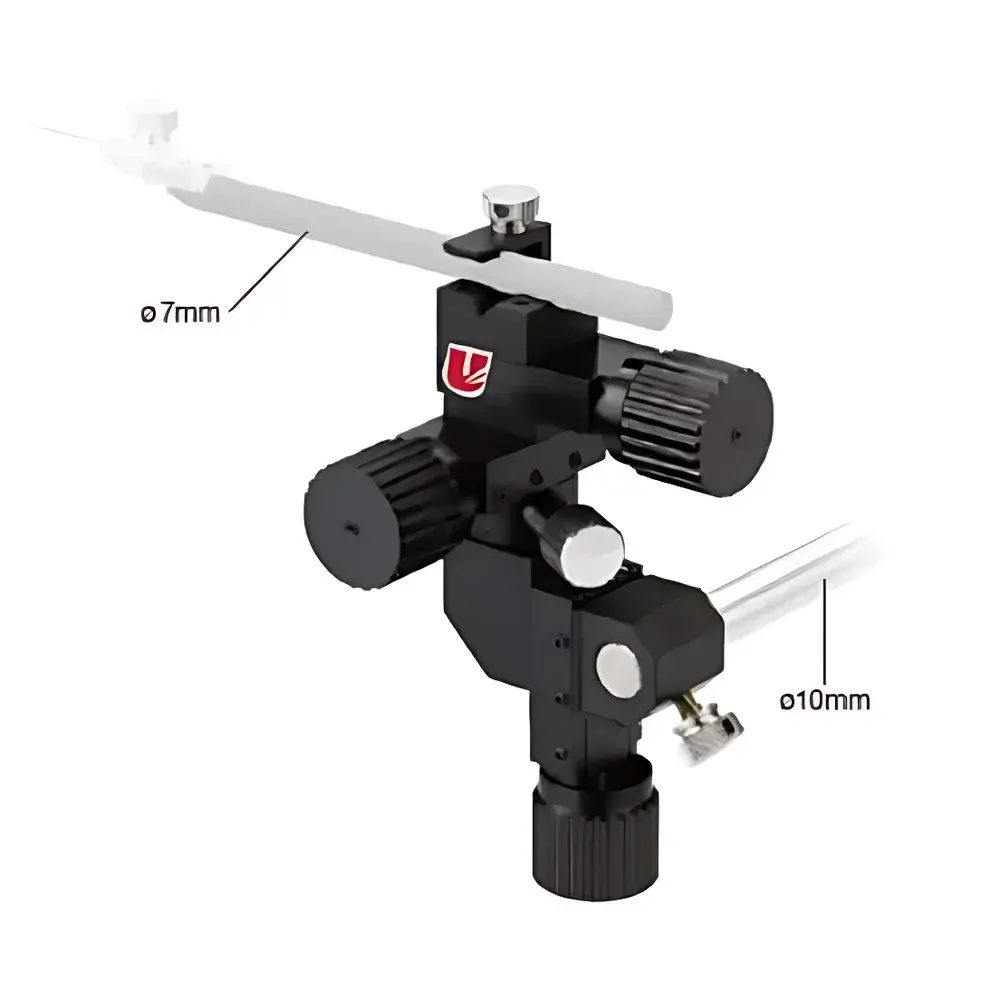
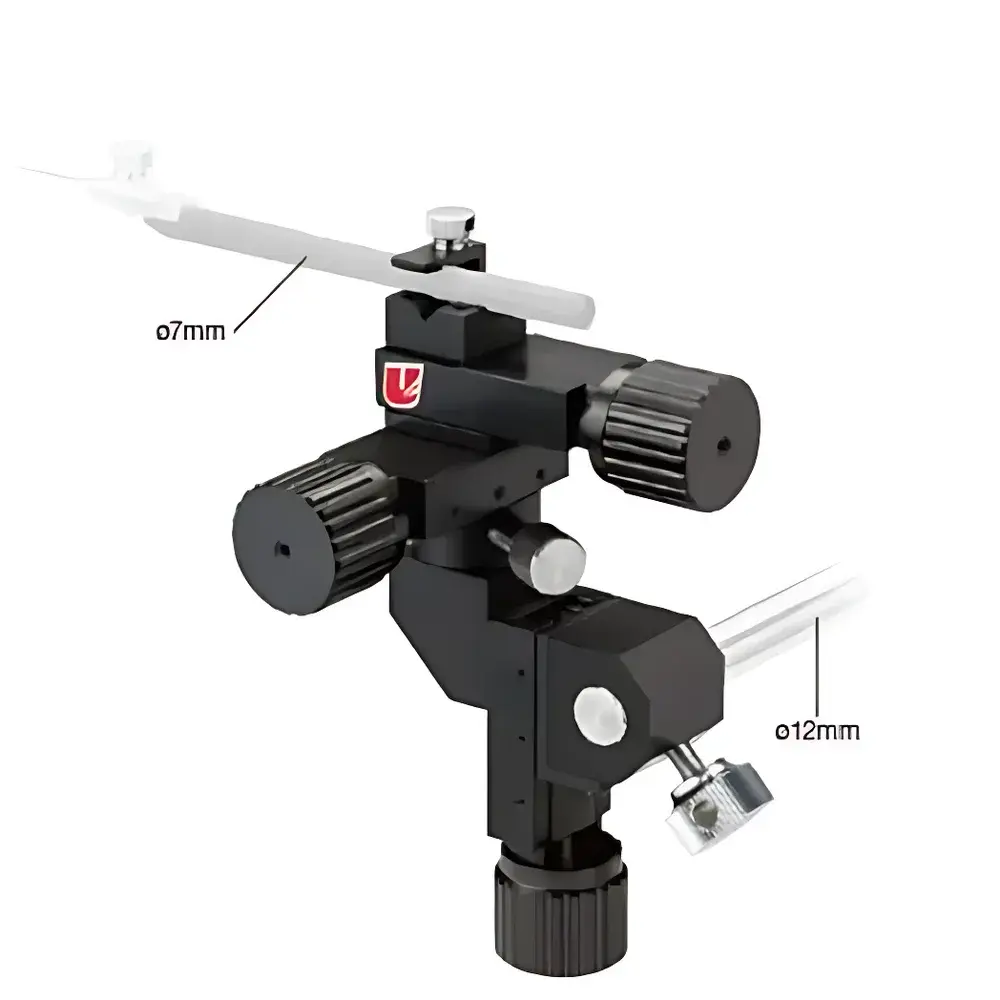
NARISHIGE UM-3C and UMM-3C Micromanipulators
| Brand | NARISHIGE |
|---|---|
| Origin | Japan |
| Model | UM-3C, UMM-3C |
| Gross Movement Range (UM-3C) | X±10 mm, Y±10 mm, Z±10 mm |
| Gross Movement Range (UMM-3C) | X±15 mm, Y±15 mm, Z±15 mm |
| Rotation | Manual 360° continuous |
| Mounting Shaft Diameter (UM-3C) | 10 mm |
| Mounting Shaft Diameter (UMM-3C) | 12 mm |
| Compatible Magnetic Stands | GJ-1 (UM-3C), GJ-8 (UMM-3C) |
| Dimensions (UM-3C) | 120 × 60 × 95 mm |
| Weight (UM-3C) | 235 g |
| Dimensions (UMM-3C) | 145 × 75 × 130 mm |
| Weight (UMM-3C) | 475 g |
Overview
The NARISHIGE UM-3C and UMM-3C are precision-engineered manual micromanipulators designed for high-stability positioning of microelectrodes, glass pipettes, or other fine probes in electrochemical, electrophysiological, and microinjection applications. Both models operate on a robust coarse-adjustment mechanical principle—leveraging orthogonal linear translation stages combined with a coaxial rotation mechanism—to deliver repeatable, backlash-free positioning without reliance on electronic feedback or motorized drives. Unlike piezoelectric or stepper-motor-based systems, these manipulators prioritize mechanical simplicity, long-term dimensional stability, and immunity to electromagnetic interference—critical attributes in shielded Faraday cages, low-noise patch-clamp rigs, or multi-electrode electrochemical cells. The UM-3C is optimized for compact integration where space and weight constraints are stringent; the UMM-3C offers extended travel range and increased rigidity for heavier probes or deeper sample access. Neither unit incorporates fine adjustment mechanisms—positioning resolution is governed entirely by operator dexterity and calibrated vernier scales (where fitted), making them ideal for preparatory alignment, coarse probe placement, and iterative experimental setup rather than sub-micron real-time tracking.
Key Features
- Orthogonal three-axis gross movement (X/Y/Z) with independent locking screws for positional retention under vibration or thermal drift
- Integrated 360° manual rotation stage enabling rapid left/right hand reorientation and pipette exchange without disassembly
- Modular mounting architecture: UM-3C accepts 10 mm diameter support rods; UMM-3C accommodates 12 mm rods—ensuring compatibility with standard optical tables and NARISHIGE magnetic base systems (GJ-1 and GJ-8, respectively)
- Minimalist all-metal construction (anodized aluminum and stainless steel components) providing thermal stability, corrosion resistance, and non-magnetic integrity for use near MRI or SQUID environments
- No electrical power requirement—eliminates grounding loops, EMI coupling, and firmware dependencies common in motorized alternatives
- Dual-purpose design: serves both as a primary positioning platform and as a secondary coarse-adjustment stage beneath fine-resolution manipulators (e.g., MO-200 or MN-401)
Sample Compatibility & Compliance
These manipulators are routinely deployed in ISO/IEC 17025-accredited electrochemistry labs performing ASTM D1149 (ozone cracking), ASTM D522 (bend testing of coatings), and IEC 60825-1 (laser safety alignment)–related electrode positioning tasks. Their passive mechanical design ensures full compliance with GLP documentation requirements for instrument qualification: no software validation burden, no audit trail generation, and no 21 CFR Part 11 considerations. The absence of electronics also satisfies EN 61326-1 (EMC for laboratory equipment) and avoids conflicts with sensitive potentiostat/galvanostat signal paths. Both models are compatible with aqueous, organic, and ionic liquid electrolyte environments when used with chemically inert probe holders (e.g., borosilicate capillaries or Pt/Ir wires), though direct immersion is not recommended due to lack of IP-rated sealing.
Software & Data Management
The UM-3C and UMM-3C operate independently of any software interface. Position data is not digitally recorded, transmitted, or stored—consistent with their role as analog positioning tools in regulated workflows where traceability is maintained via lab notebook entries, annotated schematics, or time-stamped microscopy images. This architecture eliminates cybersecurity risks associated with network-connected instrumentation and simplifies IQ/OQ/PQ protocols during facility audits. Users requiring digital position logging must integrate external encoders or machine vision systems—NARISHIGE does not supply or certify such add-ons for these models.
Applications
- Coarse alignment of reference/counter electrodes in three-electrode electrochemical cells prior to CV or EIS measurements
- Manual positioning of carbon fiber microelectrodes for fast-scan cyclic voltammetry (FSCV) in brain slice preparations
- Stabilization and angular orientation of dual-barrel theta pipettes in iontophoretic drug delivery experiments
- Mounting and orienting rotating disk electrodes (RDEs) or ring-disk electrodes (RDEs) for hydrodynamic voltammetry
- Supporting quartz crystal microbalance (QCM) sensor heads during thin-film deposition or corrosion monitoring setups
- Positioning optical fibers or photodiodes in photoelectrochemical reaction cells where EMI-free operation is mandatory
FAQ
Are the UM-3C and UMM-3C compatible with non-NARISHIGE magnetic bases?
Yes—provided the base features a standard M6 or 1/4″-20 threaded post with sufficient clamping force and vertical clearance; however, only GJ-1 and GJ-8 are factory-tested for optimal load distribution and tilt resistance.
Can these manipulators be used in vacuum or glovebox environments?
Yes—the all-metal construction and absence of plastics or lubricants with high vapor pressure make them suitable for dry nitrogen gloveboxes and low-vacuum (<10⁻² mbar) chambers; outgassing validation per ASTM E595 is recommended for ultra-high-vacuum use.
Is there a fine-adjustment version available?
No—NARISHIGE positions the UM-series strictly as coarse manipulators; fine control requires pairing with dedicated fine-adjustment units such as the MMO-202 or MN-401.
Do the rotation mechanisms include detents or indexing marks?
No—rotation is smooth and continuous with no mechanical stops or angular markings; users rely on external protractors or camera-based angle estimation for reproducible orientation.
What maintenance is required?
Periodic cleaning of sliding surfaces with isopropyl alcohol and light application of silicone-free instrument grease every 6–12 months under moderate usage; no recalibration is necessary.
Related Products





